When Silicon Meets the Street: How Chinese Humanoid Robots Are Reimaging Global Dance
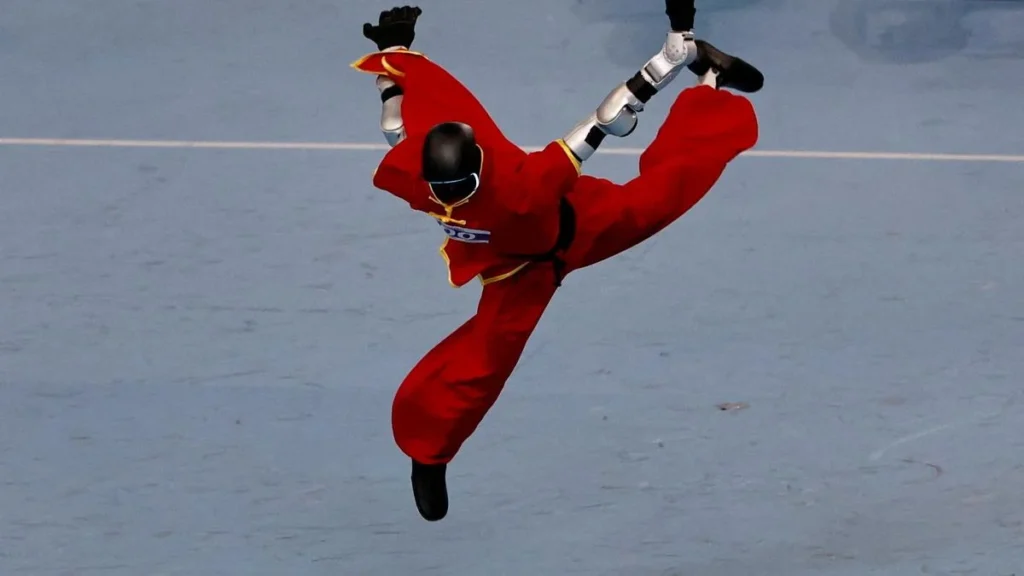
PASADENA, California — For the better part of 13 years, Chinese street dancer Wu Yufei navigated the rigorous, solitary landscape of professional solo performance. He relied on his own reflexes, muscle memory, and the raw kinetic energy of his Sichuan roots to captivate audiences. But this year, the 27-year-old virtuoso found himself sharing the spotlight with an unusual ensemble: a synchronized crew of humanoid robots boasting astonishingly sleek moves.
Together, Wu and his mechanical troupe—performing under the banner of the group "Homies"—have shattered expectations, securing a coveted spot in the finals of America’s Got Talent (AGT). For Wu, standing on a stage he had dreamed of reaching for years alongside machines built by Chinese robotics pioneer Unitree, the experience transcends mere performance. It has birthed what he describes as a "very magical feeling."
What began as a novelty in the realm of entertainment is rapidly evolving into a fascinating cultural and technological crossover. As artificial intelligence and advanced mechatronics converge on the global stage, the ancient art of dance is serving as an unexpected laboratory for the future of human-machine collaboration.
Main Facts: The Intersection of Street Dance and Robotics
The collaboration between Wu Yufei and Unitree’s humanoid robots represents a striking milestone in the commercialization and cultural integration of advanced robotics.
- The Breakthrough: Wu and the "Homies" dance crew made it to the final of America’s Got Talent in Pasadena, California, marking a high-profile validation of robot-assisted performance on international television.
- The Technology: The humanoids are manufactured by Unitree, a prominent Chinese robotics firm, and programmed using motion-capture data derived from human dancers.
- The Cultural Craze: Robot dancing exploded into mainstream consciousness in China following a breakout performance at the annual Spring Festival gala—the nation’s most-watched television extravaganza.
- The Economic Landscape: Driven by a booming domestic market, Morgan Stanley recently forecast that China’s humanoid robotics sector could reach a staggering $2 billion in value this year, with Chinese firms accounting for over 97 percent of global humanoid robot shipments in the first half of 2026.
Chronology: From Spring Festival Galas to the AGT Stage
The journey of the dancing robot from an industrial novelty to a primetime international sensation has unfolded with breakneck speed, catalyzed by strategic media exposure and relentless engineering.
Early 2024–2025: The Domestic Spark
The current craze for robotic performance art traces its origins back to China’s televised cultural events. When Unitree robots executed a flawless, synchronized routine at the nation’s annual Spring Festival gala, it captured the imagination of hundreds of millions of viewers. Overnight, businesses, event planners, and commercial venues across China rushed to hire robotic troupes to draw crowds, transforming mechanical precision into high-demand entertainment.
Mid-2026: Market Waves and Global Competitions
The momentum spilled over into the competitive circuit. In August 2026, Unitree made a blistering debut on the Shanghai stock market, surging a jaw-dropping 629 percent during its first day of trading, though its market capitalization subsequently stabilized and fell by around half from its peak. Concurrently, events like the World Humanoid Robot Games showcased the burgeoning capabilities of robotic street dance, where specialized studios like Shanghai’s Limit Crew swept top honors.
Fall 2026: The America’s Got Talent Final
Culminating months of meticulous cross-disciplinary training, Wu Yufei and the Unitree humanoid crew touched down in Pasadena, California. Navigating linguistic, mechanical, and artistic hurdles, the human-machine collective captured the attention of American judges and viewers alike, securing their place in the AGT finals and proving that the phenomenon could transcend cultural and geographic boundaries.
Supporting Data: Behind the Scenes of Mechanical Choreography
While audiences witness effortless backflips, synchronized popping, and liquid-smooth tutting, the reality behind the curtain is a grueling process of digital translation, coding, and physical debugging.
Industry insiders explain that training a robot to dance begins with capturing intricate human movements via advanced motion-capture technology. This data is processed through complex computer simulations before being transferred to the physical hardware.
According to Liu Zhiquan, commercialization lead at robotics motion-capture firm BridgeDP, perfecting a mere 30-second dance routine can take days or even weeks. "If the dancers are not tech-savvy, there will be a lot of re-takes," Liu noted, emphasizing the necessity of deep collaboration between artists and engineers.
Wegers Wei of Shanghai’s Limit Crew—whose robots claimed the top two spots for street dance at the World Humanoid Robot Games—highlighted the mechanical strengths and limitations inherent in current hardware:

- The Strengths: Robots excel at high-torque rotations and power moves. Because these maneuvers rely primarily on adjusting motor power and arm torque, machines can execute them with infallible repetition.
- The Limitations: Routines requiring extreme body flexibility remain immensely difficult. Furthermore, robots suffer from a distinct "blind spot" in musicality. Because robot dancing relies on scripted playback rather than conscious auditory processing, machines cannot improvise or make on-the-spot adjustments if the tempo or music shifts unexpectedly.
Despite these hurdles, the speed at which robots learn remains a game-changer. As Wu Yufei observed from the Pasadena studio, "Their knowledge can be replicated extremely quickly. Not only does a single robot learn quickly, but they can all learn the same things at the same time, which is quite terrifying."
Official Responses and Industry Perspectives
The convergence of art and automation has elicited profound emotional and philosophical shifts from the human creators tasked with bridging the gap between flesh and steel.
Fang Zhenghua, the art director steering Wu and Unitree’s AGT performances, admitted to deep skepticism at the outset. "The impact of AI on dance performances, or the impact of robots on dancing—I was quite against it all at the beginning," Fang told AFP from Shanghai.
However, months of working alongside software engineers—whom he affectionately refers to as the "mothers" of the robots—fundamentally altered his outlook. Fang came to view the arduous training process not as a sterile technical upload, but as an act akin to "creating a soul."
For the engineering community, artistic performance serves a dual purpose: it captivates the masses while rigorously stress-testing hardware reliability. Guo Renjie, founder and CEO of robotics engineering firm Zeroth, emphasized that high-skill public showcases are vital for demonstrating technical capability.
"That’s why everyone is keen to perform these kinds of high-skill dances," Guo explained.
Implications: The Quest for Real-World Utility and the "ChatGPT Moment"
While dazzling dance routines on international television provide compelling entertainment, they also underscore the central anxiety gripping the modern robotics industry: finding commercially viable, everyday utility beyond the stage.
Industry executives openly acknowledge that the humanoid robotics sector is still years away from experiencing its own "ChatGPT moment"—the pivotal juncture where robots transition from novelty acts into indispensable tools for ordinary households and industries.
Accounting for over 97 percent of global humanoid robot shipments in the first half of 2026, China’s booming robotics ecosystem faces intense scrutiny from international investors, policymakers, and market analysts. Many startups continue to burn capital searching for practical applications that justify multi-billion-dollar valuations.
Yet, leaders in the space urge patience. "I think everyone should give this industry time to reach its full potential," Zeroth CEO Guo Renjie asserted.
Back in Pasadena, as Wu Yufei prepared for the final moments of the AGT spotlight, his perspective had shifted from viewing his metallic costars as cold, lifeless machinery to recognizing the emergence of a genuine collaborative ethos. After months of grueling synchronization, training, and troubleshooting, the line between human expression and artificial intelligence had blurred just enough to catch the world’s attention.