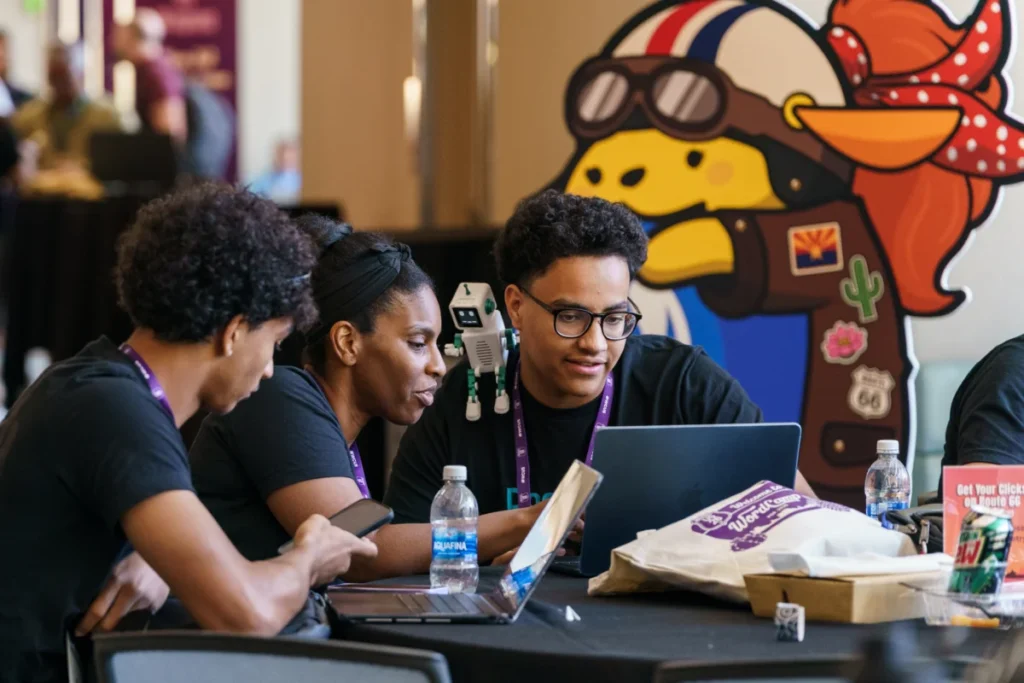
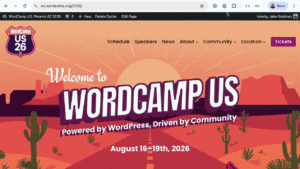
PHOENIX, Arizona — Beneath a blazing desert sun that pushed temperatures to a staggering 111°F (44°C), the global WordPress community converged on the Phoenix Convention Center for WordCamp US (WCUS) 2026. Over four intensive days, more than 1,100 registered attendees—and thousands more tuning in globally via livestreams—participated in a conference defined by high-stakes digital migrations, intense debates over the integration of artificial intelligence, and a unifying rallying cry for core simplicity.
Despite the external heat, logistical lifelines—including air-conditioned golf carts ferrying travelers between the Sheraton Phoenix Downtown and the convention center—kept the momentum smooth. Inside, the energy was electric as participants navigated the Sponsor Hall, the interactive Happiness Bar, and packed session rooms. WCUS 2026 proved to be a watershed moment for the open-source platform, confronting the realities of automated code generation while doubling down on the irreplaceable value of human oversight.
1. Main Facts: The Core Takeaways of WCUS 2026
Record-Breaking Attendance & Engagement: Over 1,100 attendees registered on-site in Phoenix, supported by a massive global remote audience. The event drew an exceptionally high number of first-time attendees.
The Launch of WordPress 7.1 "Mary Lou": Mid-week, release leads took to the stage to officially press the button on WordPress 7.1, driving hundreds of thousands of downloads within hours.
AI, Trust, and Oversight: Keynotes and panel discussions centered heavily on balancing the rapid acceleration of AI tooling with human judgment, security, and digital ethics.
Phoenix WordPress Day: Phoenix Chief Innovation Officer Michael Hammett presented a mayoral proclamation from Mayor Kate Gallego, officially declaring August 19, 2026, as "Phoenix WordPress Day" in recognition of the city’s growing digital economy.
Global Profile Updates: The project announced the rollout of streamlined w.org profile links, such as w.org/@matt, enhancing identity sharing across the ecosystem.
2. Chronology: A Four-Day Journey Through the Open Web
Contributor Day: "Real Artists Ship"
Kicking off the week, Contributor Day adopted the motivating motto "Real artists ship." Eschewing traditional, open-ended participation structures, the 425 participants—which included 29 first-time contributors—organized into 26 distinct, goal-oriented teams.
With experienced mentors guiding the way, teams utilized a dynamic 30-second pitch format. By day’s end, participants had closed lingering tickets, shipped pull requests, and tested themes for accessibility. Highlights included:
The creation of description-list blocks for glossaries and product details.
Enhanced email settings, testing tools, and checks for account, password-reset, and recovery messages.
The development of a WordPress Photo Directory importer and updates to dashboard Notes and Multisite documentation.
The formalization of new contribution pathways converted into structured courses on Learn WordPress for remote members.
Showcase Day: Reclaiming Platform Ownership
Monday shifted focus from code creation to sustainable digital infrastructure. Highlighting the WordPress Showcase, the day featured monumental case studies of independent publishers and enterprises taking back control of their digital presence.
The Ankler: Nicola Catton detailed the publication’s massive migration of 15 separate newsletters away from Substack and onto WordPress, regaining direct governance over subscriber data, paywall boundaries, revenue rules, and overall reader experience via a custom block theme.
Daily Kos: Ben Greeley and Allison McHenry walked the audience through the colossal migration of a community-driven giant boasting 1.5 million posts, 88 million comments, and 2.7 million users—a feat tested via a public beta involving over 500 community members.
The Mid-Week Keynotes and Core Debates
Tuesday and Wednesday anchored the conference in architectural vision and philosophical debate. Keynoters Bo English-Wiczling and Loyal Pyczynski addressed the friction points of modern development. English-Wiczling challenged the audience to rethink AI integration: "AI doesn’t remove your work. It moves it." Meanwhile, Pyczynski—drawing on his extensive background at Disney and Meta—emphasized iterative growth and creative confidence: "Success is an iterative endeavor, and time is our most precious resource."
The event also featured a cross-industry keynote exploring autonomous mobility and trust. Amanda Ventura of Waymo joined David Levine for a fireside chat, detailing how physical and digital products must earn user trust through iterative feedback loops, accessibility enhancements, and transparent data practices—standards directly applicable to the WordPress security and supply-chain discussions led by Core committer Jonathan Desrosiers and Robert Abela.
3. Supporting Data and Metrics
The scope and technical ambition of WCUS 2026 are highlighted by key project metrics and milestones shared throughout the event:
Metric / Category
Data Point / Description
On-Site Attendance
1,150+ registered global participants
Contributor Day Participation
425 participants across 26 teams (including 29 first-timers)
WordPress 7.1 Adoption
Hundreds of thousands of downloads within the first hours of release ("Mary Lou")
Daily Kos Migration Scale
1.5M posts, 88M comments, 2.7M users
Five for the Future Scope
2 million self-sponsored hours pledged weekly across 150,000 contributors
Experimental Tech (Piplets)
Up to 25MB single self-modifying PHP files loading in ~50ms without a database
4. Official Responses and Leadership Insights
The philosophical heartbeat of the conference was struck during the closing session, featuring WordPress co-founder Matt Mullenweg in conversation with Robert Jacobi. Addressing the industry’s compounding complexity, Mullenweg delivered a clear mandate:
"I want WordPress to be known for simplicity, not just complexity."
This ethos manifested in discussions around WordPress Piplets—an experimental concept exploring a single, self-modifying PHP file capable of storing its own data without relying on a database or third-party packages. Loading in roughly 50 milliseconds and holding up to 25 megabytes (roughly four million words), Piplets represent an extension of the lightweight principles driving innovations like WordPress Playground and SQLite integrations.
Mullenweg also tackled the governance of contribution ecosystems, critically evaluating the Five for the Future initiative. Noting that the directory currently records two million pledged hours weekly, he argued that recognition should shift toward verifiable, recorded impact—such as actual commits, tickets closed, and code reviews—rather than unverified pledges.
On inter-community collaboration, Mullenweg extended an olive branch to other open-source projects, encouraging leaders to share stages and cross-pollinate ideas. "Copying good code between projects is the entire point of open source," he noted.
5. Implications for the Future of the Open Web
The convergence of AI acceleration, enterprise-scale migrations, and a grassroots push for simplicity leaves clear takeaways for the broader web ecosystem:
The Evolution of Developer Roles: As AI tools draft code and layout patterns in seconds, the role of the developer and designer is pivoting rapidly from mechanical execution to curatorial oversight. Human judgment remains the vital firewall against accessibility flaws, security vulnerabilities, and context-blind automated logic.
Decentralized Independence: The successful migrations executed by high-profile publishers like The Ankler and Daily Kos signal a broader market realization: relying on closed, third-party platforms creates structural vulnerabilities. Owning data, subscriber relationships, and publishing pipelines on open-source infrastructure is becoming a critical business imperative.
The Imperative of Simplicity: As web architectures bloat with microservices and complex abstractions, the WordPress project’s renewed focus on lightweight tools—exemplified by SQLite, Playground, and Piplets—suggests that the next era of the web will reward speed, self-containment, and lowered barriers to entry.
Looking Ahead
As the Phoenix Convention Center lights powered down, the community turned its gaze toward the horizon. Next on the global calendar is the annual State of the Word, followed by WordCamp Asia 2027 in Penang, Malaysia, and WordCamp Europe 2027 in Málaga, Spain.
Session recordings, transcripts, and speaker slides from WCUS 2026 remain publicly available at us.wordcamp.org/2026/schedule.