Navigating the Reverse Logistics Maze: The State of E-commerce Returns in Europe
The digital transformation of the European retail landscape has fundamentally altered the consumer journey. For many, the online shopping experience is no longer viewed as complete upon the "Buy Now" click; it now extends through to the unboxing and, frequently, the reverse journey of the product back to the merchant. In the modern e-commerce ecosystem, returns have evolved from a peripheral administrative headache into a core strategic pillar that defines brand loyalty, operational profitability, and environmental accountability.
As European markets continue to mature, the challenges associated with managing these returns have intensified. With return rates fluctuating wildly across borders and sectors, businesses are being forced to rethink their logistics, regulatory compliance, and customer engagement strategies.
1. The Landscape of European Returns: An Overview
Returns are an unavoidable reality for European e-commerce. While the ease of returning an item is a significant driver of conversion—acting as a psychological safety net for the consumer—it places immense pressure on the retailer’s bottom line.
Statistical Reality: A Continent of Varying Habits
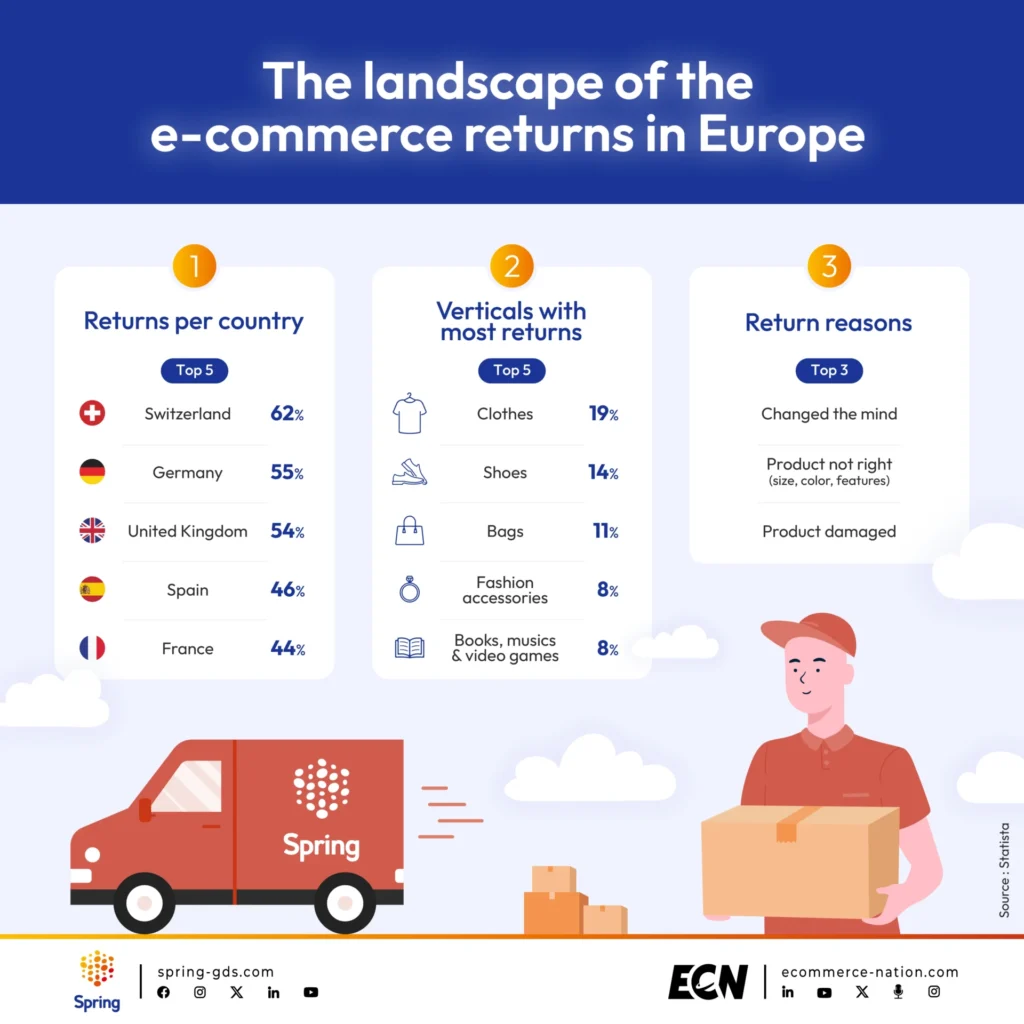
The average return rate across the European Union fluctuates between 30% and 40%, but these figures mask significant regional disparities. According to recent data from Statista, the propensity to return goods is heavily influenced by cultural shopping norms and consumer protection legislation.
- Switzerland: Currently leads the pack with a staggering 62% return rate per online buyer.
- Germany: Known for its highly consumer-centric return culture, Germany follows closely at 55%.
- United Kingdom: Despite shifts in retail policies, the UK maintains a high return rate of 54%.
These statistics represent a double-edged sword. While lenient return policies are instrumental in acquiring new customers—particularly in the fashion sector—they create a "try-before-you-buy" mentality that drives up operational costs significantly.
The Financial and Operational Burden
For the retailer, the cost of a return is rarely just the shipping label. The true expense includes:
- Logistical processing: The cost of receiving, inspecting, and re-sorting the item.
- Restocking and refurbishment: The labor-intensive process of sanitizing or repackaging goods.
- Revenue erosion: Products that cannot be sold at full price must be discounted or liquidated, often at a loss.
- Administrative overhead: The customer service resources required to manage the reverse logistics flow.
2. Chronology of a Return: From Purchase to Reintegration
To understand the complexity of returns, one must look at the lifecycle of a returned product.
- Phase 1: The Transaction (T+0): The customer receives the product. A period of "evaluation" occurs, during which the customer decides whether the item meets their expectations.
- Phase 2: The Initiation (T+1 to T+14): The customer initiates a return request. This is a critical touchpoint where the brand’s digital interface (the returns portal) dictates the ease of the process.
- Phase 3: Transit (T+3 to T+10): The product moves through the reverse logistics network. Cross-border hurdles often appear here, involving customs clearance or regional carrier hand-offs.
- Phase 4: Inspection & Decisioning (T+11 to T+15): The product arrives at a warehouse. It is assessed: Is it resellable? Does it need refurbishment? Or is it a total loss destined for recycling or liquidation?
- Phase 5: Final Disposition (T+16+): The product is either returned to inventory, liquidated, or recycled, and the customer is finally reimbursed.
Any friction in this timeline, such as a lack of tracking updates or delayed refund processing, acts as a primary catalyst for negative customer sentiment.
3. The Core Challenges: Why Returns Are Difficult
Managing reverse logistics is arguably more complex than managing outbound shipping. The challenges are multifaceted, ranging from legal to ecological.
Logistical Infrastructure and Cross-Border Complexity
Cross-border trade within Europe, while facilitated by the Single Market, is still subject to varying national regulations. When a customer in Spain returns a product to a warehouse in Poland, the merchant must account for:
- Customs and Tax: Handling VAT refunds and ensuring compliance with local import/export regulations.
- Traceability: Ensuring the parcel is tracked across multiple carriers in different jurisdictions.
- Localized Addresses: Customers are increasingly unwilling to pay for international shipping to return an item. Merchants are now pressured to set up local return hubs or third-party drop-off points to maintain competitiveness.
The Rise of "Bracketing"
A concerning trend for retailers is "bracketing"—the practice of ordering the same item in multiple sizes or colors with the express intention of returning the ones that don’t fit. While this reduces the risk of an ill-fitting purchase for the buyer, it artificially inflates return rates and creates a massive logistical bottleneck for the merchant.
The Ecological Footprint
The "Return-to-Sender" journey is carbon-intensive. Each return typically involves double the packaging materials—or worse, the disposal of perfectly functional goods. As sustainability becomes a key consumer value, companies are facing increasing pressure to optimize their supply chains to minimize the environmental impact of reverse logistics.
4. Strategic Recommendations for Optimization
How can merchants balance profitability with the modern consumer’s demand for seamless returns?
Leveraging Technology for Visibility
The first step is moving away from manual, spreadsheet-based return management. Advanced Return Management Systems (RMS) allow retailers to:
- Automate Authorization: Set rules for what can be returned and when, reducing the need for manual support.
- Real-time Tracking: Provide customers with transparency, which significantly reduces "Where is my refund?" support tickets.
- Predictive Analytics: By analyzing return reasons (e.g., "too small," "color inaccurate"), merchants can update product descriptions, sizing charts, and photography to prevent the return from happening in the first place.
Adopting a Proactive Policy
Rather than being reactive, retailers should design their return policies as a conversion tool.
- Incentivize Keepers: Some brands offer store credit or loyalty points to customers who choose to keep an item they intended to return.
- Clearer Information: Use AI-driven sizing tools or virtual try-on technology to ensure the product meets expectations before it is even shipped.
- Localizing Returns: By utilizing consolidated shipping or local return partners, merchants can reduce the financial and environmental cost of long-haul return shipping.
The Ecological Pivot
Sustainability is no longer a "nice-to-have." Implementing eco-friendly strategies—such as batch processing returns to reduce transportation frequency or using biodegradable packaging that can be reused for the return journey—enhances brand perception. Moreover, investing in "re-commerce" or secondary market channels allows retailers to capture value from returned goods that would otherwise be discarded.
5. Implications for the Future of Retail
The "return economy" is at an inflection point. As customer acquisition costs rise, the efficiency of the post-purchase experience will become the primary differentiator for successful e-commerce brands.
The industry is moving toward a model of "Return Prevention." Merchants who successfully use data to refine their product offerings and improve the clarity of their online presence will naturally see a decline in return rates. For those items that must be returned, the focus will shift toward "Logistical Efficiency," where the use of local hubs and automated processing ensures that the product is back on the shelf—or in the hands of a new buyer—in the shortest possible time.
In conclusion, while European returns present a formidable challenge, they also offer a distinct opportunity. By embracing transparency, technological automation, and sustainable practices, e-commerce merchants can transform the return process from a cost center into a strategic advantage, fostering deep-seated consumer trust in an increasingly competitive digital marketplace.