Global Diplomacy and Strategic Outreach: PM Modi Concludes Landmark Visit to France and Slovakia
By Global Affairs Desk
June 19, 2026
Prime Minister Narendra Modi departed for New Delhi on Thursday, June 18, 2026, marking the conclusion of a high-stakes, two-nation diplomatic tour that saw India further cement its position as a pivotal global player. The visit, which spanned across Slovakia and France, was characterized by high-level G7 deliberations, a historic first-time visit to Bratislava, and a renewed commitment to the strategic partnership between New Delhi and Paris.
From the quiet, historic halls of power in Slovakia to the bustling innovation hubs of Paris and the elite diplomatic circles of the G7 Summit in Evian-Les-Bains, the Prime Minister’s itinerary underscored India’s evolving role as a “trusted partner” on the global stage.
The Strategic Itinerary: A Chronological Overview
The Prime Minister’s tour was designed to address three distinct tiers of international relations: bilateral consolidation, multilateral cooperation, and technological diplomacy.
The Slovakian Milestone
The journey began with a landmark visit to Slovakia—the first-ever by an Indian Prime Minister. This leg of the trip focused on institutionalizing ties. By elevating the bilateral relationship to a "Comprehensive Partnership," India and Slovakia signaled a shift from casual engagement to deep, structured cooperation. The two nations finalized 11 agreements spanning defense, digital technology, and migration, setting a robust framework for long-term economic integration.

The G7 Summit at Evian-Les-Bains
Following the Slovakian visit, Mr. Modi traveled to the French commune of Evian-Les-Bains. Invited as a guest participant to the G7 Summit, the Prime Minister utilized the platform to engage with the world’s most powerful economies. The summit served as a focal point for multilateral discussions on geopolitical stability, supply chain resilience, and international peace.
The French Engagement: Innovation and Diaspora
The final leg of the trip took the Prime Minister to Nice and Paris. The schedule was intense:
- Nice: Launch of the "Bharat Innovates" programme, signaling India’s commitment to global startup ecosystems.
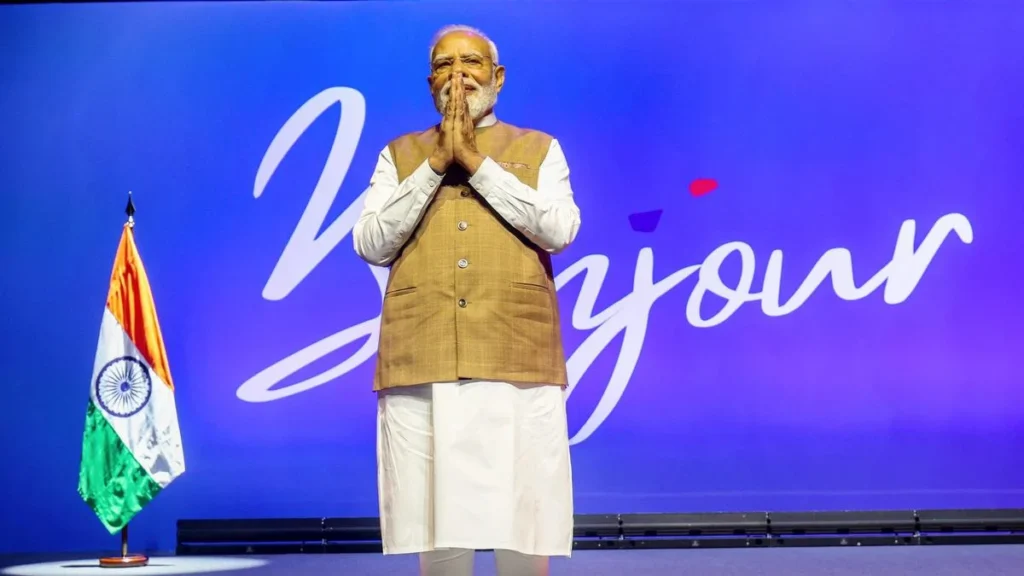
- Paris (VivaTech 2026): A key address highlighting India’s digital infrastructure.
- Paris (Community Event): A major rally with the Indian diaspora, reinforcing the "soft power" aspect of India’s global presence.
Key Policy Pillars and Diplomatic Interactions
Democratizing Technology: The VivaTech Address
During his keynote at VivaTech 2026, Prime Minister Modi made a compelling case for the “democratization of technology.” Addressing an audience of global tech leaders, he redefined the acronym AI, asserting that for India, it stands for "All-Inclusive."
He bolstered his argument with data: India currently facilitates nearly half of the world’s real-time digital transactions. This technological prowess, he argued, is not just a domestic success story but a blueprint for other developing nations to bridge the digital divide. By positioning India as a primary exporter of digital public infrastructure, the Prime Minister effectively signaled that India is no longer just a consumer of global tech, but a lead architect.
Bilateral Summits: Shaping the Geopolitical Agenda
On the sidelines of the G7, the Prime Minister engaged in a whirlwind of bilateral meetings. Perhaps the most scrutinized of these was his discussion with U.S. President Donald Trump. A focal point of this meeting was the security of seafarers in the context of Washington’s peace deal with Iran. By raising this, Mr. Modi highlighted India’s role as a voice for the global maritime community, emphasizing that economic peace deals must not come at the cost of human safety.

Other high-profile meetings included:
- Keir Starmer (UK): Discussions likely focused on the long-pending Free Trade Agreement (FTA) and security cooperation.
- Volodymyr Zelenskyy (Ukraine): A critical meeting given the ongoing regional instability in Europe.
- Sheikh Mohamed bin Zayed Al Nahyan (UAE): A reinforcement of the growing India-Middle East strategic corridor.
- Friedrich Merz (Germany) and Mark Carney (Canada): Focus on energy transition and trade diversification.
The Diaspora: India’s Human Bridge
A recurring theme throughout the tour was the Prime Minister’s interaction with the Indian diaspora. In Paris, addressing thousands of members of the Indian community, Mr. Modi described the current era as a “defining period” in India’s history.
He noted that the aspirations of 140 crore Indians are reaching “new heights,” and the diaspora plays a critical role in acting as a bridge between their host nations and India. This outreach is not merely symbolic; the Indian government has increasingly viewed the diaspora as an essential component of its economic diplomacy, facilitating investments, technology transfers, and soft-power influence.
Implications: A "Trusted Partner" in a Fragmented World
The cumulative impact of this visit suggests that India is strategically distancing itself from the traditional "non-aligned" stance of the past, moving toward a "multi-aligned" posture. By simultaneously engaging with the G7, hosting talks with the UAE, and finalizing defense agreements in Central Europe, India is positioning itself as a reliable mediator and a necessary stakeholder in global governance.
Economic and Strategic Outcomes
The 11 agreements signed in Slovakia, combined with the tech-heavy agenda in France, point to a deliberate effort to de-risk the Indian economy by diversifying its partnerships.

- Defense: The agreements in Slovakia suggest a deepening of the defense industrial base.
- Digital Infrastructure: By championing India’s digital transaction model at VivaTech, the government is looking to export its "India Stack" software, creating new revenue streams and diplomatic goodwill.
- Geopolitical Stability: By acting as a participant in G7 dialogues, India is actively shaping the discourse on international security, specifically regarding maritime routes and peace processes.
Official Responses and Future Outlook
Reflecting on the visit via social media, Prime Minister Modi was effusive in his praise for the hospitality received. "The India-France friendship will become even stronger in the times to come," he stated, acknowledging the warm reception from President Emmanuel Macron.
Analysts suggest that the success of this tour lies in its breadth. While previous visits often focused on a single issue—be it trade or defense—this tour effectively blended trade, high-tech diplomacy, and human-centric engagement.
As the Prime Minister returns to New Delhi, the diplomatic machinery will now focus on the implementation phase of these 11 Slovakian agreements and the follow-through on the various G7 action plans. With the global economic landscape facing headwinds, the partnerships forged in Paris and Bratislava are expected to serve as shock absorbers for the Indian economy, providing stability and access to high-growth markets in Europe.
The visit to France and Slovakia serves as a testament to India’s rising confidence. Whether through the lens of technological innovation or strategic bilateralism, the message sent from Europe to New Delhi is clear: India is no longer waiting for the global order to change; it is helping to write the rules.
Key Data Points:
- 11: Number of bilateral agreements signed with Slovakia.
- 50%: India’s estimated share of global real-time digital transactions, as highlighted by PM Modi.
- 2: Number of nations in the official tour.
- Multi-continental: Engagement spanned Central Europe (Slovakia) and Western Europe (France).
This report concludes the coverage of the Prime Minister’s two-nation diplomatic mission. Further analysis on the long-term impact of the defense agreements will follow in the coming weeks.