Beyond the Desk: Why Context Windows Are Not AI Memory
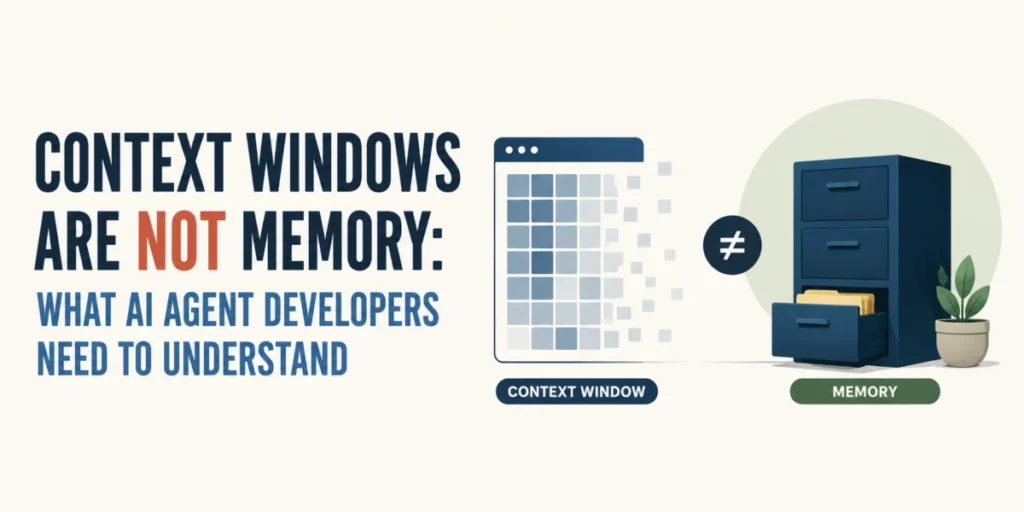
In the rapidly evolving landscape of Large Language Models (LLMs), a dangerous misconception has taken root among developers: the belief that an expansive context window is a substitute for persistent memory. As AI labs race to release models capable of processing 2 million tokens or more, the temptation for engineers is to treat these windows as infinite digital scratchpads—"shoving" entire codebases or multi-year conversation histories into a prompt to solve state management problems.
However, architectural reality suggests otherwise. Relying on a massive context window as a primary memory solution is akin to buying a 25-foot-wide desk because you are too lazy to install a filing cabinet. You can spread out all your documents, but the moment the workday ends, the cleaning staff wipes the desk clean. To build truly intelligent AI agents, developers must move beyond the "large context" fallacy and understand the nuanced cognitive stack required to simulate genuine, persistent memory.
The Architectural Reality: Why Statelessness Matters
At the heart of every modern LLM is a fundamental, immutable fact: these models are stateless. Every single API call to a model begins at "step zero." When an agent processes a conversation spanning 200,000 tokens, it is not "remembering" previous interactions in a human sense. Instead, it is performing a high-speed, brute-force re-read of its entire operational environment in milliseconds.
This "re-reading" strategy introduces significant risks. First, there is the snowballing latency issue. Every subsequent interaction requires the re-processing of all previous data, leading to skyrocketing latency as the conversation grows. Second, there is the cost inefficiency. Most LLM providers charge based on token count; re-sending your entire project history for a simple query is an expensive way to burn through an API budget. Finally, there is the fidelity degradation that occurs when models are forced to parse massive amounts of redundant information, which can lead to "lost in the middle" phenomena where the model prioritizes the beginning and end of a prompt while ignoring the critical details hidden in the center.
Chronology of Context Management: From Scratchpad to Database
To understand how to move from "stateless" to "intelligent," developers must look at the cognitive stack as a lifecycle of data.
1. The Immediate Scratchpad (The Context Window)
The context window should be reserved for the active task—the immediate, transient information required to compute the next token. It is the workbench. If you are coding, the current function and its immediate dependencies belong here.
2. The Library (Retrieval-Augmented Generation)
When the desk gets cluttered, we turn to RAG. RAG acts as a bookshelf, allowing the agent to fetch relevant information on demand. However, developers often treat RAG as a panacea. The risk here is semantic drift. Vector similarity does not equate to semantic truth. If a user instructs an agent to "cancel the meeting" at 2:00 PM and "confirm the meeting" at 4:00 PM, a naive RAG system might retrieve both, leaving the model confused. Sophisticated agents must perform reconciliation—using metadata like timestamps to resolve conflicts before the data ever touches the prompt.
3. The Digital Archive (Summarization)
When data is no longer "active" but remains vital for future context, we must transition to summarization. Unlike compression, which preserves the data in a smaller format, summarization creates an abstraction. A best practice here is "forked storage." The raw, unabridged transcript is offloaded to durable, low-cost storage (like an S3 bucket or a SQL database), while a distilled, semantic summary is kept in the agent’s reach.
Supporting Data: The Cost of Naivety
Consider a developer building a customer service agent. In a naive implementation, every time a customer asks "What is the status of my ticket?", the system sends the last six months of support logs into the context window.
- Token Count: If the logs reach 100,000 tokens, each request costs thousands of times more than a query that only retrieves the specific, relevant ticket entry.
- Response Accuracy: As the context grows, the model’s attention mechanism is diluted. Studies have shown that as context windows reach their limits, model performance in logical reasoning tasks drops significantly.
- System Latency: The "Time to First Token" (TTFT) increases linearly with the volume of input tokens. For a real-time chatbot, this delay can be the difference between a high-quality user experience and a frustrating, sluggish interface.
Implications for AI Agent Design: The State Machine Approach
True memory is not found in the prompt; it is found in the state machine. To build agents that feel "alive" and consistent, developers must transition from being "prompt engineers" to "database administrators."
An agent should act as a gatekeeper to an external, persistent state. Instead of relying on the model to "remember" that a user’s dog is named Pluto, the agent should be equipped with tools to update a Knowledge Graph or a SQL database.
The Query-Commit Cycle
- Query: At the start of every turn, the agent queries the state machine for relevant entities.
- Generate: The agent performs the task, using the retrieved state to inform its response.
- Commit: If the user provides new information (e.g., "Actually, let’s stick with the name Goofy"), the agent triggers a tool-call to update the database.
This ensures that the "truth" is decoupled from the "prompt." If the LLM goes down or the context window is flushed, the underlying data remains intact.
Official Perspectives: The Industry Shift
Leading AI infrastructure platforms are beginning to move away from the "bigger is better" narrative. Recent technical papers from major labs emphasize "Prompt Caching" and "Memory Layers" as the next frontier. The industry is reaching a consensus: Context is for computation; Memory is for state.
As developers, the shift in mindset is clear. We must stop trying to force language models to be everything at once. By treating the context window as a transient scratchpad and implementing robust external memory systems—knowledge graphs, vector databases, and persistent SQL stores—we can build agents that are not just smarter, but more reliable, cost-effective, and capable of long-term reasoning.
Conclusion: Lessons for the Future
The "large context window" era has provided us with remarkable capabilities, but it has also lulled many into a state of architectural complacency. We have the tools to build systems that scale, provided we stop trying to store the world in a prompt.
The path forward is defined by a modular cognitive stack:
- Use the context window for reasoning.
- Use RAG for retrieval.
- Use compression for bandwidth optimization.
- Use summarization for historical distillation.
- Use databases for persistent state.
Stop buying the massive desk. Get a standard-sized one, sharpen your pencil, and learn how to manage your filing cabinet. In the world of AI agents, those who master the architecture of memory will be the ones who build the most enduring and capable systems.