Beyond the Hype: Decoding the Architectural Spectrum of Agentic AI
As generative AI transitions from a tool for creative drafting to a functional engine for enterprise operations, a critical vocabulary shift is occurring. Deloitte projects that by 2027, half of all companies leveraging generative AI will have launched agentic pilots or proofs of concept. However, this surge in adoption has brought a linguistic crisis: the term "agentic" is being applied indiscriminately to everything from simple, hard-coded API scripts to complex, self-directed systems.
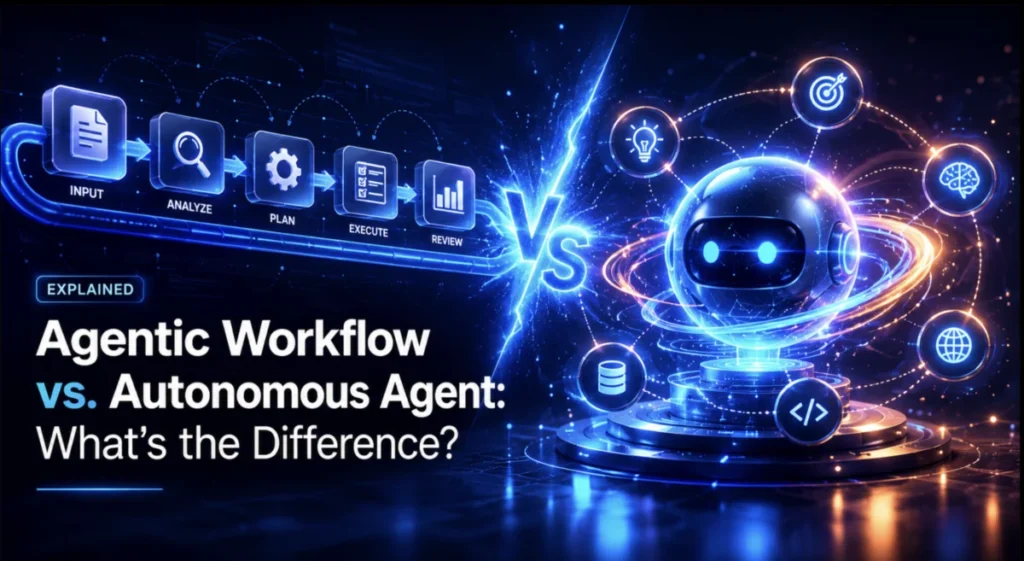
To build reliable systems, engineers and architects must move past the marketing fluff. The foundational question is not "Does this system use an LLM?"—as nearly every modern application does—but rather: "Who owns the control flow?" Is the sequence of operations dictated by a human writing code in advance, or is it determined by a model reasoning at runtime?
The Core Conflict: Predictability vs. Autonomy
The industry is currently grappling with a fundamental trade-off between two architectural poles. On one end lies predictability, where every step is auditable, explainable, and repeatable. On the other lies autonomy, where the system discovers its own path through an open-ended problem space.
Treating these approaches as interchangeable is a recipe for failure. Over-engineering a simple task with unnecessary autonomy introduces chaotic, non-deterministic behavior into stable processes. Conversely, forcing a complex, high-variability problem into a rigid, deterministic pipeline will cause the system to break the moment reality deviates from the script.
Anthropic, in their seminal Building Effective Agents framework, provides the bedrock for this distinction: workflows are systems where LLMs and tools are orchestrated through predefined code paths, whereas agents are systems where LLMs dynamically direct their own processes, maintaining agency over how they accomplish a task.
The Architectural Spectrum
To understand where a system sits on the spectrum, we must categorize it by its decision-making logic.
1. Deterministic Workflows: The Baseline
A deterministic workflow follows a fixed sequence of steps defined at design time. While an LLM might participate in individual steps—perhaps to summarize a document or classify a piece of incoming text—it has no authority over the next step in the sequence.
In a deterministic model, the control flow is hard-coded. For example, a customer support bot might follow a chain: Extract Input → Classify Intent → Summarize Content → Send Notification. Even if the Classify Intent step returns a vastly different label for two different users, the subsequent Summarize and Notify functions will trigger in the exact same order. This is the hallmark of a deterministic system: the LLM provides data, but the human-written code provides the roadmap.
2. Orchestrated Workflows: The Dynamic Middle Ground
Often mislabeled as "agentic," orchestrated workflows represent the middle ground. Here, the system possesses a map of potential paths, all defined by a human, but the choice of path is made at runtime by the LLM.
Think of this as a restaurant menu. A human chef (the developer) has written the menu (the ROUTE_MAP), and the waiter (the LLM) decides which item the customer should receive based on their preference. The waiter cannot invent a new dish that isn’t on the menu. This approach is highly effective for tasks like intelligent routing in support centers—directing tickets to "Billing," "Technical," or "General" queues—without the risks associated with true autonomy.
3. Reactive Agents: The ReAct Loop
True autonomy begins with the ReAct pattern—Reasoning plus Acting. Introduced by Yao et al. in 2022, this paradigm creates an iterative loop where the model thinks, acts, observes the result, and then decides its next move.
Unlike the orchestrated workflow, there is no if/else logic covering every scenario. The agent is provided with a set of tools and a goal. It may call a search tool, receive a null result, and then, based on that observation, decide to escalate to a human. The sequence of events is not known in advance. The agent might take two steps to solve a query or ten; it might use one tool or three. The human provides the tools and the constraints, but the agent provides the strategy.
4. Autonomous Multi-Agent Systems
The furthest point on the spectrum involves nested autonomy. A "swarm" of agents functions as a team, where an orchestrator agent delegates sub-tasks to specialized agents—a researcher, a coder, or a finance specialist. Each sub-agent runs its own independent ReAct loop. In this architecture, the complexity compounds, offering high-level creative problem solving at the expense of total loss of predictive control.
Supporting Data and Production Realities
Despite the allure of autonomous swarms, production data from 2025 shows that workflows remain the dominant pattern for high-stakes enterprise applications. The reasoning is clear: auditability.
In regulated industries like finance, healthcare, and law, non-determinism is a liability. If a diagnostic system cannot explain exactly why it ordered a specific test—or if the same input leads to two different outcomes on consecutive runs—it fails the compliance test.
Consequently, the most successful systems are currently hybrids. They employ a "Human-in-the-Loop" architecture where an autonomous agent handles the high-level strategy (the "what"), but the actual execution of tasks is offloaded to deterministic, validated code modules (the "how"). This creates a system that is flexible enough to handle novel situations but rigid enough to satisfy regulatory requirements.
Implications for Future Development
The maturation of agentic systems will depend on our ability to build "guardrails" around autonomy. We are currently moving toward a standard where:
- Deterministic modules are used for critical data processing, security, and compliance-heavy tasks.
- Reactive agents are reserved for discovery, synthesis, and handling edge cases that cannot be anticipated by developers.
- Observability becomes the primary concern. Since we can no longer predict the exact path a system will take, we must invest in logging the "thought processes" of agents so that they can be audited post-hoc.
Conclusion: A Tool, Not a Religion
"Agentic workflow" and "autonomous agent" are not competing technologies; they are distinct tools in an architect’s shed. There is no moral or technical imperative to make every system fully autonomous. In many cases, adding autonomy where a deterministic script would suffice is not an innovation—it is an error.
The systems that will define the next decade of AI deployment are those that recognize this spectrum. They treat deterministic code as the foundation of trust, and autonomous agents as the engine of intelligence. By placing each component of a problem at its appropriate point on the spectrum, organizations can build systems that are as creative as they are reliable. The future of AI is not about choosing between human control and machine autonomy; it is about designing the precise, calibrated balance of both.