Security Crisis at CISA: Congressional Leaders Demand Answers Over Massive Credential Leak
In a profound embarrassment for the agency tasked with defending the nation’s digital borders, the U.S. Cybersecurity & Infrastructure Security Agency (CISA) is currently scrambling to contain the fallout from a catastrophic security lapse. A contractor working for the agency reportedly published a vast trove of internal secrets, including plaintext AWS GovCloud keys and administrative credentials, to a public repository on GitHub.
The incident, which has sent shockwaves through Washington, has prompted bipartisan outrage and formal inquiries from key members of Congress. As investigators work to assess the extent of the exposure, the incident has reignited a fierce debate regarding the agency’s internal security culture, its reliance on third-party contractors, and its ability to maintain operational security during a period of significant institutional turbulence.
A Breach of Trust: The "Private-CISA" Repository
The vulnerability was first brought to light by KrebsOnSecurity, which reported on May 18 that a CISA contractor—possessing high-level administrative access to the agency’s development platforms—had established a public GitHub profile explicitly titled "Private-CISA."
Rather than a professional workspace, the repository acted as a digital "junk drawer" for sensitive agency materials. Forensic analysis of the repository suggests it was used as a synchronization mechanism, allowing the contractor to move work-related files between secure government environments and personal devices. The repository included plaintext credentials to dozens of critical internal systems, effectively providing a "roadmap" for any sophisticated adversary looking to penetrate U.S. government infrastructure.
Security researchers who examined the repository’s commit logs observed that the contractor had taken the deliberate, manual step of disabling GitHub’s built-in security features designed to prevent the accidental publication of sensitive keys. By bypassing these safeguards, the contractor essentially left the keys to the kingdom sitting on a public platform for anyone with an internet connection to discover.
Chronology of the Exposure
While the full timeline remains under investigation, experts have been able to reconstruct the lifecycle of the leaked data:
- November 2025: Initial creation of the "Private-CISA" repository. Experts believe the account was established as a personal convenience tool to mirror internal CISA files.
- Late April 2026: A surge in the volume of sensitive data, including critical AWS GovCloud access tokens and configuration files, was pushed to the public repository.
- May 2026: The security firm GitGuardian identified the exposure and notified CISA, triggering the current containment efforts.
- May 18, 2026: KrebsOnSecurity publicly reports the existence of the repository, forcing the agency to acknowledge the breach.
- May 20, 2026: Dylan Ayrey, creator of the security tool TruffleHog, notifies CISA that a critical RSA private key remains active, granting full access to the "CISA-IT" GitHub organization.
- Late May 2026: CISA begins a frantic, phased process of rotating and invalidating the compromised credentials, a process that experts suggest remains incomplete.
The Technical Fallout: What Was Exposed?
The scope of the exposed data is staggering. The repository contained files with alarming labels such as "Important AWS Tokens.txt," "kube-config.txt," and browser-saved passwords.
Perhaps most concerning was the exposure of an RSA private key linked to a GitHub app owned by the CISA enterprise account. As Dylan Ayrey explained, this specific key was the "keys to the castle." An attacker possessing this key would have had the ability to:
- Exfiltrate Source Code: Read proprietary code from every repository within the CISA-IT organization, including those marked as private.
- Hijack CI/CD Pipelines: Register rogue "self-hosted runners," allowing an attacker to inject malicious code into the agency’s software supply chain—a tactic frequently used by state-sponsored actors to facilitate downstream attacks.
- Modify Security Policies: Alter branch protection rules, webhooks, and administrative settings, effectively allowing an attacker to maintain persistent, undetected access to the agency’s development environment.
The fact that these credentials remained active for over a week after the initial notification by GitGuardian has raised profound questions about the speed and efficacy of CISA’s incident response team.
Official Responses and Congressional Scrutiny
The response from CISA has been characterized by brevity and a focus on containment. In a written statement, the agency claimed, "there is no indication that any sensitive data was compromised as a result of the incident."
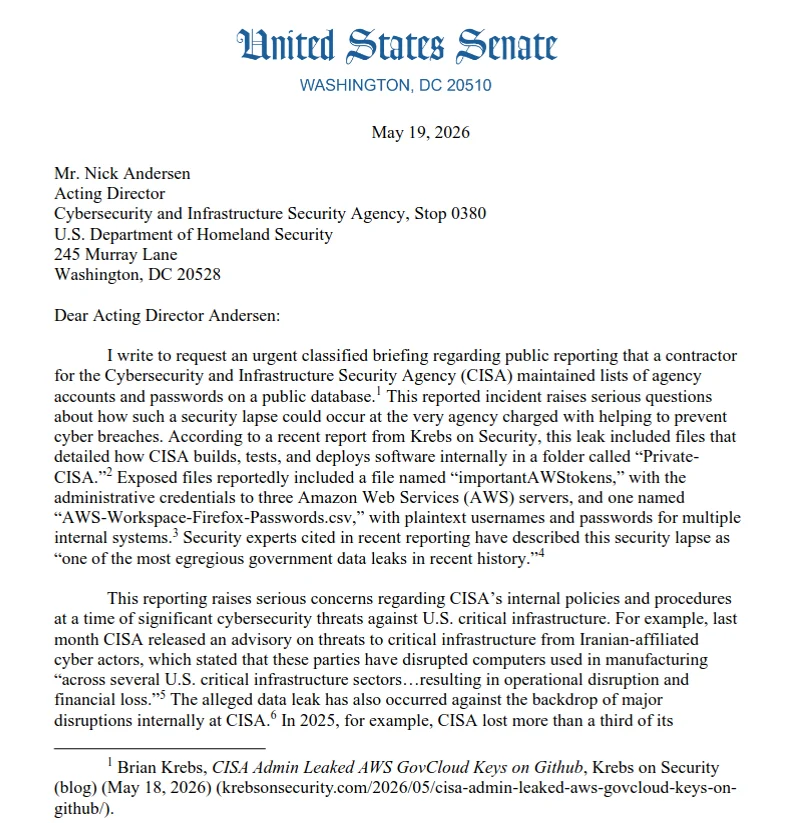
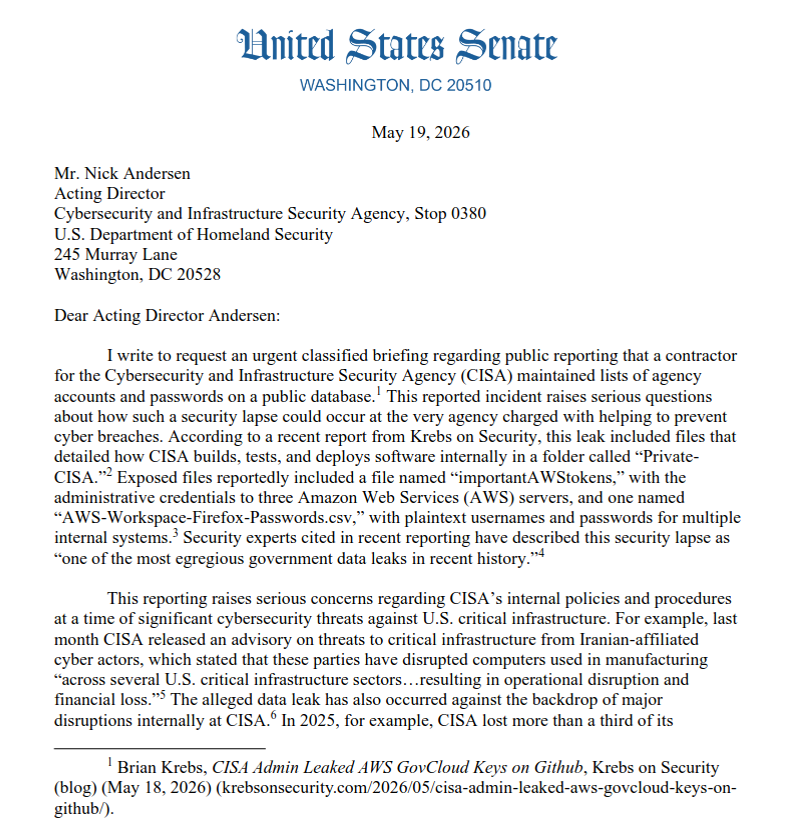
However, this assertion has done little to assuage the concerns of lawmakers. On May 19, Sen. Maggie Hassan (D-NH) sent a blistering letter to CISA’s Acting Director, Nick Andersen, demanding a detailed accounting of the agency’s internal failures. "This reporting raises serious concerns regarding CISA’s internal policies and procedures at a time of significant cybersecurity threats against U.S. critical infrastructure," Hassan wrote, requesting answers to a dozen specific questions regarding the duration of the exposure and the adequacy of oversight for third-party contractors.
Rep. Bennie Thompson (D-MS), the ranking member of the House Homeland Security Committee, joined by Rep. Delia Ramirez (D-Ill), issued their own inquiry. Their letter highlighted the geopolitical stakes, noting, "It’s no secret that our adversaries—like China, Russia, and Iran—seek to gain access to and persistence on federal networks. The files contained in the ‘Private-CISA’ repository provided the information, access, and roadmap to do just that."
Institutional Instability: A Diminished Culture?
Observers of the agency have noted that this security failure does not occur in a vacuum. CISA has recently undergone a period of intense organizational stress. Reports indicate that the agency has lost more than one-third of its workforce, including a significant portion of its senior leadership, following a wave of forced early retirements and buyouts initiated under the current administration.
Congressional leaders, including Sen. Hassan, have explicitly linked this "brain drain" to the current security lapse. The loss of veteran staff, who would typically oversee and enforce strict cybersecurity protocols, appears to have left a power vacuum that allows for such amateurish security lapses to occur. Critics argue that the agency’s "security culture" has been hollowed out, leaving it vulnerable to the very threats it is meant to combat.
The Human Element: The "Impossible" Problem
Industry experts, while critical of the specific failure, acknowledge that this incident highlights a difficult reality in modern cybersecurity. James Wilson, editor of the Risky Business podcast, and co-host Adam Boileau have noted that technical controls alone cannot solve the "human problem."
When a contractor decides, of their own volition, to move sensitive data from a protected government environment to a personal, public account, they are operating outside the agency’s visibility. "This is a human problem," Boileau noted during a recent broadcast. "I don’t know what technical controls you could put in place given that this is being done presumably outside of anything CISA managed."
This raises the broader question of contractor vetting and the necessity of "Data Loss Prevention" (DLP) tools that monitor for unauthorized data egress. If a contractor can move credentials to a personal GitHub repo without triggering an immediate, automated alarm, the security infrastructure is fundamentally broken.
Implications for the Future
The "Private-CISA" breach serves as a stark reminder that the biggest vulnerability in any network is often the human operator. For an agency that acts as the primary advisor to other federal departments on how to secure their own systems, the irony is not lost on observers.
As the investigation continues, several key questions remain:
- Adversarial Access: Did any foreign intelligence services scrape the "Private-CISA" repository while it was public? The "firehose" of GitHub event data is monitored by cybercriminal groups, and it is highly probable that the credentials were discovered by unauthorized actors long before the security researchers alerted the agency.
- Policy Reform: Will Congress mandate stricter control over contractor development environments, or perhaps ban the use of third-party public code repositories for all government-related work?
- Leadership Accountability: With the agency already struggling under the weight of recent staffing losses, will the Acting Director face further pressure to resign, or will the agency be granted the resources to rebuild its lost institutional knowledge?
The incident at CISA is a wake-up call for the federal government. It demonstrates that even the most well-intentioned security agencies are susceptible to the simplest of errors when oversight is lax and institutional memory is thin. For now, CISA continues its work to rotate thousands of potentially compromised keys, while Congress prepares for a series of hearings that will likely define the future of the agency’s operational independence.