AWS Revolutionizes Serverless Computing with the Launch of Lambda MicroVMs
In a significant expansion of its serverless ecosystem, Amazon Web Services (AWS) has unveiled AWS Lambda MicroVMs, a groundbreaking compute primitive designed to bridge the gap between ephemeral functions and long-running virtual machines. By leveraging the battle-tested Firecracker virtualization technology, AWS is empowering developers to provide end-users with isolated, stateful, and highly responsive execution environments without the traditional burden of infrastructure management.
This launch marks a pivotal shift for multi-tenant applications—specifically those involving AI coding assistants, interactive data science notebooks, and secure sandboxed code execution—where the industry has long struggled to balance the need for strong security with the requirement for low-latency, state-persistent performance.
The Core Innovation: Bridging the "Isolation Gap"
For years, developers building multi-tenant platforms have faced an architectural dilemma. On one hand, Virtual Machines (VMs) offer robust security and isolation but suffer from slow boot times, often taking minutes to initialize. On the other, Containers provide rapid deployment but, due to their shared-kernel architecture, require extensive, complex security hardening to prevent cross-tenant contamination when running untrusted user code. Finally, traditional Functions-as-a-Service (FaaS) are optimized for short, stateless, event-driven tasks, making them ill-suited for long-lived, interactive sessions that require persistent memory and disk state.
AWS Lambda MicroVMs solve this by offering "the best of all worlds." Each session receives a dedicated, Firecracker-backed MicroVM. This provides true hardware-level virtualization isolation while maintaining the "serverless" promise: no patching, no capacity planning, and no management of virtualization software.
Chronology of Development: From Firecracker to MicroVMs
The journey to Lambda MicroVMs is rooted in the success of the Firecracker project, an open-source virtualization technology built specifically for serverless computing.

- The Foundation: Since its introduction, Firecracker has powered the scale of AWS Lambda, handling over 15 trillion monthly invocations. Its ability to create lightweight, secure, and fast-launching virtual machines became the backbone of modern serverless infrastructure.
- The Problem Identification: As AI coding assistants and interactive web-based IDEs gained traction, AWS observed a growing cohort of customers struggling to implement custom virtualization layers. These teams were forced to divert engineering talent away from core product development to build and maintain bespoke "compute sandboxes."
- The Development Phase: AWS engineers sought to expose the core benefits of Firecracker—isolation, speed, and state-retention—directly to developers as a managed service.
- The Launch: On June 22, 2026, AWS officially introduced Lambda MicroVMs, moving the technology from an internal infrastructure optimization to a public-facing, high-level compute primitive.
Technical Mechanics: How it Works
The architecture of Lambda MicroVMs rests on a three-pillar technical framework:
1. VM-Level Isolation
Unlike containers that share a host OS kernel, each MicroVM is a distinct, isolated unit. Using Firecracker, AWS ensures that there is no shared kernel and no shared memory space between users. This creates a secure "blast radius" where untrusted code—such as a user-generated Python script or an AI-compiled model—cannot compromise the underlying infrastructure or neighboring sessions.
2. Snapshot-Based Initialization
The performance secret behind Lambda MicroVMs is the "image-then-launch" workflow. When a developer creates a MicroVM Image, they provide a Dockerfile and a code artifact. AWS builds the environment, initializes the application, and captures a Firecracker snapshot of the system’s memory and disk state.
When a user requests a session, the system does not "boot" the OS from scratch. Instead, it clones the pre-initialized snapshot. This results in near-instantaneous startup times, even for complex, multi-gigabyte environments.
3. Stateful Persistence
Lambda MicroVMs are designed for the "interactive session." They maintain memory, disk, and active processes for up to eight hours. Furthermore, the service includes an intelligent "suspend-and-resume" feature. When a session is idle, the MicroVM is suspended to a low-cost state. Once a new request arrives, the state is reloaded instantly, allowing the application to resume exactly where the user left off, with all local variables, loaded models, and file structures intact.
Supporting Data and Performance Metrics
The architecture is designed to handle high-performance requirements. Currently, the service supports the following specifications on the ARM64 architecture:

- Up to 16 vCPUs per MicroVM.
- Up to 32 GB of memory per MicroVM.
- Up to 32 GB of disk storage per MicroVM.
The pricing model, integrated into the existing AWS Lambda cost structure, encourages efficiency. By utilizing configurable idle policies—such as maxIdleDurationSeconds—developers can ensure that they are only paying for active compute time, while the system automatically handles the lifecycle of the "warm" versus "suspended" states.
Industry Implications: Who Benefits?
The implications of this technology are profound, particularly for the SaaS and AI industries.
AI and Machine Learning
Developers building AI agents that write and execute code on behalf of users will find the most immediate value. Because these agents often need to iterate on code, run test cases, and manage local dependencies, the stateful nature of MicroVMs allows for seamless, persistent AI-driven development environments.
Interactive EdTech and Data Analytics
Platforms that offer browser-based coding challenges or real-time data science notebooks (like Jupyter-style environments) previously struggled with "cold start" latency. With MicroVMs, a student or data scientist can trigger a code execution and see results in milliseconds, creating a fluid, professional-grade experience.
Vulnerability and Security Scanning
Security vendors that perform automated, deep-dive code analysis can now spin up short-lived, isolated environments to execute unknown binaries safely, ensuring that potential threats are contained within a dedicated MicroVM until the scan is complete.

Official Perspective: The Evolution of Serverless
In discussions surrounding the launch, AWS product leadership emphasized that Lambda MicroVMs are not a replacement for traditional Lambda functions, but a necessary evolution.
"Lambda Functions remain the industry standard for event-driven, request-response architecture," an AWS spokesperson noted. "However, the landscape of software development is changing. We are moving toward a world where code is increasingly dynamic, generated by AI, and interactive. Lambda MicroVMs were purpose-built to handle that specific class of problem, providing the isolation required for untrusted code with the persistence required for deep, session-based workflows."
Getting Started: A Developer’s Path
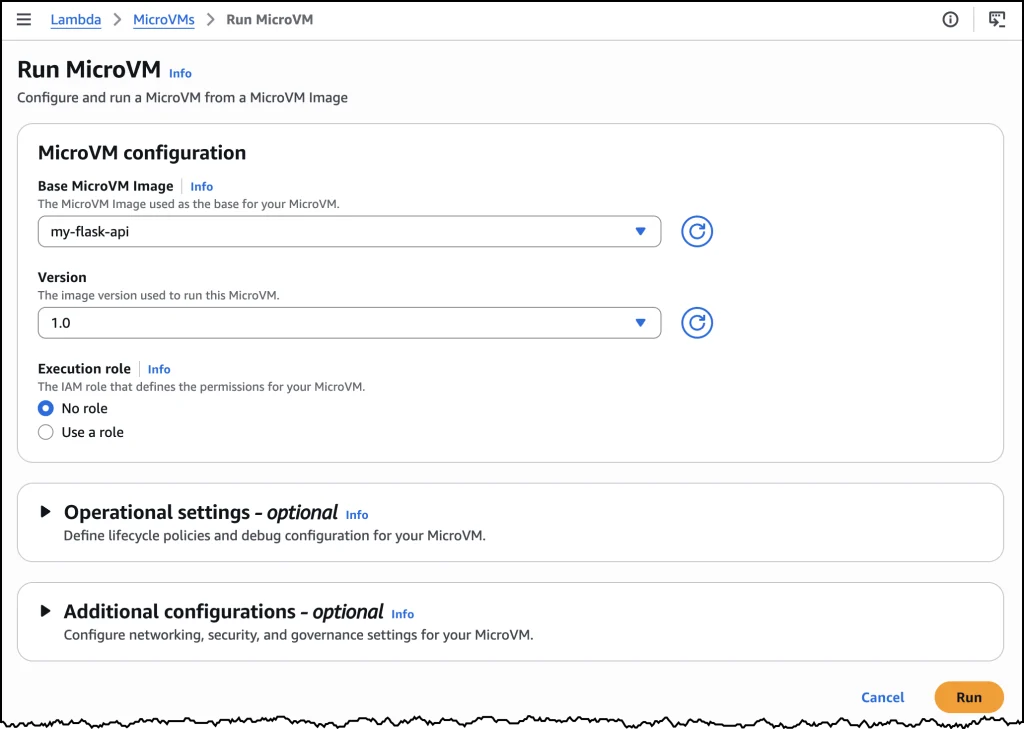
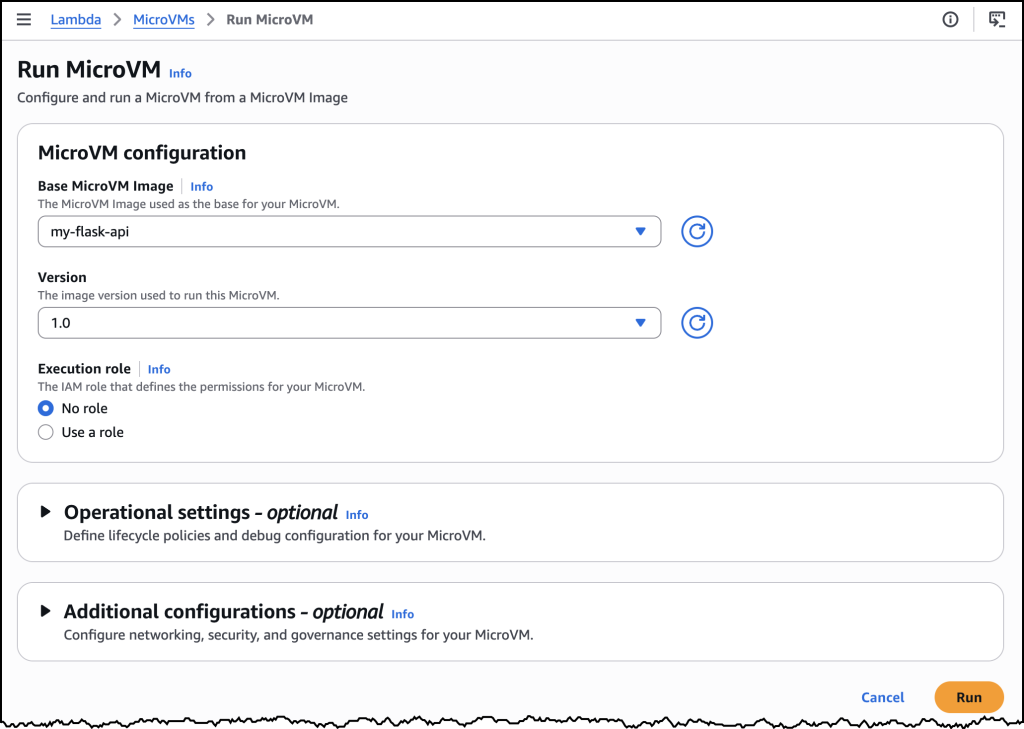
Transitioning to Lambda MicroVMs is straightforward for teams already familiar with Docker. The workflow involves three distinct steps:
- Image Creation: Developers define their environment using a standard
Dockerfile, which is packaged with their code into a ZIP archive and uploaded to Amazon S3. - Snapshotting: Using the
aws lambda-microvms create-microvm-imagecommand, the service builds the container and produces a snapshotted version of the environment. - Deployment and Lifecycle: Through the CLI or Console, developers launch the VM with a defined idle policy. Integration with existing authentication protocols, such as
X-aws-proxy-auth, allows developers to securely manage access to these environments.
The service is currently available in key regions, including US East (N. Virginia, Ohio), US West (Oregon), Europe (Ireland), and Asia Pacific (Tokyo).
Conclusion: A New Frontier for Secure Compute
The introduction of AWS Lambda MicroVMs is more than just a new feature; it is an acknowledgment of how modern, AI-augmented applications are being built. By abstracting away the complexities of virtualization and state management, AWS is enabling developers to focus on the application logic rather than the plumbing of isolation.
As these MicroVMs proliferate, we are likely to see a new generation of "stateful-serverless" applications that are faster, more secure, and significantly easier to deploy than the monolithic architectures of the past. For companies looking to integrate user-supplied code or AI-driven logic into their platforms, the era of managing custom virtualization infrastructure is officially coming to an end.