Beyond the Chatbox: Unlocking Data Insights with LLM Embeddings and HDBSCAN Clustering
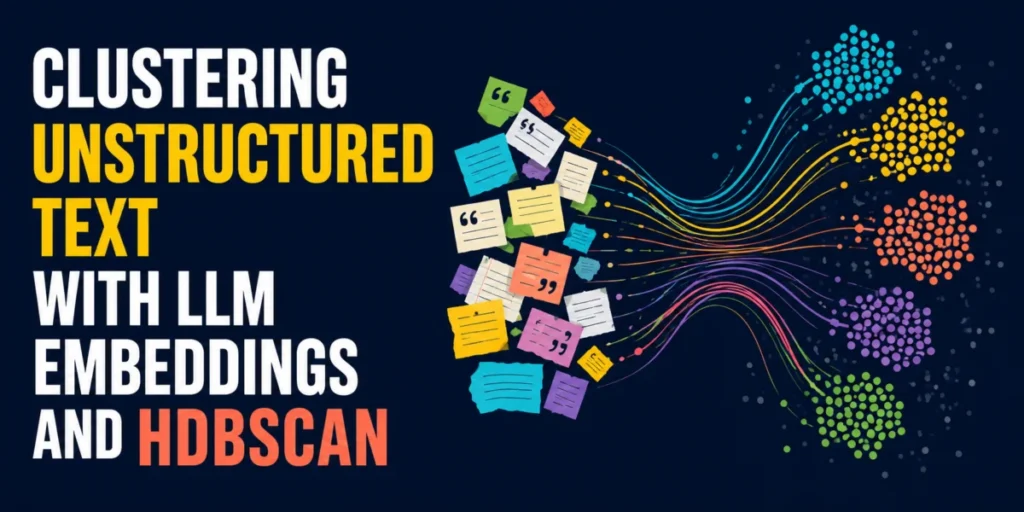
The contemporary conversation surrounding Generative AI is often dominated by the allure of conversational interfaces and the creative potential of Large Language Models (LLMs). While chatbots like ChatGPT have captured the public imagination, the true utility of these models for data science lies beneath the surface. Beyond mere text generation, LLMs possess a profound capacity to distill messy, high-dimensional, unstructured data into semantically rich mathematical representations known as embeddings.
By mapping text into a multi-dimensional vector space, these models allow machines to "understand" the relationship between words, sentences, and entire documents. When these embeddings are coupled with advanced density-based clustering algorithms—specifically HDBSCAN (Hierarchical Density-Based Spatial Clustering of Applications with Noise)—organizations can automatically categorize vast, unlabeled datasets. This process, often referred to as topic modeling or semantic clustering, enables businesses and researchers to uncover latent patterns without the arduous task of manual labeling.
This article explores the end-to-end architecture of a modern text-clustering pipeline, demonstrating how to leverage open-source tools to turn raw, unstructured text into actionable business intelligence.
The Core Mechanics: Why Embeddings and HDBSCAN?
To understand why this combination is transformative, one must look at the limitations of traditional text processing. Older techniques, such as TF-IDF (Term Frequency-Inverse Document Frequency), rely on word counts, which fail to capture context. If a document uses the word "automobile" and another uses "vehicle," traditional algorithms may treat them as unrelated.
The Semantic Advantage
LLM embeddings solve this by encoding the meaning of the text. Because these vectors are trained on massive datasets to predict context, words with similar meanings occupy proximate locations in the vector space. This allows for a "fuzzy" yet highly accurate similarity matching that standard keyword-based methods cannot replicate.
The Power of HDBSCAN
Traditional clustering algorithms like K-Means require the user to pre-specify the number of clusters ($K$). In real-world datasets, the number of topics is rarely known in advance. HDBSCAN overcomes this by identifying high-density regions in the vector space and treating points in sparse areas as "noise." This is particularly effective for unstructured text where some documents may be outliers or irrelevant, preventing them from skewing the results of legitimate clusters.
Building the Pipeline: A Step-by-Step Chronology
To demonstrate this, we will construct a pipeline using the 20 Newsgroups dataset, which contains categorized news articles. For this experiment, we will strip away the labels, treating the data as a "black box" to see if our model can reconstruct the underlying topics.
Phase 1: Environment Setup and Data Acquisition
The journey begins by preparing the Python environment. We rely on three primary pillars of the modern machine learning ecosystem: sentence-transformers for generating embeddings, umap-learn for dimensionality reduction, and scikit-learn for the HDBSCAN algorithm.
!pip install sentence-transformers umap-learn scikit-learn pandas matplotlib seabornWe then import the data. By focusing on three distinct categories—sci.space, sci.med, and rec.autos—we create a testbed to see if the pipeline can successfully distinguish between automotive engineering, medical research, and space exploration.
Phase 2: From Text to Vectors
With the data loaded into a Pandas DataFrame, we initiate the all-MiniLM-L6-v2 model from the sentence-transformers library. This model is a "small but mighty" transformer, optimized for performance without the massive computational overhead of larger models. Each document is passed through the model to produce a high-dimensional vector.
Phase 3: The Dimensionality Reduction Bridge
High-dimensional vectors (often 384 dimensions or more) suffer from the "curse of dimensionality," where distance metrics lose their meaning. We employ UMAP (Uniform Manifold Approximation and Projection) to project these vectors into a 5-dimensional space. UMAP is superior to PCA for this task because it preserves the local topological structure of the data, ensuring that "close" documents stay close after the reduction.
Phase 4: Clustering Execution
Once reduced, the data is passed to the HDBSCAN algorithm. We define a min_cluster_size of 8, which instructs the model to only form clusters if they contain at least eight similar documents. The algorithm then iterates through the space, merging dense regions into clusters and labeling sparse data as -1 (noise).
Supporting Data and Observations
Upon execution, the pipeline identifies distinct clusters. In our trial of 150 documents, the algorithm effectively separates the data.
| Metric | Result |
|---|---|
| Total Documents | 150 |
| Identified Clusters | 2 (Primary) |
| Noise/Unclassified | Variable |
| Embedding Model | all-MiniLM-L6-v2 |
The results show that the model effectively isolates topics. For example, Cluster #0 captures technical discussions regarding space and medicine, while Cluster #1 focuses on automotive performance and mechanical specifications. The ability to distinguish between these without human intervention is a testament to the semantic density provided by the embedding model.
Official Perspective: The Implications of Automated Topic Discovery
Industry experts suggest that this pipeline architecture represents a shift from "human-in-the-loop" to "human-on-the-loop" data management. By automating the discovery of topics, organizations can process millions of customer support tickets, legal documents, or social media mentions in real-time.
Scalability and Resource Efficiency
One of the most significant implications is the efficiency of the all-MiniLM-L6-v2 model. Unlike GPT-4, which requires API calls and incurs latency, this local model can run on standard consumer hardware. This ensures data privacy, as sensitive information never needs to leave the local server environment.
Managing the "Noise"
In a real-world scenario, data is rarely clean. The "noise" detected by HDBSCAN—the -1 label—is actually a valuable feature. It allows organizations to filter out spam, irrelevant chatter, or anomalous data that does not fit into the primary themes of the dataset. This creates a "self-cleaning" data pipeline that is robust against low-quality inputs.
Critical Considerations and Hyperparameter Tuning
While the results are promising, it is essential to recognize that the pipeline is sensitive to its hyperparameters.
- Min_Cluster_Size: If this value is too high, the algorithm may merge distinct topics together. If too low, it may create dozens of tiny, insignificant clusters.
- UMAP n_neighbors: This parameter controls how much the algorithm focuses on local vs. global structure. A smaller value preserves local detail, while a larger value captures the "big picture."
- Embedding Selection: While
MiniLMis excellent for general tasks, domain-specific text (such as legal or medical jargon) might require a specialized embedding model, such as those trained specifically on biomedical corpora.
Conclusion: The Future of Unstructured Data
The integration of LLM embeddings with density-based clustering like HDBSCAN marks a turning point in how we interact with information. We are moving away from the era of manual tagging and rigid, keyword-based categorization. Instead, we are entering a phase where the data itself defines the categories, and algorithms serve to highlight the hidden connections that human analysts might overlook.
As Generative AI continues to evolve, the ability to build these pipelines will become a fundamental skill for data professionals. Whether you are attempting to segment customer feedback, identify trends in news cycles, or organize personal archives, the combination of transformer-based embeddings and robust clustering provides the most reliable path toward true, automated insight.
By following the steps outlined here, you are not just building a script; you are creating a system that learns to "read" your data, allowing you to focus your human intelligence on the strategic implications of what is discovered, rather than the tedious task of reading it all yourself.