Empowering the Intelligent Data Lake: Amazon S3 Introduces Powerful New "Annotations" Capability
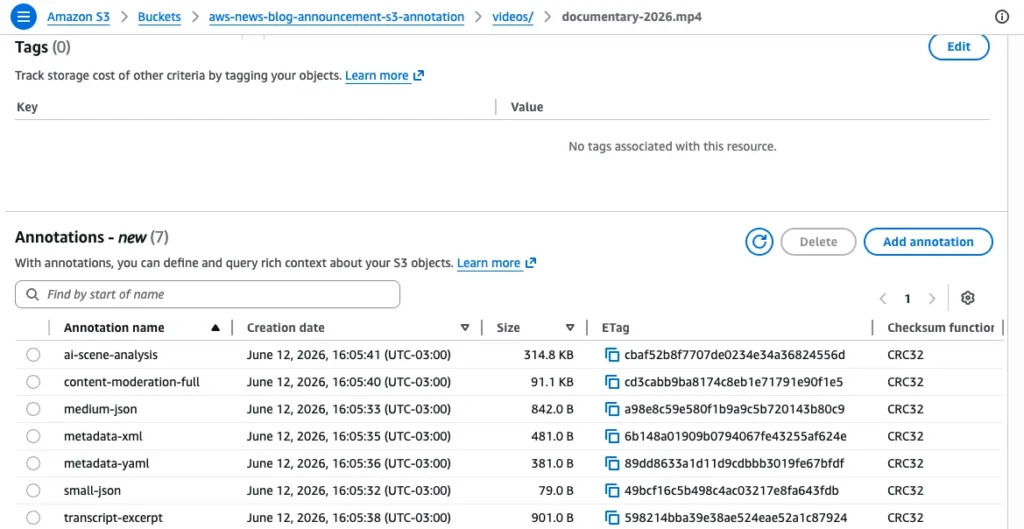
In a major leap forward for cloud-native data management, Amazon Web Services (AWS) has unveiled "Annotations," a transformative metadata capability for Amazon Simple Storage Service (Amazon S3). This new feature enables organizations to attach massive amounts of rich, business-specific context directly to their S3 objects, effectively bridging the gap between raw data storage and the complex, metadata-heavy requirements of modern artificial intelligence (AI) and autonomous workflows.
As enterprises pivot toward agentic AI—systems capable of performing tasks without human intervention—the demand for data that is not only accessible but also "self-aware" has skyrocketed. With the introduction of S3 Annotations, AWS is providing a native, scalable, and highly queryable solution that eliminates the need for cumbersome, fragmented "sidecar" databases.
Main Facts: Redefining Object Metadata
The core value proposition of S3 Annotations lies in its sheer capacity and flexibility. Historically, S3 users were limited by strict constraints: user-defined metadata was capped at 2 KB, and object tags were limited to a small number of key-value pairs designed primarily for lifecycle and access control.
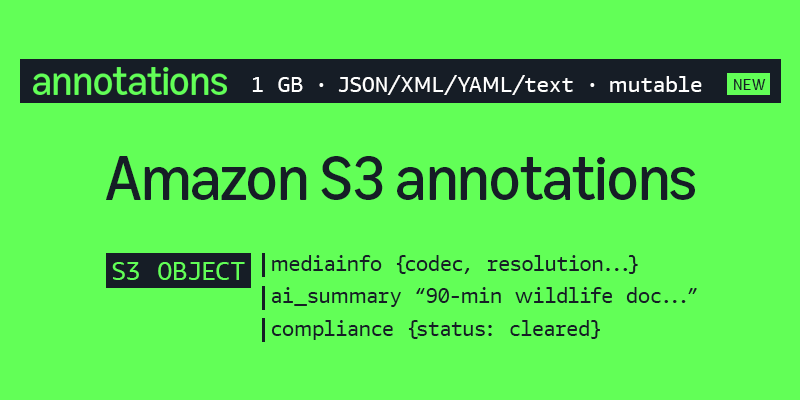
Annotations change the equation entirely. Each S3 object can now host up to 1,000 named annotations, with each annotation supporting up to 1 MB of data. This allows for a total of 1 GB of metadata per object—a massive increase compared to legacy methods. These annotations support flexible formats, including JSON, XML, YAML, and plain text, allowing developers to store everything from technical specifications and AI-generated summaries to compliance markers and content ratings.
Crucially, these annotations are mutable. They can be updated, modified, or deleted independently of the parent object. This means that as an AI model learns more about a file, or as a business process changes, the associated metadata can evolve in real time without the need to rewrite or re-upload the underlying data.
Chronology of Development: From Static Storage to Intelligent Context
The evolution of S3 metadata has been a gradual journey toward meeting the needs of the big data era.
- The Early Years: S3 began with standard system-defined metadata, providing basic utility: file size, storage class, and timestamps.
- The Expansion: As user needs grew, AWS introduced User-Defined Metadata and Object Tags. While effective for simple categorization, these were insufficient for complex applications like video streaming, genome sequencing, or large-scale machine learning datasets.
- The "Sidecar" Problem: Over the last decade, organizations resorted to maintaining external databases (such as Amazon DynamoDB or RDS) to track rich metadata. This created a "synchronization tax," where developers had to manage complex event-driven architectures just to ensure the database stayed in sync with the actual storage layer.
- The Breakthrough: Today’s announcement marks the culmination of this evolution. By integrating metadata directly into the S3 storage fabric, AWS has effectively turned S3 from a passive storage bucket into an active, queryable metadata repository.
Supporting Data: The Capability Matrix
To understand why this change is significant, one must compare the technical specifications of previous metadata options against the new Annotations feature.
| Capability | Max Size | Mutable? | Best For |
|---|---|---|---|
| System-defined | Fixed | No | Object properties (size, class, time) |
| User-defined | 2 KB | No | Small, fixed custom key-value pairs |
| Object tags | 10 tags | Yes | Access control, lifecycle, cost allocation |
| Annotations | 1 GB (1,000 x 1MB) | Yes | Rich business context (AI, JSON, XML) |
This table highlights a fundamental shift in architecture. Where previous methods were restricted to operational metadata, Annotations are designed for business intelligence metadata.
Technical Implications: Querying at Scale
Perhaps the most impressive aspect of S3 Annotations is the seamless integration with the broader AWS analytics ecosystem. When a user enables S3 Metadata annotation tables, the service automatically indexes the annotations into a fully managed Apache Iceberg table.
The Power of Amazon Athena
Once indexed, these annotations become immediately available for analysis via Amazon Athena. This means that a data scientist no longer needs to write custom code to crawl through millions of files to understand their content. They can simply run standard SQL queries against the annotation table to identify, for example, all video assets with specific technical profiles, or all documents that have been tagged as "High Priority" by an AI summarization agent.
The Role of the S3 Tables MCP Server
For the AI-forward organization, the integration with the S3 Tables Model Context Protocol (MCP) server is a game-changer. It allows AI agents to "discover" data through natural language. An agent can ask, "Find all medical records from 2024 that have been flagged for patient privacy compliance," and the S3 Table interface will return the relevant objects in seconds. This eliminates the "retrieval penalty" often associated with cold storage, as annotations are accessible even if the parent object is stored in S3 Glacier.
Official Perspective and Implementation
Daniel Abib, a key figure in the S3 product engineering team, emphasized that this release is specifically tailored for the "agentic" future. "Organizations are building AI agents that need to find, understand, and act on data without human intervention," Abib noted. "To support these workflows, you need metadata that can evolve alongside the data, scale to petabytes of objects, and remain queryable."

A Developer’s Workflow
Implementing Annotations is designed to be straightforward for teams already familiar with the AWS CLI. The process is broken down into three distinct steps:
- Permission Configuration: Ensure IAM roles allow
s3:PutObjectAnnotationands3:GetObjectAnnotation. - Attaching Metadata: Use the
PutObjectAnnotationAPI to attach structured data (JSON/YAML) or text to an object. - Indexing: Enable the annotation table within the S3 bucket configuration to trigger the automated Iceberg indexing process.
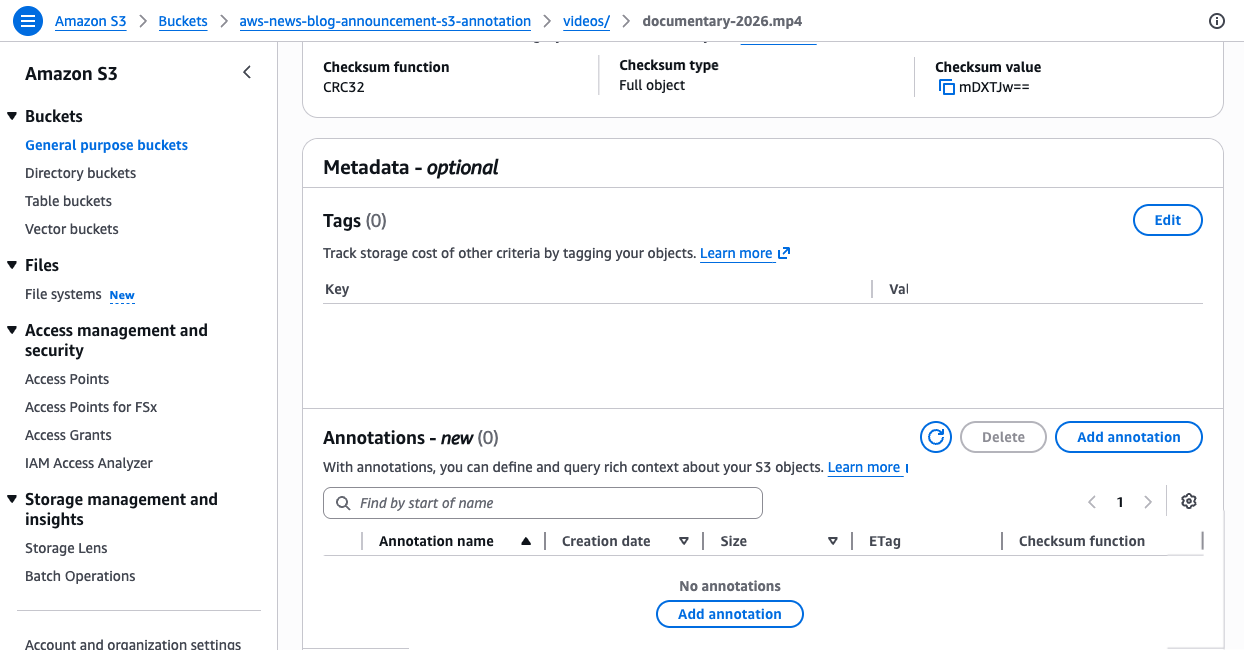
For instance, a media company storing high-resolution 4K video files can now attach a mediainfo.json file containing codec details, resolution, and frame rates directly to the video asset. If the video is re-encoded or the metadata needs to be corrected, the PutObjectAnnotation command updates the record instantly without ever touching the video file itself.
Implications: The Future of Data Governance
The implications for data governance and cost management are profound.
1. Reduced Infrastructure Overhead:
Companies will no longer need to provision and manage separate database clusters simply to track metadata. By moving this logic into S3, organizations reduce the "Total Cost of Ownership" (TCO) for their data lakes.
2. Improved Data Lifecycle Management:
Because annotations are tied to the object, they automatically follow the object during replication, cross-region transfers, and even deletion. When an object is deleted, the associated annotations are removed by the system, preventing the "metadata drift" that occurs when external databases hold stale references to objects that no longer exist.
3. Enhanced Compliance and Auditing:
With the ability to store large, structured annotations, companies can maintain detailed audit logs, provenance information, and compliance certificates directly within the storage layer. This creates a transparent lineage for every byte of data, which is essential for regulated industries like finance and healthcare.
4. The Rise of "Self-Describing" Data:
The industry has long discussed the "self-describing" data lake. S3 Annotations bring us closer to this ideal. By treating metadata as a first-class citizen alongside the data payload, AWS is ensuring that the "what, why, and how" of data remains inseparable from the data itself.
Conclusion
As businesses continue to scale their storage to petabytes and exabytes, the challenge is no longer just storing data—it is knowing what that data is. Amazon S3 Annotations provides a sophisticated, scalable, and highly performant solution to this challenge. By moving rich context directly to the storage layer and making it queryable through standard SQL, AWS is setting a new standard for how we interact with our digital assets.
For developers, data engineers, and AI architects, the message is clear: the era of managing disconnected metadata is ending. The future of the data lake is intelligent, integrated, and, thanks to S3 Annotations, significantly more capable. As these tools become widely adopted, we can expect to see a new wave of autonomous, data-driven applications that are faster to build, easier to maintain, and more powerful than anything that came before.