INS Mahendragiri: India’s Maritime Prowess Ascends with the Commissioning of the Sixth Project 17A Stealth Frigate
By Naval Affairs Correspondent
Visakhapatnam, July 11, 2026
In a significant stride toward achieving total maritime self-reliance, the Indian Navy today formally inducted INS Mahendragiri into its Eastern Fleet. The commissioning ceremony, held at the strategically vital port of Visakhapatnam, was presided over by Union Defence Minister Rajnath Singh. This milestone represents the sixth vessel of the formidable Project 17A class to join the naval ranks, further cementing India’s position as a premier global hub for sophisticated warship construction.
As the tricolor was hoisted, the vessel officially transitioned from a construction project into a mission-ready combat platform. Named after the majestic mountain peak in the Eastern Ghats, the Mahendragiri embodies the spirit of resilience and peak performance, standing as a testament to the "Atmanirbhar Bharat" (Self-Reliant India) initiative.
Main Facts: A Technological Marvel of the High Seas
INS Mahendragiri is not merely a ship; it is a complex, multi-mission platform designed to navigate the increasingly contested waters of the Indian Ocean Region (IOR) and beyond. Built by the state-owned Mazagon Dock Shipbuilders Limited (MDL), the vessel serves as a flagship example of integrated modular construction—a technique where blocks are built independently and joined with surgical precision to reduce construction timelines.
The frigate is defined by its "stealth" DNA. By utilizing radar-absorbent materials and a unique hull geometry, the Mahendragiri significantly reduces its radar cross-section, allowing it to operate in hostile environments with a degree of anonymity. Furthermore, the ship boasts a high level of automation, allowing for a leaner crew complement while maintaining peak operational efficiency.

The vessel is propelled by a sophisticated Combined Diesel or Gas (CODOG) system, which offers the flexibility of fuel-efficient long-range cruising alongside high-speed burst capabilities required during combat maneuvers. With over 75% indigenous content, the construction of the ship has spurred a ripple effect across the Indian economy, engaging hundreds of Micro, Small, and Medium Enterprises (MSMEs) to provide specialized components, from high-tensile steel to complex electronic sensors.
Chronology: The Journey to Commissioning
The path to the Mahendragiri’s commissioning is marked by a rapid, disciplined schedule that highlights the newfound efficiency of Indian shipyards.
- December 20, 2024: The Indian Navy takes delivery of the first ship of the series, INS Nilgiri, setting the benchmark for the Project 17A program.
- Early 2025 – Mid 2026: A record-breaking pace follows. In less than 17 months, the Indian naval shipbuilding ecosystem successfully delivered six frigates, an achievement that once seemed improbable for a nation transitioning from an importer to an exporter of naval hardware.
- July 10, 2026: Defence Minister Rajnath Singh confirms his arrival in Visakhapatnam, characterizing the upcoming commissioning as a "proud moment for the nation."
- July 11, 2026: INS Mahendragiri is formally commissioned into the Eastern Fleet, marking the conclusion of its initial outfitting and sea-trial phase.
Supporting Data: Specifications and Capabilities
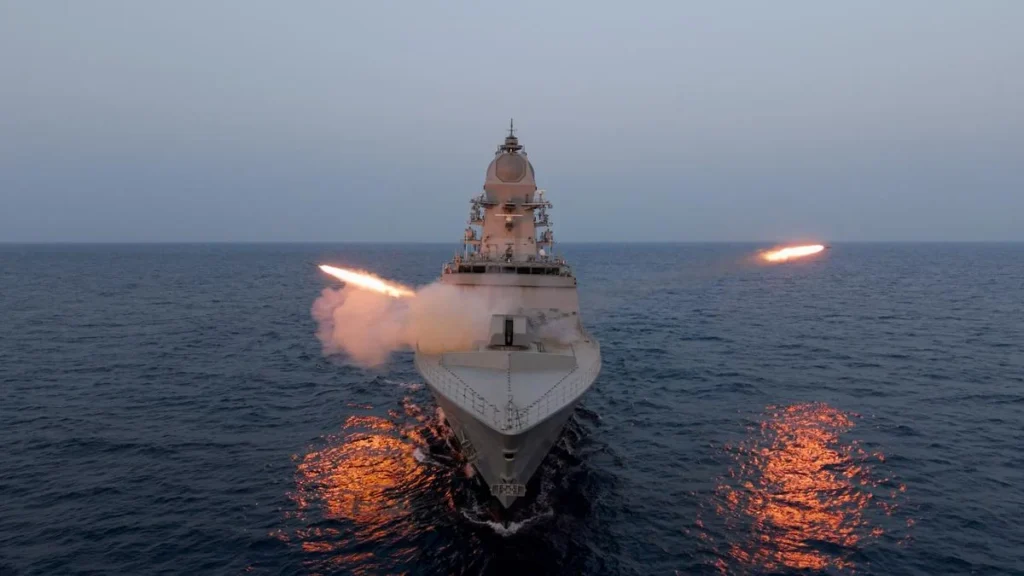
The Mahendragiri is designed to confront the multi-dimensional threats of modern naval warfare. Its operational profile is bolstered by an arsenal that ensures dominance in air, surface, and sub-surface domains.
Technical Arsenal
- Combat Management System (CMS): A proprietary, indigenous system that integrates data from all sensors and weapons, providing the commanding officer with a real-time "God’s-eye view" of the battlespace.
- Weaponry: The frigate is equipped with long-range surface-to-surface missiles, advanced surface-to-air missile systems, and heavy-duty anti-submarine warfare (ASW) rockets and torpedoes.
- Electronic Warfare (EW): A suite of state-of-the-art electronic countermeasure systems allows the vessel to jam enemy signals and defend against incoming guided munitions.
- Endurance: Designed for sustained deployments, the ship features advanced habitability standards for the crew, enabling extended operations in high-sea states without the need for frequent replenishment.
Economic Impact
The Project 17A program has become the backbone of the domestic defence industrial base. By mandating 75% indigenous content, the program has localized the supply chain for marine engineering, fire-control systems, and specialized communications. This shift has not only saved significant foreign exchange but has also ensured that the Indian Navy is no longer beholden to international supply chains for critical ship maintenance and upgrades.
Official Responses and Strategic Vision
During his address at the commissioning ceremony, Defence Minister Rajnath Singh emphasized that the Mahendragiri is a symbol of India’s growing "strategic autonomy."

"This state-of-the-art warship is a testament to our dedication to securing the Indian Ocean," the Minister stated. He noted that the vessel’s motto—Mighty, Majestic, Matchless—perfectly captures the philosophy behind its design. The Minister further lauded the Warship Design Bureau and the Warship Overseeing Team in Mumbai for their meticulous oversight, which ensured the ship was delivered ahead of standard global timelines.
Naval leadership echoed these sentiments, noting that the inclusion of the Mahendragiri allows for greater flexibility in the Eastern Fleet’s deployments. By acting as a "force multiplier," the frigate enhances the Navy’s capacity for humanitarian assistance and disaster relief (HADR) missions, as well as its traditional role in power projection and maritime surveillance.
Implications: A New Era for the Indian Navy
The induction of INS Mahendragiri carries profound implications for the geopolitical landscape of the Indo-Pacific.
Strengthening the Indian Ocean Region (IOR)
As the world’s focus shifts to the Indian Ocean as a critical transit route for global trade, the Mahendragiri provides the Indian Navy with the reach and lethality to act as a "first responder." Whether it is combating piracy, monitoring illegal traffic, or deterring regional aggression, the frigate’s ability to conduct long-range deployments ensures that India remains the primary security guarantor in the region.
The Rise of Indigenous Naval Diplomacy
India’s ability to build its own fleet of stealth frigates has changed the nature of its naval diplomacy. The nation is now increasingly seen as a preferred partner for regional navies in the Global South, offering training, technical support, and potentially future export opportunities for its indigenous naval platforms.

Future-Proofing the Fleet
The "Project 17A" class is designed with modularity in mind. This means that as new technologies—such as laser-directed energy weapons or unmanned aerial vehicle (UAV) swarms—become standard, the Mahendragiri can be upgraded with minimal structural modifications. This "future-proofing" is a significant departure from older designs that required extensive refits to incorporate new tech.
A Legacy of Excellence
As the first warship to bear the name Mahendragiri, the vessel is tasked with building its own legend. The ship is more than an assembly of steel and sensors; it is a manifestation of the collective intellectual and industrial capacity of India. With its high degree of automation and advanced sensor suites, the ship is perfectly suited to the demands of the 21st-century maritime environment.
In conclusion, the arrival of the Mahendragiri marks a pivotal moment in the modernization of the Indian Navy. As it begins its service life, it serves as a powerful reminder that India’s maritime interests are protected by vessels that are designed, built, and operated by the nation’s finest. From the mountain ranges of the Eastern Ghats to the deep blue of the Indian Ocean, the Mahendragiri stands as a sentinel of peace, a tool of deterrence, and a symbol of national pride.