Accelerating Delivery: AWS DevOps Agent Unveils Autonomous Release Management in Preview
In the modern era of rapid software development, the velocity of code creation has outpaced the human capacity for verification. With the widespread adoption of AI-assisted coding tools, development teams are drowning in a sea of pull requests, often leading to "review fatigue," where critical security or functional flaws slip through the cracks. Today, Amazon Web Services (AWS) is taking a decisive step toward solving this bottleneck with the announcement of new release management capabilities for the AWS DevOps Agent, now available in preview.
Designed as an "always-available teammate," the AWS DevOps Agent is engineered to handle the complex orchestration of software changes across AWS, hybrid cloud, and on-premises environments. By expanding its scope to include autonomous release readiness and testing, AWS is aiming to transform the DevOps pipeline from a manual, high-friction process into an automated, AI-driven engine of quality and security.
The Core Innovation: Moving Beyond Human Review
The primary challenge facing engineering organizations today is the disconnect between the speed of AI-generated code and the manual nature of the deployment pipeline. When developers are under pressure, code reviews often become perfunctory, and testing environments frequently suffer from "configuration drift," where they no longer accurately reflect the nuances of production.
AWS DevOps Agent addresses this by integrating directly into the development lifecycle. It functions not merely as a bot that flags errors, but as an intelligent agent that understands the intricate dependencies of a service, its historical production behavior, and the specific compliance standards set by an organization.
Release Readiness Review
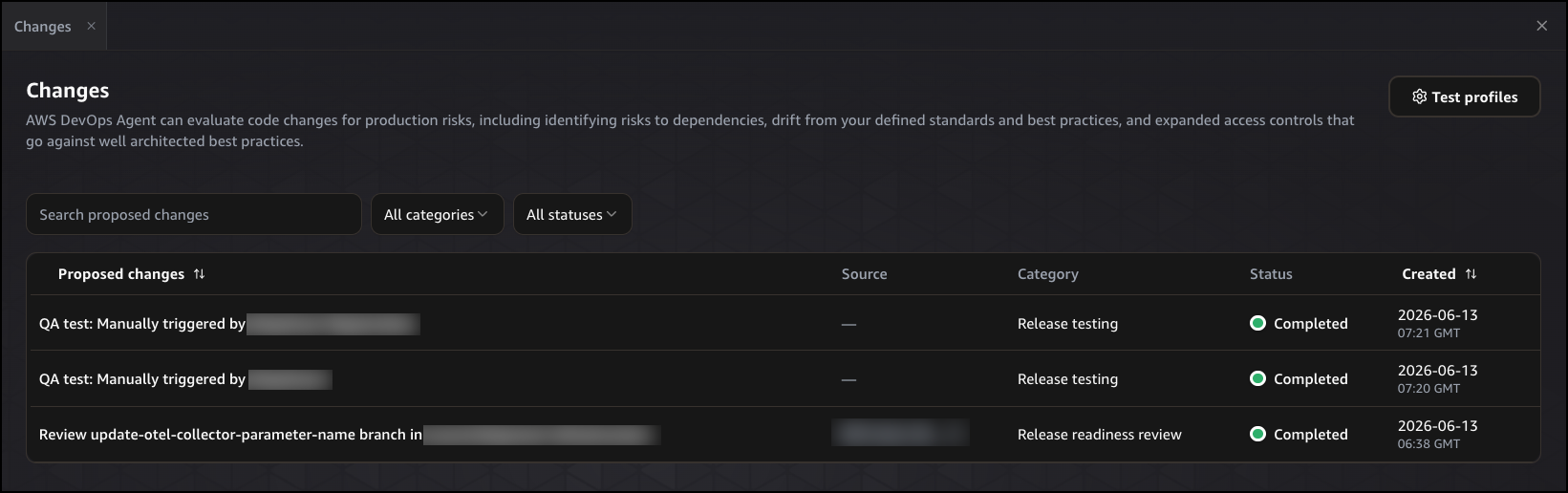
The new "Release Readiness Review" feature acts as an automated gatekeeper. Before a line of code is merged, the agent evaluates the proposed change against:
- Production Requirements: Checking for infrastructure impacts and dependency safety.
- Organizational Standards: Applying plain-English, user-defined instructions that govern encryption, network access, and observability.
- Security Best Practices: Assessing changes against the AWS Well-Architected Framework.
By running this code in an AWS-managed isolated environment and executing lightweight user-journey tests, the agent provides a definitive "BLOCK," "Proceed with Caution," or "Safe to Release" status before the code ever reaches the production branch.

Autonomous Release Testing
Going beyond static analysis, the agent introduces autonomous release testing. Unlike traditional CI/CD pipelines that rely on pre-written, often outdated test suites, the AWS DevOps Agent analyzes the specific nature of a code change and constructs a tailored test plan. It reasons about the change’s behavior to identify potential regressions, integration failures, and functional gaps, providing developers with a structured, transparent log of the validation process.
Chronology of Development: From Incident Response to Proactive Delivery
The evolution of the AWS DevOps Agent has been rapid and focused.
- Initial Launch: The agent was originally introduced as an operational tool focused on post-deployment monitoring. Its primary mission was to autonomously investigate incidents, provide root-cause analysis (RCA), and suggest mitigation strategies for production issues.
- Building the Knowledge Graph: Throughout its development, the agent has been "indexing" customer environments. By mapping the relationships between cross-repository dependencies and cloud resources, it gained the foundational context required to predict how a single change might ripple through an entire architecture.
- Integration Phase: By connecting with GitHub and GitLab, the agent became a participant in the version control workflow.
- Current Milestone: The transition to "Release Management" represents the agent’s graduation from a reactive incident solver to a proactive delivery partner, closing the loop from code creation to production deployment.
Data-Driven Insights: Why Automation Matters
The necessity for this technology is grounded in the shifting landscape of software engineering. According to industry observations, the volume of pull requests has seen an exponential increase since the mass adoption of Large Language Models (LLMs) for coding.
The "Queue" Problem: When AI models generate code faster than humans can review it, the value of that code remains trapped in queues. This leads to:
- Context Switching: Developers lose momentum while waiting for reviews.
- Increased Risk: Fatigue-induced errors, where reviewers approve changes without thorough investigation.
- Environment Drift: A widening gap between what is tested in staging and what actually exists in production.
The AWS DevOps Agent mitigates these risks by providing a consistent, auditable trail. Every test run generates a structured report—including logs, traces, and metrics—ensuring that even if an error occurs, the team has a clear, timestamped record of how the agent reached its conclusions.
Implications for Development Teams
The integration of the AWS DevOps Agent into the CI/CD pipeline signals a fundamental shift in how teams define "developer productivity."
Shifting Left with Intelligence
By enabling developers to invoke reviews directly from their IDEs—using plugins like Kiro or Claude Code—the agent brings production-level validation to the very beginning of the workflow. Developers no longer need to wait for a pipeline to fail; they receive real-time feedback on dependency risks and security violations as they write code.
Standardizing "Best Practice"
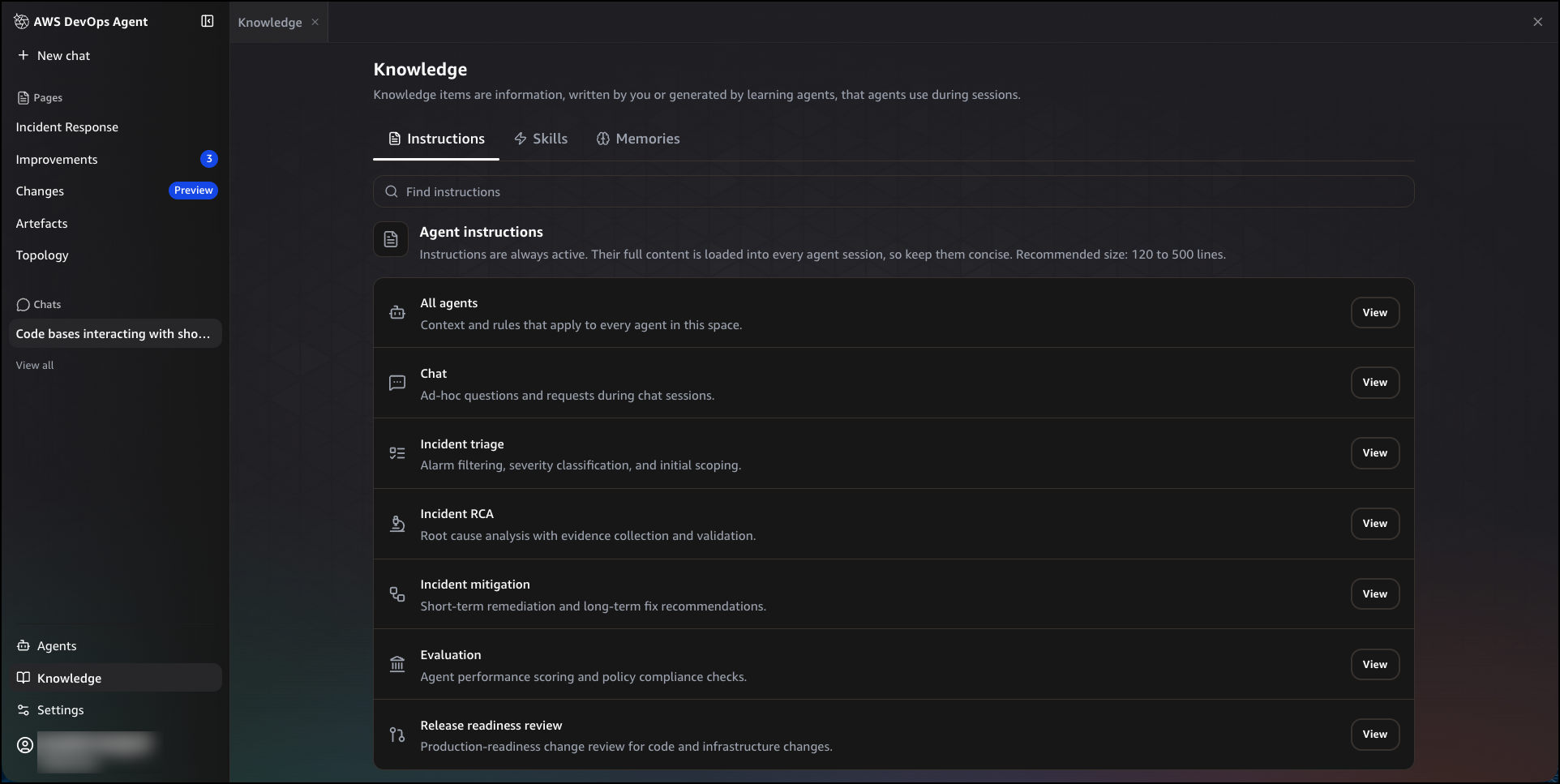
For many organizations, maintaining a consistent set of "best practices" across hundreds of microservices is an impossible management task. With the Agent’s "Instructions" feature, organizations can define their governance in plain English. Whether it is mandating specific encryption standards for a database or ensuring that new networking rules comply with corporate policy, the agent enforces these rules autonomously. This creates a "self-governing" architecture where compliance is built-in, rather than bolted on.
Transparency and Trust
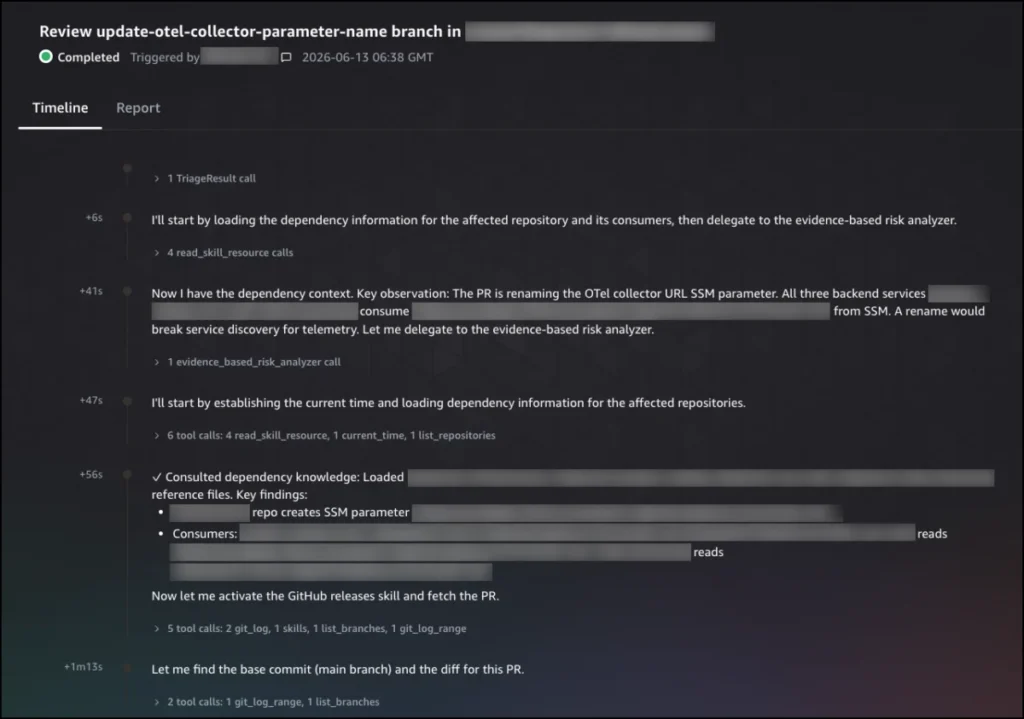
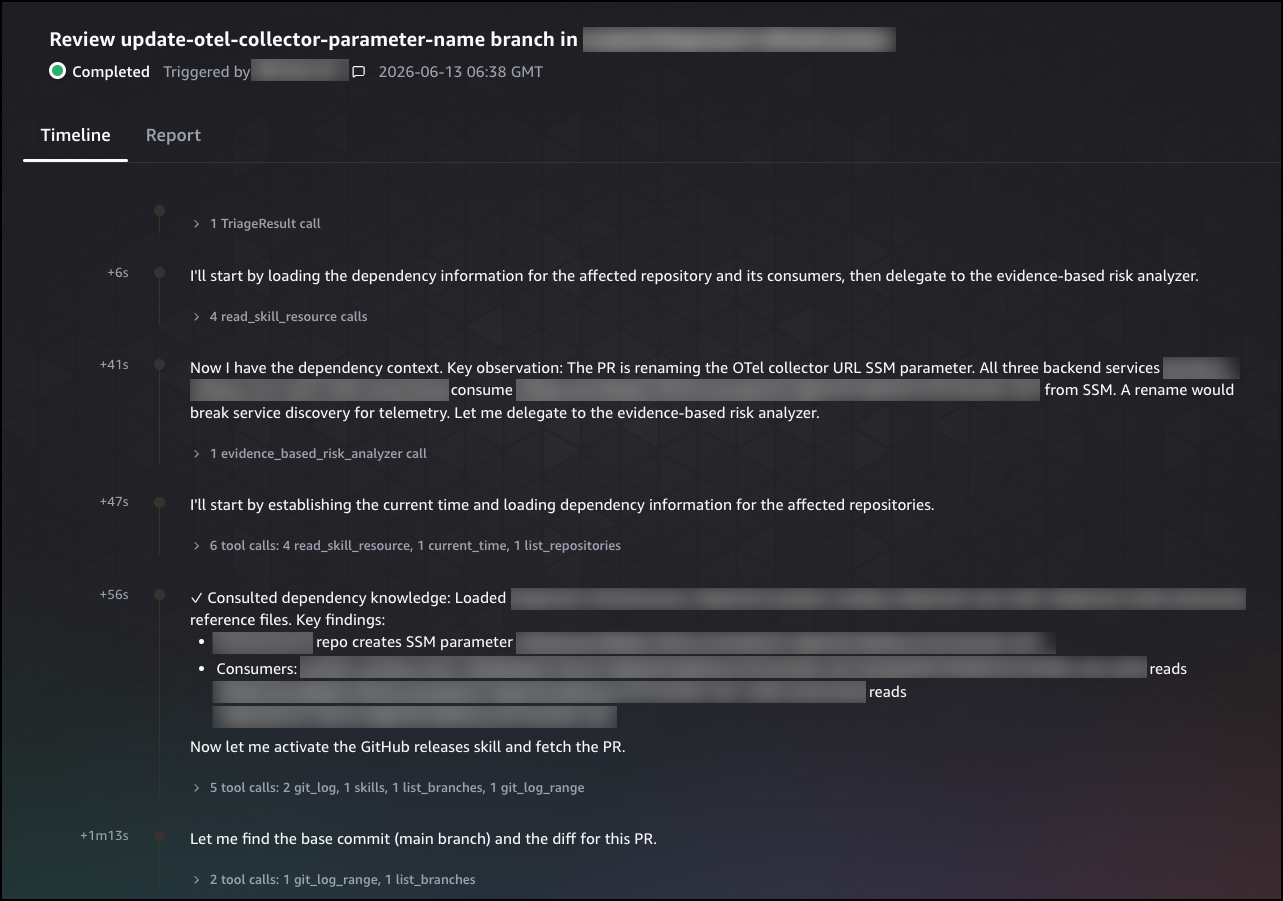
One of the most critical aspects of the agent’s design is the Timeline tab. In the world of AI, the "black box" problem is a primary concern for engineers. AWS has addressed this by providing a step-by-step reasoning record. When a developer asks, "Why was my release blocked?", the agent doesn’t just return an error code; it provides a narrative of its reasoning, the tools it consulted, and the specific evidence that led to its decision. This transparency is essential for building trust between automated systems and human operators.
Official Perspective and Implementation
AWS has emphasized that the agent is not intended to replace human judgment but to augment it. By handling the "drudgery" of checking for common errors, dependency conflicts, and basic functional regressions, the agent frees up senior engineers to focus on architectural design and complex feature development.
How to Get Started
Getting started is designed to be low-friction for existing AWS users:
- Connect: Link a GitHub or GitLab repository to the Agent Space.
- Index: Allow the agent to build its knowledge graph of your environment.
- Configure: Navigate to the "Knowledge" tab to define internal standards via simple text instructions.
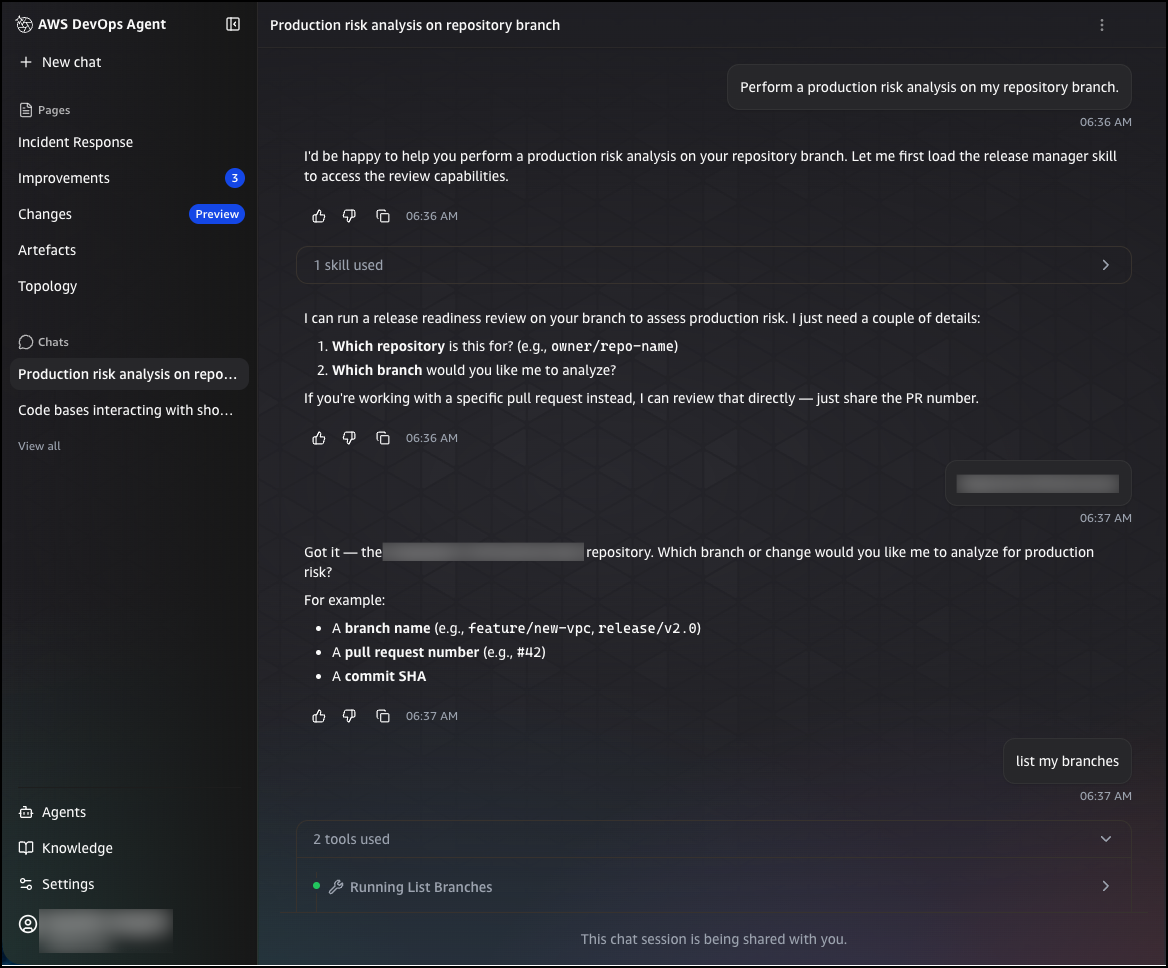
- Execute: Trigger reviews via pull requests or through the chat interface using natural language queries like: "Perform a production risk analysis on my repository branch."
The service is currently available in preview in the US East (N. Virginia) region at no additional cost, allowing organizations to experiment with the workflow without impacting their operational budgets.
Future Outlook: The Autonomous Pipeline
The release of these capabilities marks a significant milestone in the maturity of AI-driven DevOps. We are moving toward a future where the "release manager" is no longer a role defined by manual oversight, but a software-defined function.
As these tools continue to evolve, we can expect the AWS DevOps Agent to become increasingly adept at handling complex, multi-service releases that require orchestrating changes across distributed, global architectures. For teams currently struggling to maintain quality while accelerating their release cadence, the AWS DevOps Agent offers a path toward a more sustainable, scalable, and secure software delivery lifecycle.
By automating the "readiness" aspect of the release process, AWS is not just helping teams move faster—it is helping them move with the confidence that their systems remain resilient, compliant, and production-ready, regardless of the volume of code moving through their pipelines.