Hasselblad Bridges the Gap: Phocus Mobile Finally Arrives on Android
After a sixteen-year wait since its inception on the iOS platform, and six years since the debut of Phocus Mobile 2, Hasselblad has finally answered the demands of its professional Android-using user base. The iconic Swedish camera manufacturer has officially launched Phocus Mobile for the Android operating system, bringing its high-end image processing ecosystem to a broader array of mobile devices. This release represents a significant shift in Hasselblad’s mobile strategy, acknowledging the growing prowess of Android hardware and the necessity of seamless, on-the-go professional workflows.
The application is now available via the Google Play Store and is designed to integrate directly with Hasselblad’s latest flagship medium-format systems, including the X2D 100C and the 907X & CFV 100C. For the mobile photographer, this means that the legendary Hasselblad Natural Color Solution (HNCS) is no longer confined to the desktop or the iPhone, allowing for an end-to-end professional workflow on the go.
Chronology of a Long-Awaited Arrival
To understand the magnitude of this release, one must look at the evolution of Hasselblad’s mobile strategy. The original Phocus Mobile application was a pioneering effort when it first appeared on the iOS App Store 16 years ago. At the time, it was revolutionary to remotely control a medium-format camera and view previews on a handheld device. However, as mobile technology evolved, so did the expectations of Hasselblad users.
When Phocus Mobile 2 was introduced for iOS six years ago, it marked a transition from a simple tethering and remote control app to a robust editing and management suite. Yet, for nearly two decades, Android users were left in the cold, forced to rely on third-party workarounds or transfer files to desktop computers before they could begin their editing process.
The delay, according to industry analysts, was largely due to the fragmented nature of the Android ecosystem. Unlike the controlled hardware environment of Apple’s iOS, Android devices vary wildly in processing power, display calibration, and USB-C implementation. Ensuring that the color-accurate, high-fidelity experience of the Hasselblad brand remained consistent across these disparate devices required extensive internal development and rigorous quality control. Today’s launch is the culmination of years of engineering aimed at ensuring that the "Hasselblad experience" is not diluted by the complexities of the Android platform.
Supporting Data: Technical Capabilities and AI Integration
The new Phocus Mobile for Android is not merely a file-transfer utility; it is a full-featured image processing powerhouse. The app provides a comprehensive suite of tools that allows users to review, edit, organize, and export images directly from their camera to their Android device via high-speed Wi-Fi or a wired USB-C connection.
The Power of HNCS and HDR
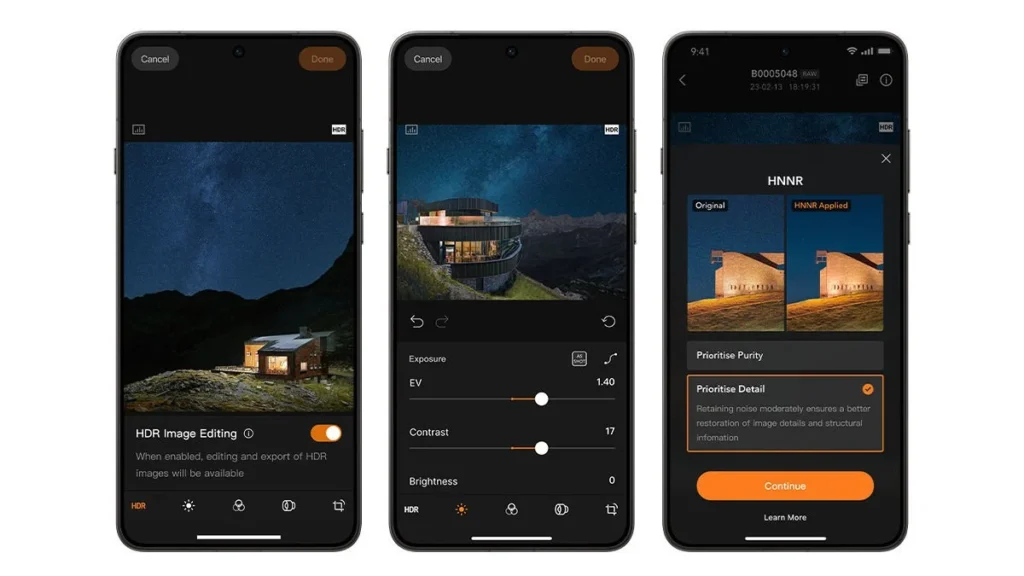
At the core of the app is the Hasselblad Natural Color Solution (HNCS). This algorithm is the backbone of the brand’s reputation, ensuring that colors, tonal gradations, and highlight details are preserved with near-perfect fidelity from the moment of capture through to final export. For Android devices equipped with high-dynamic-range (HDR) displays, the app shines. Images captured with the 100MP sensors of the X2D series reveal shadow details and luminous highlights that closely mimic the depth and nuance of human vision.
AI-Driven Noise Reduction
Perhaps the most impressive technical addition is the integration of an AI-powered RAW noise reduction engine. Processing 100-megapixel medium-format files is a significant computational task. Hasselblad’s new algorithm manages this, typically processing a single 100MP RAW file in roughly 15 to 20 seconds.
The application offers two distinct modes for photographers:
- Purity Mode: This setting is optimized for aggressive noise suppression, ideal for clean, clinical images where smooth gradients are paramount.
- Detail Mode: This setting retains a level of luminance noise, which, in many high-end professional contexts, is preferred as it preserves the "organic" feel of the image and protects fine textural details that might otherwise be smoothed away by more heavy-handed software.
Editing and Export Flexibility
Beyond noise reduction, the app provides a deep editing suite. Users can perform precision adjustments to:
- Exposure and Curves: Fine-tuning the dynamic range and tonal map.
- White Balance: Correcting color temperature to ensure the integrity of the scene.
- Lens Correction: Automatically rectifying distortion and vignetting specific to Hasselblad optics.
- Keystone Correction: Essential for architectural and commercial photography.
The app supports a professional-grade export pipeline, allowing users to move files in JPG, TIFF, HEIF, 3FR, and RAW formats. Furthermore, the ability to apply settings in batches—a feature typically reserved for desktop software like Adobe Lightroom or Capture One—is a massive productivity boost for event and portrait photographers who need to deliver previews rapidly.
Official Responses and Strategic Intent
In an official press release, Hasselblad emphasized that this move is a response to the "evolving needs of the modern creative professional." The company stated that the goal was to ensure that the medium-format experience is not restricted by the physical location of the photographer.
"Our users expect uncompromising quality," the press release noted. "By bringing Phocus Mobile to Android, we are ensuring that the world-class color science and image processing capabilities of our X-System cameras are accessible to anyone, anywhere, regardless of their mobile device preference."
Industry experts view this move as a strategic pivot. By embracing Android, Hasselblad is opening its ecosystem to a vast demographic of creators who use high-end tablets and smartphones for on-set monitoring and quick client deliverables. This integration helps maintain the relevance of the Hasselblad brand in a world where speed is just as important as image quality.
Implications for the Professional Photography Market
The release of Phocus Mobile for Android has several far-reaching implications for the industry.
1. The Death of the "Desktop-Only" Workflow
For many years, the medium-format workflow was synonymous with a stationary desk, a calibrated monitor, and a high-performance computer. The mobile-first approach enabled by this app suggests that the line between "capture" and "edit" is blurring. Photographers can now present edited, color-accurate images to clients before they even pack up their lighting equipment.
2. Standardization of Color Science
By providing the HNCS engine on mobile, Hasselblad is standardizing the color look across devices. This consistency is critical for professional photographers who need to ensure that the colors seen on a tablet on-set match the colors delivered to a client or sent to a printing house.
3. Increased Competitiveness
Hasselblad’s move puts pressure on other camera manufacturers. Sony, Canon, and Nikon have all struggled to produce mobile applications that can handle high-resolution RAW files with the same level of sophistication. Hasselblad has effectively set a new benchmark for what a manufacturer-provided mobile application should look like.
4. Hardware Synergy
The focus on the X2D 100C and 907X systems highlights Hasselblad’s commitment to its current generation of digital backs. By optimizing the app for these specific cameras, the company is adding significant value to their hardware, potentially incentivizing users who were previously "locked out" by their choice of smartphone to invest in the Hasselblad ecosystem.
Conclusion: A New Era for Mobile Medium Format
The wait for Phocus Mobile on Android has been long, but the result appears to be a polished, professional-grade tool that does not compromise on the Hasselblad ethos. By combining AI-powered image processing with a full-featured editing suite and the legendary HNCS color science, Hasselblad has successfully shrunk its desktop workflow into a portable form factor.
As photographers continue to push the boundaries of where and how they work, the ability to process, edit, and deliver 100-megapixel files from a mobile device will become an essential skill. With this release, Hasselblad has ensured that its users remain at the forefront of this digital evolution, regardless of whether they choose to carry an iPhone or an Android device. The barrier to entry for high-end, mobile-first medium-format photography has officially been lowered, and the creative possibilities for the professional community have expanded significantly.