Revolutionizing Data Intelligence: AWS Unveils Amazon S3 Annotations for Large-Scale AI Workflows
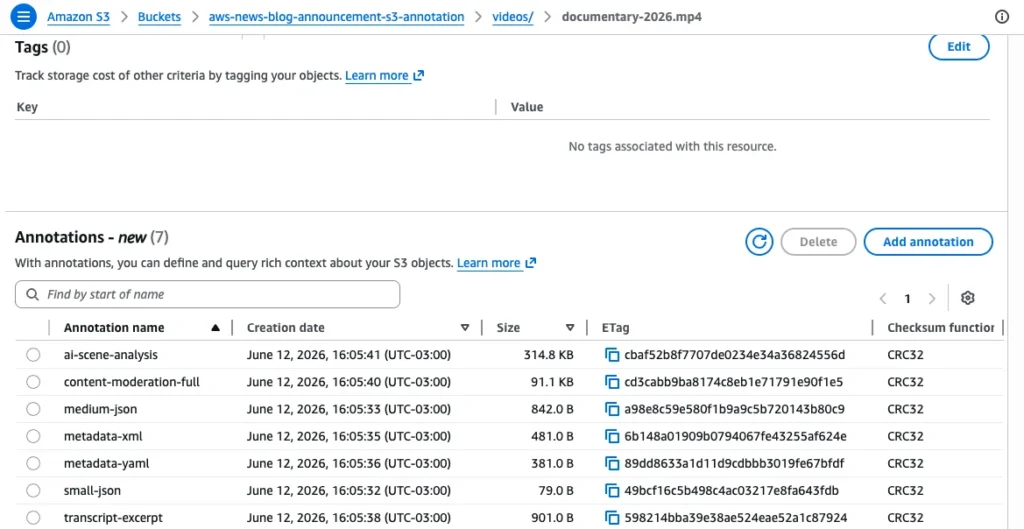
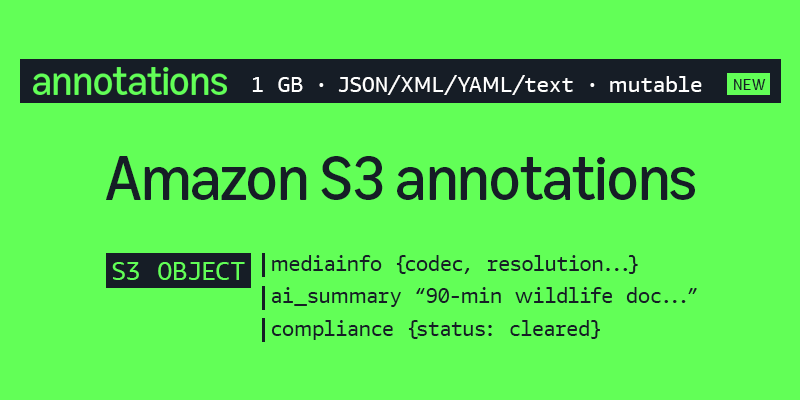
In a move that promises to redefine how organizations manage metadata at petabyte scale, Amazon Web Services (AWS) has announced the launch of "Annotations" for Amazon Simple Storage Service (S3). This new capability allows users to attach rich, large-scale business context directly to S3 objects, effectively bridging the gap between raw data storage and intelligent, agentic workflows. By enabling users to store up to 1 GB of metadata per object—structured in formats like JSON, XML, or YAML—AWS is positioning S3 as the central nervous system for modern artificial intelligence applications.
Main Facts: A New Paradigm for Object Storage
The core innovation of S3 Annotations lies in its unprecedented capacity and flexibility. Historically, S3 metadata has been limited to small, immutable headers or simple, limited-capacity tags. Annotations break these barriers. Users can now attach up to 1,000 distinct named annotations per object, with each annotation supporting up to 1 MB of data.
Unlike traditional object tags, which are restricted in size and intended primarily for lifecycle management or cost allocation, annotations are mutable. This means developers can update, append, or delete metadata without the computationally expensive and time-consuming process of re-writing the underlying object. This evolution is critical for businesses operating in fast-paced environments where data context—such as AI-generated summaries, content safety ratings, or evolving technical specifications—changes frequently.
Furthermore, S3 Annotations are designed with data integrity in mind. Because they are tethered directly to the object, the metadata moves automatically with the data during copy, replication, or cross-region transfer operations. When an object is deleted, its associated annotations are purged automatically, eliminating the risk of "metadata sprawl" and reducing the administrative overhead associated with orphan records.
Chronology: The Evolution of S3 Metadata
To understand the magnitude of this update, one must look at the progression of storage management within AWS.
- Early Era (System-Defined Metadata): Initially, S3 provided only system-defined metadata, capturing immutable facts such as object size, storage class, and creation timestamps. These were essential for basic infrastructure management but offered zero insight into the content of the data.
- The Rise of User-Defined Metadata and Tags: Recognizing the need for customization, AWS introduced user-defined metadata (limited to 2 KB) and object tagging (10 tags per object). While these were sufficient for simple categorization, they failed to meet the demands of modern data lakes where complex, nested structures (like JSON) are required to feed AI models.
- The Modern AI Era: As organizations shifted toward building autonomous AI agents capable of "agentic" workflows—where software makes decisions without human intervention—the need for a persistent, queryable metadata layer became acute.
- The Launch of Annotations: Today’s announcement marks the culmination of this evolution. By integrating annotations with Amazon Athena and Apache Iceberg-compatible tables, AWS has effectively turned S3 into a database-like entity, allowing for deep, SQL-based insights into object-level data without requiring a separate, parallel database system.
Supporting Data: Why Annotations Matter
The current metadata landscape is fraught with inefficiencies. Many enterprises currently resort to "sidecar" files or external databases to store metadata, leading to massive synchronization challenges. When data moves, the sidecar must move with it. If the synchronization fails, the system loses the context of the data.
Comparison of Metadata Capabilities
| Capability | Max Size | Mutable | Best Use Case |
|---|---|---|---|
| System-Defined | Fixed | No | Size, Storage Class, Timestamps |
| User-Defined | 2 KB | No | Small key-value pairs |
| Object Tags | 10 tags | Yes | Lifecycle & Access Control |
| Annotations | 1 GB | Yes | JSON, XML, YAML, Rich Context |
This comparison highlights why annotations are a "force multiplier." With the ability to store 1 GB of data per object, developers are no longer forced to compromise on the granularity of their metadata. Whether it is a frame-by-frame breakdown of a 4K video, a detailed technical specification of a CAD file, or an entire AI-generated summary of a document, the metadata is now as rich as the data itself.
Implications: Empowering the AI Agentic Economy
The implications of S3 Annotations extend far beyond simple storage optimization; they represent a fundamental shift in how AI models interact with data.
Bridging the Gap to AI Agents
AI agents require context to function autonomously. Without metadata, an agent must "read" the entire file to understand what it is—a process that is both slow and expensive. With S3 Annotations, the agent can query the metadata table to identify relevant objects instantly. Using the S3 Tables MCP (Model Context Protocol) server, these agents can interact with data using natural language, asking questions such as, "Find all video assets from 2023 that have a PG-rating and include Spanish subtitles."
Cost-Effective Analytics
Previously, querying metadata meant performing an expensive scan of the data or maintaining a complex, costly external index. By enabling S3 Metadata annotation tables, AWS has offloaded this complexity. Because the annotations are indexed into fully managed Apache Iceberg tables, companies can use Amazon Athena to run complex queries at a fraction of the cost. Because the annotations are available in the metadata layer, there is no need to restore archived objects from S3 Glacier, which significantly lowers retrieval costs and latency.

Streamlined Compliance and Governance
For industries like healthcare, finance, and legal, the ability to attach immutable or auditable context is a regulatory requirement. Annotations allow companies to append compliance tags or provenance information directly to the file. Because these annotations flow into the "journal table," organizations gain a transparent, near-real-time audit trail of every change made to the object’s metadata, ensuring that data lineage is preserved throughout the asset’s lifecycle.
Official Responses and Strategic Vision
Daniel Abib, the primary architect behind this initiative at AWS, emphasizes that this update is a direct response to customer feedback regarding the "data discovery bottleneck."
"Organizations are building AI agents and autonomous workflows that need to find, understand, and act on data without human intervention," Abib stated during the release. "To support these agentic workflows, you need metadata that can evolve alongside the data, scale to petabytes of objects, and remain queryable without expensive retrieval."
The strategic vision here is clear: AWS is moving to eliminate the "silo effect." By making S3 the single source of truth for both the data and its context, AWS is lowering the barrier to entry for enterprises looking to deploy sophisticated AI systems. The integration with Apache Iceberg is particularly noteworthy, as it ensures that users are not locked into a proprietary format. By utilizing an open standard, AWS is encouraging a more interoperable data ecosystem, where metadata can be queried by a wide range of analytical tools, not just those native to the AWS stack.
Getting Started: A Developer-First Approach
For developers, the integration process is straightforward. Using the AWS CLI or SDKs, updating an object with new metadata is as simple as calling the PutObjectAnnotation API.
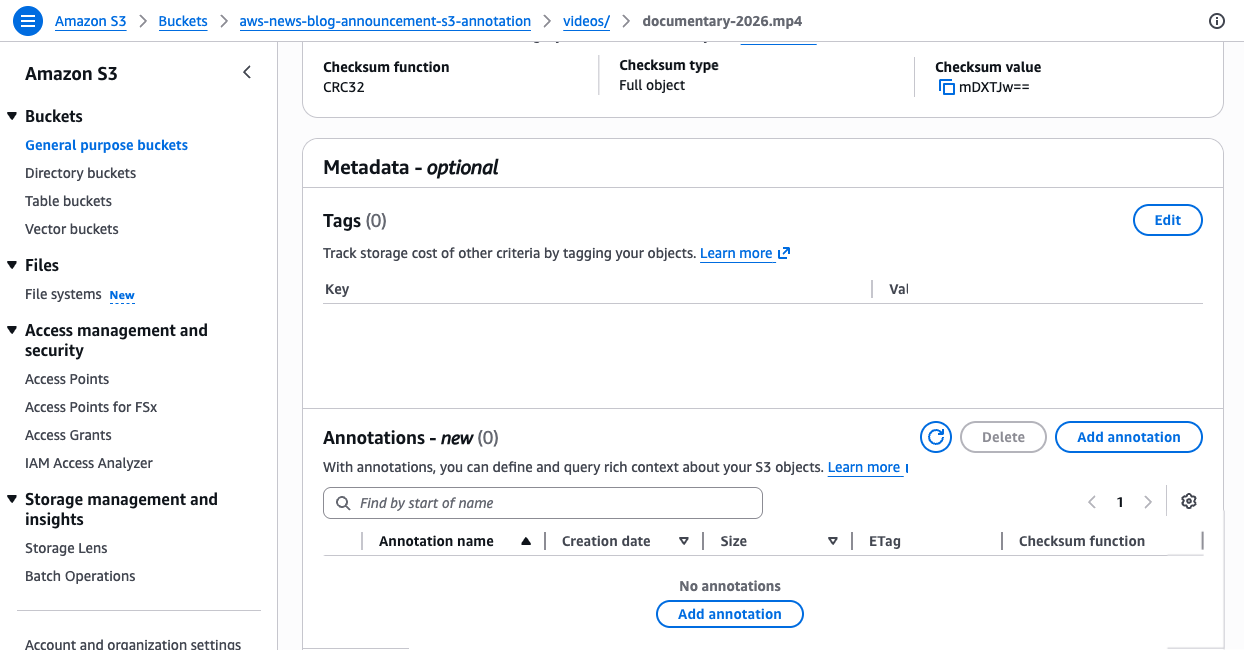
Example: Attaching technical metadata via CLI
aws s3api put-object-annotation
  --bucket my-media-bucket
  --key videos/documentary-2026.mp4
  --annotation-name mediainfo
  --annotation-payload ./mediainfo.json
The flexibility of being able to attach multiple, distinct annotations to a single object—such as a technical spec and an AI-generated text summary—allows different teams within an organization to work in parallel. A media company’s engineering team can manage technical metadata, while the content team manages classification tags, all on the same object, without any risk of one team overwriting the other’s work.
Conclusion
The introduction of Amazon S3 Annotations represents a significant milestone in the history of cloud storage. By transforming S3 from a passive storage bin into an active, intelligent data repository, AWS has provided the foundation upon which the next generation of AI-driven enterprise applications will be built.
For the average enterprise, the benefits are clear: reduced operational complexity, lower costs for metadata management, and a massive acceleration in data discoverability. As AI agents become more prevalent in the corporate environment, the ability to provide these agents with accurate, high-fidelity context at scale will be the differentiator between successful digital transformation and stagnation. With S3 Annotations, AWS has ensured that the "context" of data is now as durable, scalable, and accessible as the data itself.