Architecting Intelligence: A Comprehensive Guide to AI Agent Memory Strategy
In the rapidly evolving landscape of agentic AI, memory is no longer a luxury—it is the foundation of autonomy. Yet, many developers treat memory as a monolithic block, bolting on a vector database and hoping for the best. This "one-size-fits-all" approach is the primary reason many AI agents falter, exhibiting either amnesia regarding user preferences or erratic behavior caused by cluttered, irrelevant context.
To build agents that truly reason and adapt, architects must shift their mindset from "where do I store this?" to "how does this information behave?" By utilizing a structured decision-tree approach, we can categorize data based on its lifecycle, stability, and utility, ensuring that every byte of information serves a specific, optimized purpose.
The Strategic Importance of Memory Layers
The fundamental design question for any AI agent is: How long should different types of information live, and how should they be retrieved?
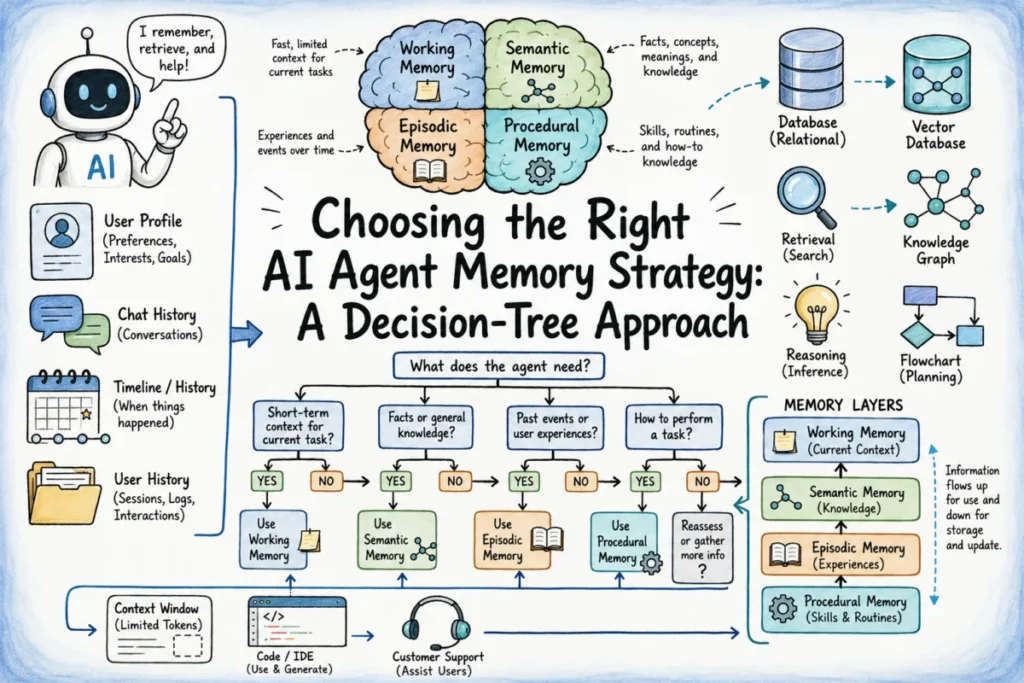
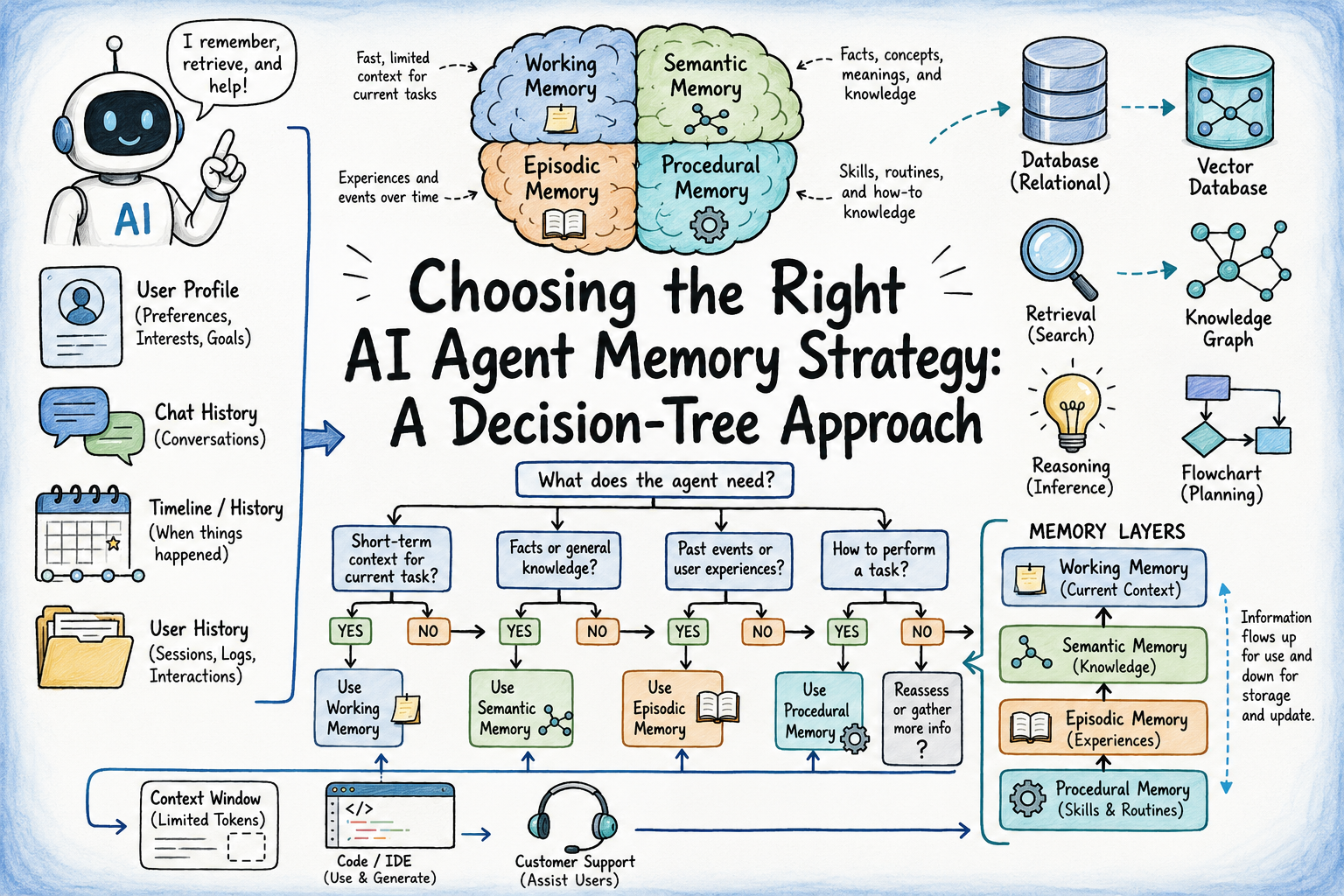
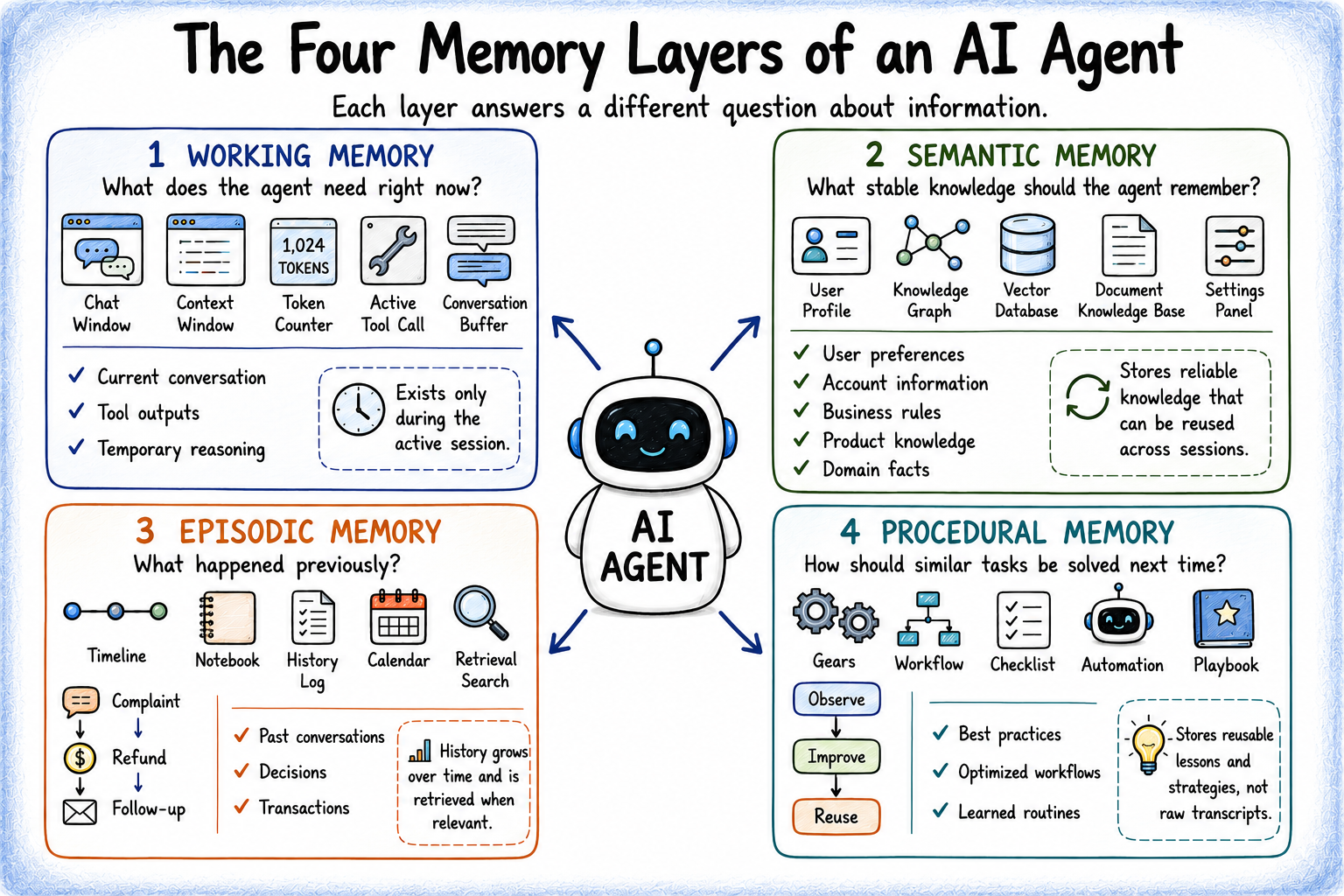
If we view an AI agent through the lens of cognitive science, we see that memory is not a singular entity but a multi-layered system. In production-grade systems, an agent must juggle four distinct types of memory:
- Working Memory: The immediate context of the current conversation or task.
- Semantic Memory: Stable, long-term knowledge, such as user profiles, business rules, or domain-specific facts.
- Episodic Memory: The historical record of past events, interactions, and experiences.
- Procedural Memory: The learned "know-how"—the ability to distill past actions into optimized, reusable routines.
The most common point of failure occurs when these layers are conflated. For instance, storing transient session variables in a vector database introduces latency and noise, while forcing an agent to search its entire episodic history for a simple, static fact—like a user’s subscription tier—leads to expensive, inaccurate, and slow retrieval.
The Decision Tree: A Five-Step Framework
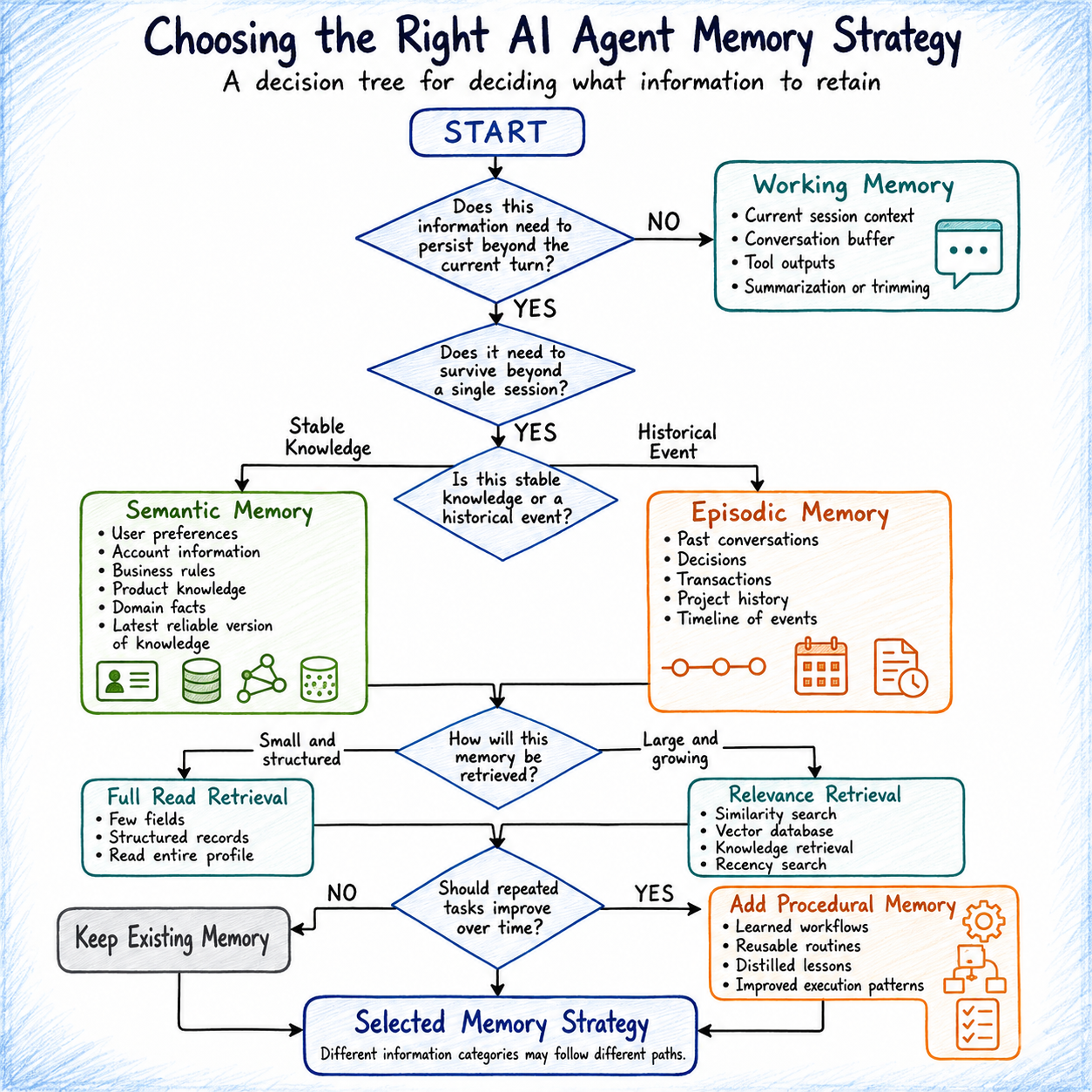
To determine the ideal storage strategy, we must run each category of information through a five-step decision tree. This allows for a modular memory architecture where the "current ticket" in a support bot and the "long-term customer relationship" are handled by systems optimized for their specific needs.
Q1: Does the information need to persist beyond the current turn?
If the answer is no, you do not need a memory layer. Relying on the standard context window of the LLM is sufficient. If the information must carry over to subsequent interactions, proceed to Question 2.
Q2: Does it need to survive beyond a single session?
This is the demarcation line between "Working Memory" and "Durable Memory." Session-scoped state (like a temporary calculation or a user’s momentary mood) belongs in a short-term buffer. If the data must be available tomorrow or next month, move to Question 3.
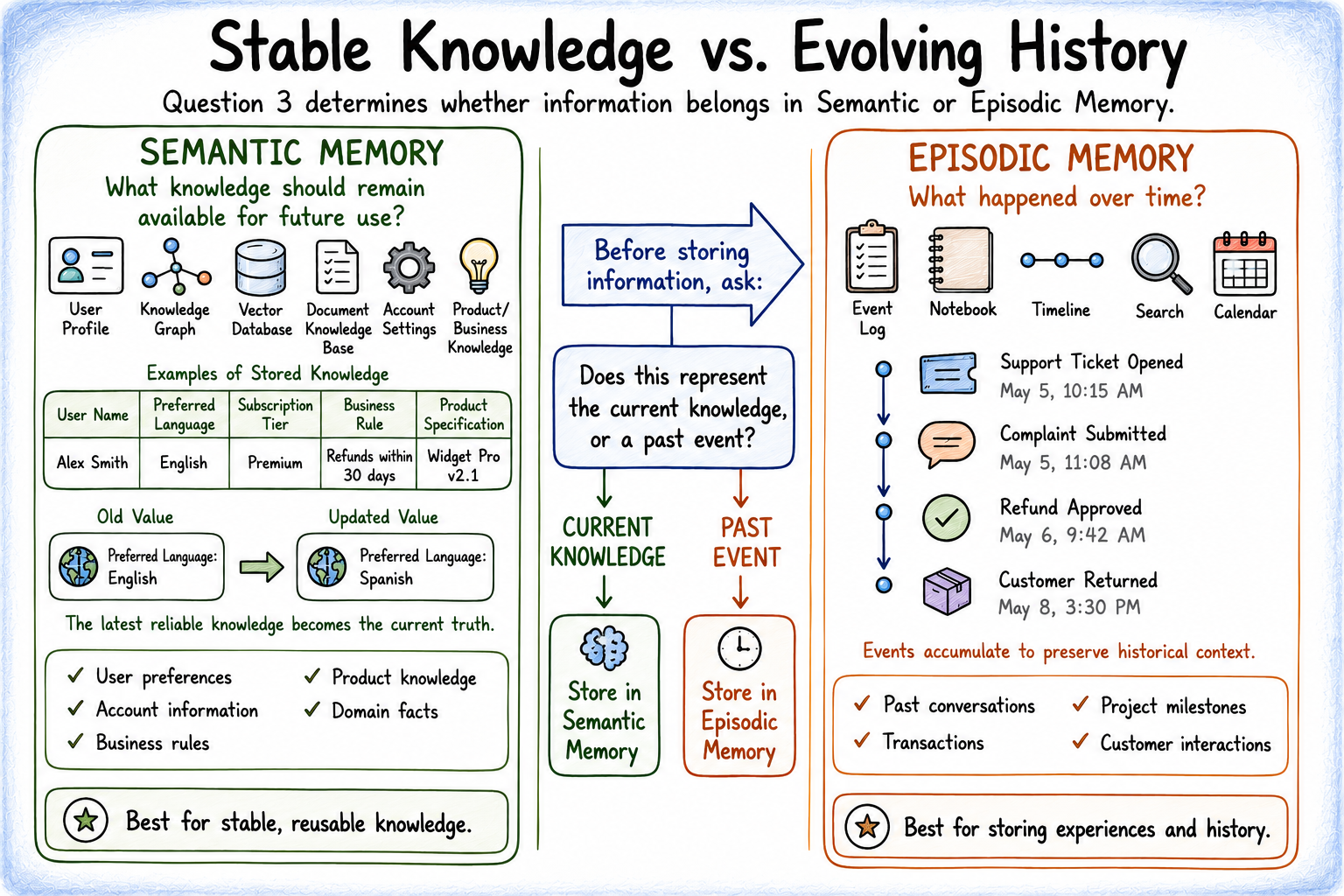
Q3: Is this a stable fact or an evolving event?
This is where many architectures fail. Stable facts (e.g., "The user prefers Python," "The refund policy is 30 days") should be stored as semantic data. Evolving events (e.g., "The user submitted a ticket," "The agent sent an email") belong in an episodic log. Mixing these into a single "dump" creates ambiguity, forcing the agent to disambiguate between historical noise and current reality.
Q4: How will this memory be retrieved?
Retrieval strategy must match the scale of the data. Small, structured profiles can be retrieved via a simple full-read (fetching the whole file). Massive episodic logs require vector-based similarity search or temporal filtering. Matching the retrieval method to the store’s growth rate ensures your agent remains performant as it scales.
Q5: Does the agent need to learn reusable procedures?
This is the pinnacle of agentic behavior. Procedural memory involves the distillation of raw logs into actionable workflows. If the agent repeatedly solves a specific problem, it should move from simply "remembering the steps" to "learning the protocol," effectively creating a template for future execution.
Chronology of Memory Evolution in AI Systems
The development of AI memory has undergone a rapid maturation process over the last 36 months:
- 2023: The Era of Statelessness. Most agents operated entirely on stateless principles, relying on full conversation re-feeds to maintain the illusion of context. This was limited by context window sizes and led to high token costs.
- 2024: The Vector Database Explosion. Developers began leveraging Retrieval-Augmented Generation (RAG) to provide agents with external knowledge. While this solved the "knowledge gap," it often resulted in "retrieval bloat," where agents were flooded with irrelevant information.
- 2025: The Rise of Cognitive Architectures. We saw the emergence of specialized memory stores (graph databases for relationships, logs for events). Developers began treating memory as an orchestration layer rather than a storage layer.
- 2026 and Beyond: The Procedural Turn. We are now entering an era where agents are not just retrieving data; they are synthesizing experiences into reusable procedural code, allowing them to optimize their own workflows without human intervention.
Supporting Data: Memory Performance Metrics
When implementing these strategies, developers should monitor the following key performance indicators (KPIs) to ensure their memory layers are functioning correctly:
| Metric | Goal | Impact of Failure |
|---|---|---|
| Retrieval Latency | < 200ms for semantic queries | User frustration, session timeouts |
| Context Relevance | > 90% of retrieved chunks used | Hallucinations, wasted token spend |
| Fact Staleness | < 5% error rate on updated facts | Conflicting information, loss of trust |
| Procedural Hit Rate | Increase in success rate over time | Stagnant performance, high operational costs |
Implications of Poor Memory Architecture
The implications of ignoring these design principles are not merely technical; they are experiential. An agent that lacks a proper memory hierarchy will inevitably suffer from "Context Drift."
In a customer service context, this manifests as an agent asking a user for their account number three times in one conversation, or worse, providing a refund policy that was updated six months ago because it pulled an old, non-validated document from a bloated vector store.
Furthermore, the economic implications are significant. Processing excessive, irrelevant context is the fastest way to blow through token budgets. By pruning episodic logs and keeping semantic facts clean, businesses can reduce their API spend while simultaneously improving the precision of the agent’s responses.
Official Industry Perspectives: The Shift Toward Determinism
Industry leaders in agentic frameworks, such as the teams behind Zep and Pinecone, have recently begun advocating for "Temporal Knowledge Graphs." The consensus is shifting toward the idea that memory must be versioned and validated.
"An agent’s memory should not be a static dump of everything that ever happened," says an architect at a leading AI infrastructure firm. "It should be a curated, living representation of the world. We are moving away from ‘dumping into a database’ toward ‘managed state transitions.’ If a fact changes, the old version must be invalidated, not just left to clutter the search results."
This shift underscores the transition from "AI as a tool" to "AI as a reliable employee." Just as an employee learns to prioritize, summarize, and verify information, our agents must now do the same.
Conclusion and Future Steps
The decision tree provided here is not a final destination but a design framework. By forcing yourself to classify information into Working, Semantic, Episodic, or Procedural layers, you transition from building a chatbot to building a sophisticated agentic system.
Next Steps for Implementation:
- Audit your current context: Identify which data is session-specific versus long-term.
- Separate your stores: Do not use the same vector database for your user profiles and your conversation logs.
- Implement distillation: Start building a layer that converts raw logs into procedural summaries.
As we move deeper into 2026, the competitive advantage will lie not in which model you use, but in how effectively your agent remembers, learns, and applies its own history to the challenges of the future. The next phase of this journey involves evaluating the emerging memory frameworks designed to automate these tasks—a topic we will tackle in our upcoming deep dive into the 2026 AI Agent Memory Landscape.