A Historic Milestone: President Murmu’s Landmark Tour Strengthens India’s Ties with Eastern Europe
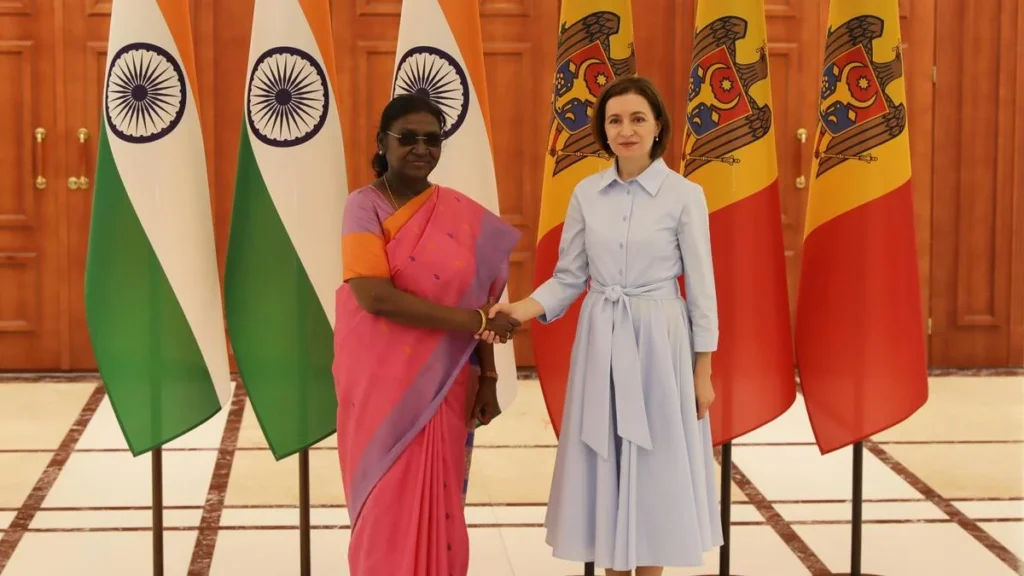
CHISINAU, Moldova – In a move signaling a strategic pivot in India’s diplomatic engagement with Eastern and Southeastern Europe, President Droupadi Murmu arrived in Chisinau on Monday, July 20, 2026. The visit marks a historic milestone as the first-ever trip by an Indian Head of State to the Republic of Moldova, underscoring New Delhi’s intent to deepen partnerships in trade, technology, and cultural exchange.
The arrival of the President at Chisinau International Airport was marked by a warm diplomatic reception led by the Deputy Prime Minister and Minister of Foreign Affairs of Moldova, Mr. Mihai Popsoi. This visit is the inaugural leg of a high-stakes, three-nation European tour that will also encompass North Macedonia and Romania, reflecting a concerted effort by the Indian government to expand its footprint in a region that serves as a vital bridge between the European Union and the post-Soviet space.
The Core Agenda: Strengthening Bilateral Ties
President Murmu’s schedule in Moldova is densely packed with high-level engagements designed to translate long-standing diplomatic relations into tangible economic and political cooperation.
During her stay, the President is slated to conduct delegation-level talks with her Moldovan counterpart, President Maia Sandu. These discussions are expected to cover a wide spectrum of issues, including the facilitation of bilateral trade, collaboration in the IT and agriculture sectors, and potential frameworks for educational partnerships.
Furthermore, the President will meet with the President of the Moldovan Parliament, Igor Grosu, to discuss parliamentary cooperation and the harmonization of legislative efforts to foster mutual growth. A key highlight of the visit will be the interaction with the Moldova-India Parliamentary Friendship Group, a platform aimed at fostering legislative dialogue and cross-cultural understanding.
To address the economic dimension of the partnership, President Murmu is set to address a Business Forum, where she will highlight India’s growing technological prowess and the opportunities for Moldovan enterprises to integrate with India’s burgeoning digital economy.
A Strategic Geographic Nexus: Understanding Moldova
To appreciate the significance of this visit, one must understand the unique position Moldova occupies on the global map. A small, landlocked nation covering approximately 33,846 square kilometers, Moldova is nestled strategically between Romania to the west and Ukraine to the north, east, and south.

While its size is modest, its location at the crossroads of European integration and regional security dynamics makes it a country of significant interest. For India, the relationship is underscored by a unique demographic bridge: the Indian student community. There are currently around 2,000 Indian nationals residing in Moldova, an overwhelming majority of whom—approximately 1,800—are medical students. This presence has turned India into one of the largest sources of foreign students in the country, effectively creating a "people-to-people" foundation that the two governments are now eager to institutionalize through formal agreements.
Chronology of the Three-Nation Tour
The presidential tour is meticulously structured to maximize diplomatic outreach across three distinct, yet interconnected, European states:
- July 20, 2026: Moldova
The focus remains on establishing the inaugural foundation for high-level state visits, setting the stage for future cooperation in the medical education and technology sectors. - July 21–22, 2026: North Macedonia
Following her departure from Chisinau, President Murmu will travel to North Macedonia. This visit is similarly historic, representing the first-ever visit by an Indian President to this landlocked Southeast European nation. The discussions here are expected to focus on regional stability and infrastructure investment. - July 23–25, 2026: Romania
The final and perhaps most complex leg of the tour will see the President in Romania. This visit is highly significant as it marks the first time an Indian President has visited the country in over three decades. Invited by her Romanian counterpart, Nicușor Dan, President Murmu will focus on reviving legacy ties and exploring modern partnerships in defense, energy, and European market access.
Official Delegation and Diplomatic Significance
The weight of this mission is reflected in the composition of the Indian delegation. Accompanying President Murmu are key government figures, including Union Minister of State for Consumer Affairs, Food and Public Distribution, Nimuben Jayantibhai Bambhaniya; Rajya Sabha member Dinesh Sharma; and Lok Sabha member Vijay Baghel.
The inclusion of both administrative and legislative representatives signals that India is looking for a multi-dimensional approach to these relationships—combining executive-level economic agreements with parliamentary diplomacy.
The Rashtrapati Bhavan, in an official statement, emphasized that the tour reflects the "importance India attaches to strengthening its bilateral ties with these countries." By engaging with Moldova, North Macedonia, and Romania, India is effectively signaling that its foreign policy is no longer confined to major power blocs but is actively seeking to diversify its diplomatic portfolio in emerging European markets.
Implications: A New Chapter in India-Europe Relations
The strategic implications of this tour are multi-fold.
1. Economic Diversification
For India, diversifying trade partners is essential to mitigate the risks associated with global economic volatility. Eastern Europe offers a unique value proposition: highly skilled labor forces, a growing interest in Indian technology and pharmaceutical exports, and a gateway to the broader European Single Market.

2. Educational and Cultural Soft Power
The presence of 1,800 Indian medical students in Moldova is a powerful tool of soft power. By fostering an environment where these students can flourish and bridge the cultural gap, India is planting the seeds for long-term diplomatic dividends. The visit serves to reassure these students and their families while elevating the status of Indian academic credentials in the region.
3. Geopolitical Alignment
In an era of shifting global alliances, India’s outreach to Eastern and Southeastern Europe is a masterstroke of balanced diplomacy. By engaging with nations that are increasingly looking toward European integration, India secures its position as a reliable, non-aligned partner that offers economic cooperation without the heavy-handed geopolitical strings often associated with larger regional powers.
Future Outlook: Beyond the Visit
As President Murmu continues her tour, the success of these visits will be measured by the follow-up actions taken by the respective ministries. Observers anticipate that the Business Forum in Chisinau will lead to a Memorandum of Understanding (MoU) regarding trade facilitation. Similarly, the visit to Romania is expected to be a watershed moment for Indo-Romanian relations, potentially resulting in a renewed strategic roadmap for the coming decade.
The visit has already achieved its primary goal: elevating India’s visibility in a region where it has historically had limited direct interaction. By moving beyond conventional diplomatic channels and engaging in direct, high-level dialogues, the President has opened a new chapter of engagement that promises to benefit both the Indian economy and its diaspora, while strengthening the bonds of friendship with nations that are eager to partner with the world’s fastest-growing major economy.
As the President proceeds to North Macedonia and eventually concludes her tour in Bucharest, the international community will be watching closely to see how these nascent partnerships evolve. One thing is certain: India’s "Look West" policy in Europe has officially arrived in the heart of the continent, and the ripple effects of this historic week are likely to be felt for years to come.