AT&T Announces Imminent Internet Price Hikes: What Customers Need to Know
In an era defined by the digital economy, high-speed internet has transitioned from a luxury to a fundamental utility. Consequently, any adjustment to service pricing sends ripples through millions of households. AT&T, one of the nation’s largest telecommunications providers, has recently confirmed that a new round of price adjustments is on the horizon. Starting August 16, a significant segment of the company’s internet subscriber base will see their monthly bills climb by $5. As the cost of living continues to be a primary concern for consumers, this development has drawn significant scrutiny regarding the balance between corporate profitability and service affordability.
Main Facts: Who Is Affected and When?
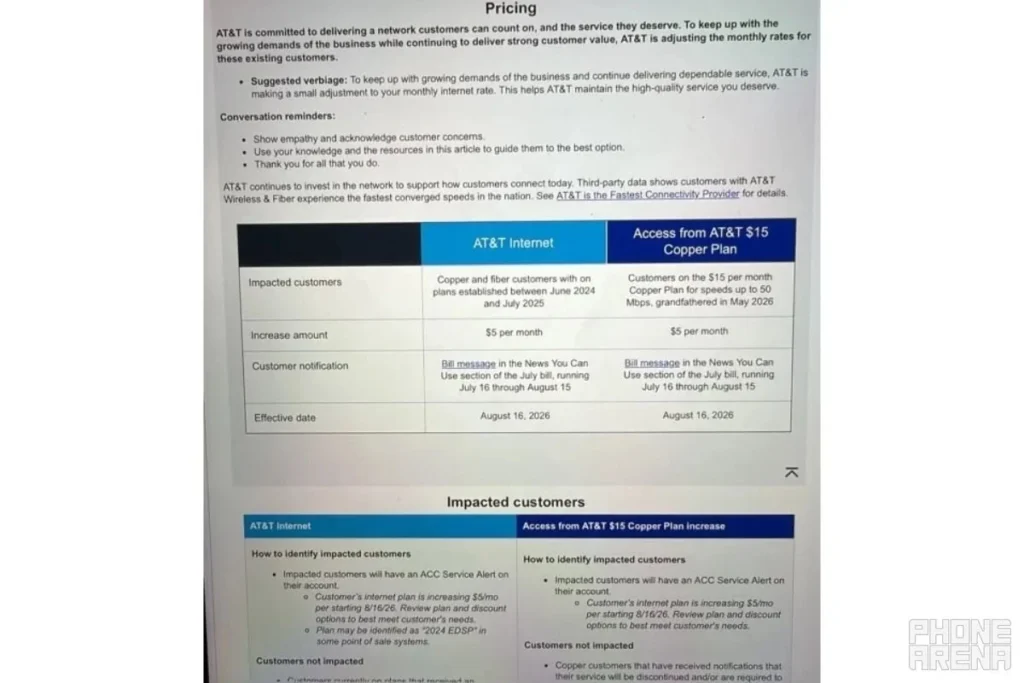
The upcoming price hike is not a universal increase across all of AT&T’s service tiers, but rather a targeted adjustment affecting specific segments of their customer base. According to leaked internal documentation, the $5 monthly increase will impact two primary groups:
- Newer Fiber and Copper Accounts: Customers who established their home internet plans (both fiber and copper-based) between June 2024 and July 2025 are scheduled to see the increase reflected in their billing cycles beginning August 16.
- Legacy Copper Plan Subscribers: The hike also extends to the specific $15 per month "Copper Plan," which provides speeds of up to 50Mbps. This tier, which was grandfathered into the system as of May, will also see the $5 increase, effectively raising the price by 33%.
The notification process has already commenced, with AT&T utilizing the "News You Can Use" section within its mobile application and online customer portals to alert the affected parties. Customers are encouraged to log into their respective accounts to verify if their specific plan has been flagged for this adjustment.
A Chronology of AT&T’s Recent Pricing Strategy
To understand the current trajectory of AT&T’s pricing, one must look at the company’s broader strategic shifts over the past few years. Following the spin-off of its media assets, AT&T has been hyper-focused on its core telecommunications business, specifically the aggressive expansion of its fiber-optic footprint.
- Mid-2024: AT&T continued its "Fiber First" strategy, attempting to migrate as many legacy copper DSL customers as possible to high-speed fiber infrastructure. During this period, the company introduced competitive promotional rates to entice users to switch, effectively setting the stage for the cohort currently being impacted by the August 2026 hike.
- May 2026: The company moved to solidify its legacy copper user base, grandfathering the low-cost 50Mbps plan. While this provided stability for a specific segment of users, it simultaneously created a controlled environment where price adjustments could be implemented with minimal churn.
- July 2026: Internal documentation surfaced, detailing the impending price hikes. This leak provided the first public insight into the August 16 implementation date.
- August 16, 2026 (Forthcoming): The official effective date for the $5 monthly increase across the identified plans.
Supporting Data and the "Converged Speed" Narrative
AT&T’s justification for these increases rests on a specific marketing claim: that its Wireless and Fiber customers experience the "fastest converged speeds in the nation." In the eyes of the company, this technical achievement warrants a premium price tag.
But what does "converged speed" actually mean to the average consumer? In technical terms, it refers to the integration of fiber-optic backbones with 5G wireless delivery systems. AT&T argues that by investing heavily in both infrastructures, they provide a seamless handoff between home Wi-Fi and mobile data. According to data cited by the company, this synergy provides a superior user experience, particularly for households with multiple high-bandwidth users—such as those engaging in 4K streaming, online gaming, or professional-grade video conferencing simultaneously.
However, industry analysts suggest that while these speeds are technically impressive, the average consumer may not perceive the difference in their day-to-day internet usage. The challenge for AT&T is to convince the subscriber that a $5 increase is a fair trade for "converged speed" in a marketplace where competitors like T-Mobile and Verizon are offering aggressive, flat-rate 5G home internet solutions that often undercut traditional fiber pricing.
Official Responses: The Language of Corporate Adjustment
When questioned about the logic behind the increase, AT&T has maintained a script that focuses on quality and infrastructure sustainability. Leaked training materials for customer service representatives provide a glimpse into the company’s defensive strategy. Employees have been explicitly instructed to frame the hike as a "small adjustment to your monthly internet rate" aimed at "maintaining the high-quality service you deserve."
This phrasing is a calculated attempt to soften the blow of a price hike by emphasizing value. By using words like "adjustment" rather than "increase" and linking it to "high-quality service," the company is attempting to shift the narrative from profit-seeking to service maintenance.
AT&T representatives are encouraged to point toward the rising costs of maintaining and upgrading aging infrastructure, particularly in areas where fiber and copper networks coexist. The company argues that as data consumption continues to grow at exponential rates, the capital expenditure required to keep networks robust necessitates periodic revenue growth from the user base.
The Broader Implications: What Does This Mean for the Market?
The ripple effects of this price hike extend far beyond the immediate $5 increase on a monthly bill. There are several key implications for both the consumer and the broader telecommunications industry.
1. The Death of the "Copper" Era
This hike is a clear signal that AT&T is aggressively pushing its final remaining copper-based customers toward fiber. By increasing the price of the $15 legacy plan, the company is likely hoping to make the cost-benefit analysis of staying on copper less attractive. For many, this will be the final push to upgrade to higher-tier fiber plans, which, while more expensive, provide the company with better margins and lower maintenance costs than legacy DSL.
2. Market Sensitivity and Competitive Churn
The telecommunications market is currently experiencing high levels of competition. With fixed wireless access (FWA) providers like T-Mobile Home Internet and Verizon 5G Home Internet offering competitive rates (often around $50 per month without the threat of frequent hikes), AT&T faces the risk of increased churn. If a customer is paying an additional $60 annually, they may be prompted to compare their current speeds against local 5G competitors. This price hike will test the loyalty of AT&T’s subscriber base.
3. Regulatory and Public Perception
Public utility commissions and consumer advocacy groups have historically kept a close eye on price hikes in the telecommunications sector. While high-speed internet is not regulated as strictly as legacy telephone service, the frequency of these "small adjustments" can invite legislative scrutiny. If consumers feel that these increases are occurring too frequently without a tangible improvement in service, the public pressure on the FCC to enforce stricter transparency or price controls could intensify.
4. The Inflationary Context
Finally, it is worth noting that telecommunications companies are not immune to the broader economic climate. Inflation has driven up the cost of labor, hardware, and energy, all of which are essential to running a national internet network. While consumers are understandably frustrated by rising bills, the industry maintains that these costs are simply being passed through to sustain service levels. The question remains: at what point does the cumulative cost of these "small adjustments" reach a breaking point where the consumer chooses to opt-out of high-speed connectivity altogether?
Final Thoughts for the Consumer
For the millions of AT&T customers affected by this change, the next few weeks are a critical window for financial planning. Because the notification has already been sent via the "News You Can Use" portal, the company considers the communication phase complete.
If you are a subscriber, it is advisable to take the following steps:
- Audit Your Bill: Log into your AT&T account immediately to check for notifications regarding the rate increase.
- Evaluate Your Plan: If you are on the legacy copper plan, check if fiber is available in your area. While it may be more expensive, the stability and speed increase may offer better long-term value.
- Compare the Market: Use tools like the FCC’s Broadband Map to see if there are alternative providers in your area offering introductory pricing or locked-in rates.
In conclusion, while a $5 increase may seem negligible on a monthly basis, it is a significant reflection of the current state of the telecommunications industry. As AT&T leans heavily into fiber infrastructure and seeks to optimize its margins, customers should prepare for a landscape where price adjustments are a regular, rather than exceptional, occurrence. The "high-quality service" you deserve, it seems, now comes with an increasingly flexible price tag.