Google Business Profile: The End of "Set It and Forget It" Era and the Rise of Dynamic Local Engagement
London, UK – [Insert Date] – In an increasingly competitive digital landscape, businesses treating their Google Business Profile (GBP) as a static online listing are rapidly losing ground to competitors who embrace it as a dynamic, live engagement channel. What was once a simple directory entry has evolved into a sophisticated platform, demanding continuous attention and real-time interaction to secure local visibility and customer trust. The days of "set it and forget it" are definitively over, replaced by an imperative for active management that directly impacts rankings, customer acquisition, and, critically, AI-driven discovery.
For years, local businesses – from bustling retailers to niche law firms, dental practices, restaurants, gyms, plumbers, and salons – could establish a rudimentary online presence by simply filling out their Google Business Profile, adding an address, selecting categories, and perhaps gathering a handful of reviews. This approach, while once sufficient, now represents a significant missed opportunity, causing businesses to bleed valuable map pack rankings and remain invisible to a growing segment of their potential customer base.
The Evolution of Google Business Profile: A Chronology of Change
To understand the current imperative, it’s essential to trace the journey of GBP from its origins to its present form as a multifaceted engagement hub.
The Directory Era: Simplicity and Static Presence
Cast your mind back to the early days of local search, often referred to as the "directory era." Google Business Profile (then Google Places, or Google My Business) functioned primarily as a digital phonebook. Businesses would meticulously fill out their Name, Address, and Phone number (NAP), choose a primary category, upload a logo, and perhaps a few static images. The algorithmic focus was largely on NAP consistency across various online directories – the more citations matching precisely, the better. Google’s primary objective was to confirm the physical existence of a business at a given address, serving as a fixed reference point in the physical world. A static profile was not just acceptable; it was the norm, and often, all that was required to rank.
The Catalyst for Transformation: User Behavior and Mobile Dominance
The shift began subtly but accelerated dramatically with the proliferation of smartphones and the changing nature of user intent. People stopped "browsing" for businesses and started "searching" with immediate, often hyper-local, intent. Queries like "coffee shop near me open now," "plumber emergency," or "dentist accepting new patients today" became commonplace. These were not research questions but urgent decisions waiting to happen.
Google, ever responsive to user behavior, recognized that a static directory could no longer meet these immediate needs. Users required real-time information: current operating hours, immediate product availability, reservation options, and quick answers to specific questions. This fundamental change in user interaction implicitly became Google’s "official response" – a strategic pivot to transform GBP from a mere listing into an active engagement surface. The goal was clear: to keep users within the Google ecosystem by providing comprehensive, up-to-the-minute information and facilitating direct interaction.
GBP Today: A Live Engagement Surface
Today, GBP has evolved into a dynamic interface where businesses can not only display foundational information but also interact directly with customers, showcase real-time updates, and facilitate transactions. It’s a critical component of Google Maps, local search results, and increasingly, AI-driven discovery. The platform expects ongoing input, and it actively rewards businesses that provide it, viewing this continuous engagement as a strong signal of relevance, credibility, and vitality.
The New Local Search Landscape: Supporting Data and Evolving Ranking Factors
While the foundational elements of local SEO remain, they are no longer sufficient to secure top rankings. They have become the "table stakes" – the minimum entry requirement in a highly competitive arena.
Foundational Elements: Still Essential, But Not Differentiators
According to the 2026 Local Search Ranking Factors report by Whitespark, critical elements like the primary GBP category still hold immense weight as the number one factor for local pack visibility. Proximity to the searcher and keywords in the business title also remain hugely important. These fundamentals are the bedrock upon which local visibility is built. However, in an environment where every serious competitor has these elements meticulously dialed in, they cease to be differentiators. Simply having a perfectly optimized NAP and categories will no longer guarantee superior performance.
The Ascendance of Engagement and Behavioral Signals
The same Whitespark report unequivocally highlights a significant shift: behavioral and engagement signals are rapidly climbing in importance. This includes metrics such as posts, photos, clicks to website, calls made, direction requests, and the cadence and quality of reviews. Google is actively rewarding businesses that demonstrate a vibrant, "look alive" presence. These signals tell Google that a business is not just existing but thriving and actively serving its customer base.
The Criticality of Business Hours: A Direct Ranking Signal
Perhaps one of the most striking findings in recent research concerns the immediate impact of business hours on local rankings. Being open when users search is now the No. 5 local pack ranking factor. This was initially observed by Joy Hawkins of Sterling Sky and subsequently corroborated by a BrightLocal study of 50 businesses across 10 categories. The study found a clear trend: rankings tended to drop when a business was listed as closed. This underscores a vital point: your operating hours are not merely informational; they are a powerful ranking signal.
Businesses must therefore treat their hours not as a static field, but as a living component of their profile. Quarterly audits are essential, as is the proactive setting of special hours for holidays before the holiday arrives, not after. Furthermore, businesses should critically assess whether their current operating hours might be costing them visibility during high-intent search windows, especially if competitors are open and actively engaging during those times. A static profile, even with perfect NAP and a stellar 4.8-star rating, is akin to a well-dressed candidate refusing to speak during a job interview – it looks the part, but fails to convince.
Implications and Actionable Strategies for Dynamic GBP Management
The message is clear: businesses must pivot from passive profile ownership to active, strategic management. This section details the specific actions required to harness the full power of GBP.
1. Mastering Review Velocity, Not Just Volume
Reviews have always been crucial, but the latest data emphasizes a critical nuance: review velocity and recency matter significantly more than just the total volume of reviews. Fresh reviews not only influence rankings but also play a decisive role in swaying potential customers when faced with multiple businesses boasting similar star ratings. Research further confirms that review signals are gaining substantial influence across local rankings; proximity might get a business noticed, but compelling, recent review content often secures the top spot and the conversion.

- Do This: Integrate review requests seamlessly into your operational workflow. Send personalized requests within 24 hours of a completed service or transaction, capitalizing on the recency of the positive experience. Commit to responding to every review, positive or negative, within 48 hours. Owner responses are not merely a customer service courtesy; they are a direct engagement signal that Google values and factors into its assessment of your business’s responsiveness and customer care.
- Not That: Avoid batching review requests monthly or relying on generic, impersonal follow-up emails. Steer clear of copy-pasted responses like "Thanks for your feedback!" for positive reviews. Both Google’s algorithms and discerning potential customers can easily detect a lack of genuine engagement. Consider the stark difference: a law firm earning 12 reviews over three years sends a vastly different signal to the algorithm than one earning 12 reviews over three months, even if their average star ratings are identical.
2. Leveraging GBP Posts: The Underused Freshness Signal
Google Posts remain one of the most underutilized features of Google Business Profile. Many businesses either neglect them entirely or publish a single post at the beginning of the year and then forget about the functionality. This represents a substantial missed opportunity. Posts – whether they announce offers, provide updates, detail events, or share business news – serve as a direct "freshness signal," unequivocally communicating to Google that your profile is actively managed and relevant.
- Do This: Aim to publish at least one post per week. Tie your posts to real-world happenings: a seasonal promotion, a recently completed project, a significant staff milestone, or a local community event your business is involved in. When promoting time-sensitive offers, always use the "Offer" post type; its built-in expiry date generates urgency for customers and reinforces recency for Google.
- Not That: Refrain from recycling generic "Welcome to our business!" posts every few months. Instead of posting only when you remember, integrate GBP posting into a recurring content calendar, treating it with the same priority as other marketing channels. Utilize all the post types Google provides; "Events" and "Offers" often receive more prominent display real estate within the profile than standard "Updates."
3. Optimizing Photos and Videos: Recency and Authenticity are Key
Visual content is a powerful engagement driver, but its effectiveness on GBP hinges on more than just quality; recency is paramount. According to Birdeye’s State of Google Business Profile 2025 report, verified profiles featuring photos consistently generate more website visits, direction requests, and calls. Crucially, listings with recent photos and videos demonstrate measurably higher engagement than those relying on stale or infrequently updated imagery. A profile showcasing 80 photos, all uploaded three years ago, does not convey the same freshness signal as one with a steady stream of new uploads over recent months.
- Do This: Implement a recurring reminder to upload new photos at least twice a month. Showcase authentic, real-world aspects of your business: recent work completed, your current team, updated interior or exterior spaces, or seasonal inventory. For service businesses, job-site photos, before-and-after comparisons, and testimonials in video format are invaluable; they are inherently authentic, specific, and far more compelling than generic stock imagery.
- Not That: Avoid the common pitfall of uploading a large batch of 50 photos once a year and considering it done. Steer clear of obviously staged or stock photos as your primary imagery; research on competitor GBP analysis indicates that both photo quality and authenticity are increasingly factored into how profiles are perceived by users and algorithms alike. Furthermore, do not ignore customer-uploaded photos; engage with them, respond to positive ones, or flag inappropriate content rather than leaving them unmonitored.
4. Enhancing Booking and Messaging Features: Closing the Loop within Google
Google’s overarching strategy increasingly aims to keep searchers within its own ecosystem, facilitating direct interactions and transactions without redirecting users to external websites. For local businesses, this means enabling and actively managing every feature relevant to their business type: "Book Online" links, appointment URLs, and the Q&A section. These are not mere convenience features; they are potent engagement signals. When a user books an appointment or sends a message directly through your GBP, that interaction provides Google with concrete evidence that your profile is functional, relevant, and driving tangible real-world action.
- Do This: If your business offers appointments or reservations, connect a direct booking link. Google supports integrations with numerous platforms such as Booksy, Vagaro, OpenTable, and others. Proactively "seed" your Q&A section with the three to five most frequently asked questions from your customers, and provide comprehensive answers yourself before strangers or less informed users attempt to answer them. Regularly monitor the Q&A section for new queries and respond promptly and accurately.
- Not That: Do not leave your Q&A section empty or unmonitored. Unanswered questions, or worse, inaccurate answers provided by random users, can severely erode trust and represent a significant missed engagement opportunity. Avoid broken booking links or outdated appointment information.
5. For Retailers: Real-Time Inventory as a Game-Changer
If your business sells physical products, all the above strategies apply, but you possess an additional, powerful lever that service businesses do not: real-time inventory display. Google has specifically integrated Merchant Center with GBP to enable the surfacing of what’s currently on your shelves directly in search results and Google Maps. This allows customers to see if an item is in stock before they even visit your store, dramatically improving the user experience and increasing foot traffic intent.
- Do This: Prioritize your top 50 highest-intent, most-searched products first. Ensure these are live, accurate, and consistently updated before attempting to sync your entire catalog. Implement product schema markup on your website’s product pages to ensure consistency between your inventory feed and your site, providing a unified signal to Google. Explore automated feed solutions to ensure real-time accuracy.
- Not That: Do not upload a manual inventory feed once a week and assume it’s "close enough" to real-time. Inventory changes rapidly, and outdated information can lead to customer frustration. Do not skip the Merchant Center diagnostics step; a feed with errors will silently underperform, and you won’t understand why until you investigate. Critically, do not assume inventory feeds only matter for paid ads; enabling free local listings through Merchant Center unlocks organic product visibility directly within search, Maps, and your GBP profile at no additional cost.
The AI Layer: Why Dynamic GBP Matters More Than Ever
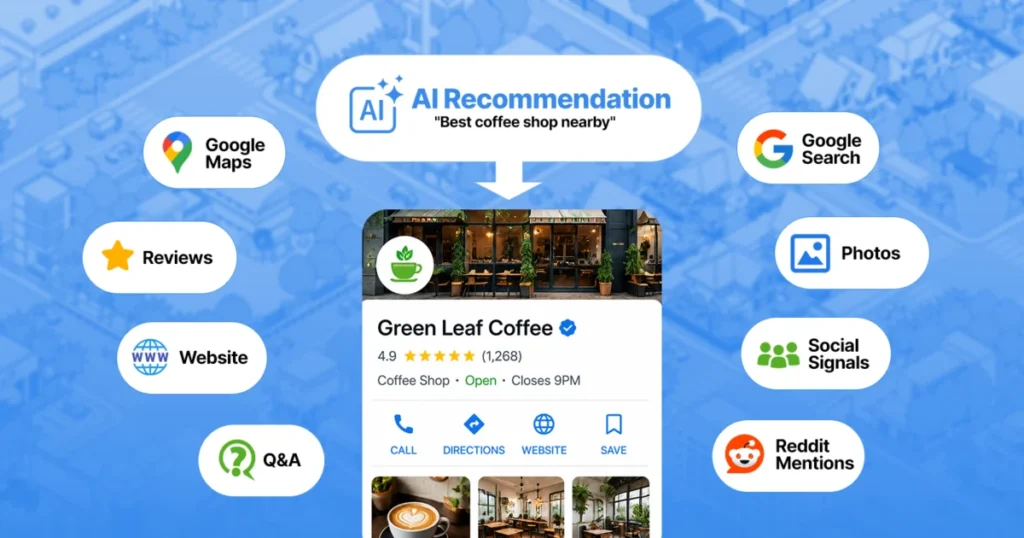
The advent of Artificial Intelligence (AI) in search introduces an entirely new and urgent dimension to active GBP management. The signals discussed throughout this article are now feeding directly into AI-driven local results, transcending the traditional local map pack.
Google’s "AI Mode" and other generative AI features pull heavily from the same rich signals that power traditional local rankings: review recency and sentiment, photo freshness, post activity, accurate operating hours, and the completeness of service descriptions. The Whitespark 2026 report, for the first time, introduced an entirely new AI Search Visibility category, highlighting that three of the top five AI visibility factors are citation and entity-based signals – precisely what a well-managed GBP provides.
Businesses that maintain a current, comprehensive, and consistent GBP are the ones being confidently surfaced in AI-generated answers and recommendations. Conversely, businesses with stale, neglected profiles are not merely losing traditional map pack spots; they are effectively becoming invisible to AI-driven discovery entirely. Every update made to your GBP should be viewed not just as a ranking tactic for the traditional local pack, but as a critical data signal for the AI systems that are rapidly becoming the primary gateway to local search. Accurate hours, fresh photos, recent reviews, and complete service descriptions are no longer merely best practices; they are the essential inputs AI needs to confidently recommend your business to high-intent users.
What to Measure: Beyond Vanity Metrics
Once you commit to actively managing your Google Business Profile, it’s crucial to track the metrics that genuinely indicate impact and progress. Focus on actionable insights rather than superficial numbers.
- Profile Interactions: Monitor calls, direction requests, website clicks, and (where applicable) direct booking clicks. These metrics directly tell you which features are driving real-world customer action.
- Review Velocity: Beyond just your total review count, track how many new reviews you are earning per month and, equally important, your average response time to those reviews.
- Post Engagement: Analyze views and clicks on your GBP posts. This data provides invaluable feedback on which content types resonate most with your local audience.
- For Retailers: Add product impressions (how often your products appear in search) and store visit conversions (metrics indicating actual foot traffic driven by online visibility) to your tracking list.
These insights, available through your GBP dashboard, empower you to refine your strategy, double down on what works, and address areas needing improvement.
The Compounding Effect: Building Durable Local Visibility
The true power of dynamic GBP management lies in its compounding effect over time. Consistent posting builds sustained freshness and algorithmic authority. A steady stream of new reviews cultivates robust trust signals. Regular updates to photos drive higher user engagement. This increased engagement, in turn, directly improves local rankings. Better rankings lead to more profile views, which generate more reviews and more interactions, further reinforcing and improving rankings. Now, all these same powerful signals are simultaneously feeding sophisticated AI systems that are fundamentally reshaping how local businesses are discovered and recommended.
Local visibility in the modern era is increasingly built on a foundation of continuous engagement, unwavering credibility, and authentic connection with the community, rather than just keyword optimization or static data points. Static profiles erode authority and relevance over time, gradually fading into obscurity. Dynamic profiles, conversely, compound their authority, visibility, and competitive advantage with every active interaction.
The businesses that continue to treat their Google Business Profile as a mere compliance checkbox are the ones destined to watch competitors steal the map pack spots they once dominated. Conversely, those businesses that show up consistently – posting fresh content, actively earning and responding to reviews, regularly updating photos, maintaining precise information, and (for retailers) feeding Google live inventory data – are building a durable, resilient local visibility that is genuinely difficult to disrupt, whether the search originates from the traditional map pack or an AI-generated answer.
That is the evolving gap in local SEO. The only remaining question is which side of it your business chooses to be on.