PayPal Honey’s Fall From Grace: A Watershed Moment for Affiliate Marketing Ethics and Program Management

The affiliate marketing industry is undergoing a seismic reckoning. In a rare and decisive sequence of events that sent shockwaves through the digital partnership economy, PayPal Honey—the ubiquitous browser extension acquired by fintech giant PayPal for $4 billion six years ago—was systematically stripped from major U.S. affiliate networks.
The coordinated crackdown follows mounting scrutiny over attribution manipulation and the willful subversion of network compliance rules. For industry veterans, affiliate managers, and enterprise merchants alike, the fall of one of the sector’s largest publishers serves as a powerful case study in the perils of poor compliance, the failure of network-level policing, and the urgent necessity of robust program management.
Main Facts: The Downfall of a Giant
The core controversy centers on the mechanics of digital attribution and browser-based software publishers (DSPs). Most modern affiliate marketing programs operate on a "last-touch-wins" attribution model. Under this system, the final affiliate link or cookie clicked by a consumer before completing a transaction receives 100% of the commission for that sale.
To prevent browser extensions from unfairly hijacking commissions from content creators, loyalty sites, or review platforms that drove the initial customer discovery, networks enforce strict "stand-down" rules. These protocols dictate that browser extensions and coupon tools must step aside and refrain from firing an affiliate cookie if another publisher already exists earlier in the customer’s clickstream.
PayPal Honey was penalized—and subsequently removed or suspended—for intentionally violating these stand-down protocols and concealing its activities. By failing to step down when a prior affiliate was present, Honey effectively overwrote existing cookies, claiming unearned credit for conversions through what industry watchdogs and network executives have explicitly termed "attribution manipulation."
The crackdown highlights systemic vulnerabilities in how large-scale publishers interact with affiliate frameworks, proving that immense market capitalization and household-name status are no longer shields against strict platform governance.
Chronology of the Crackdown
The dismantling of PayPal Honey’s network privileges unfolded swiftly over a matter of days in mid-January, perfectly coinciding with Affiliate Summit West, the largest annual gathering of affiliate professionals in the United States.
- The Lead-Up: Independent investigations—most notably a widely shared technical breakdown by researcher MegaLag and a meticulous probe by digital commerce expert Ben Edelman—exposed systematic flaws and covert tracking behaviors associated with Honey’s extension.
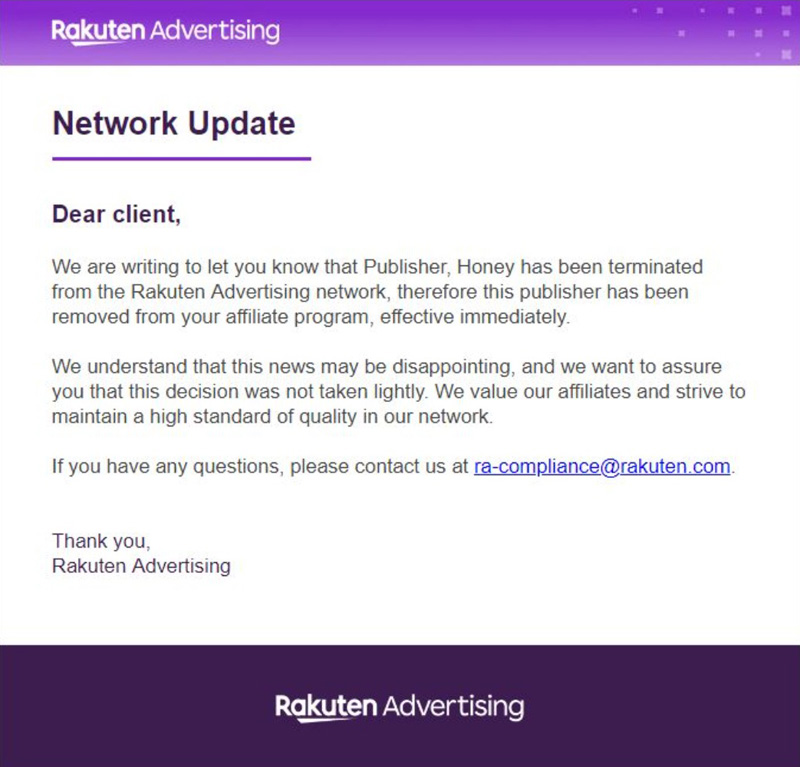
- Monday, January 12: Rakuten Advertising dropped the first major blow. Announcing that Honey had been "terminated from the network," Rakuten stated that the decisive action was necessary "to maintain a high standard of quality" across its ecosystem. The timing sent immediate ripples through Affiliate Summit West, dominating hallway conversations and social media channels.
- Friday, January 16: Impact.com followed suit, revealing that Honey was "out of compliance" with its platform policies. Impact.com removed Honey from its Discovery Marketplace, though industry filings noted this initial action took the form of a temporary suspension rather than a permanent ban.
- The Aftermath: With two of the nation’s premier affiliate networks taking simultaneous punitive actions against a single dominant publisher, brands were forced to re-evaluate their risk exposure and audit their active publisher partnerships in real time.
Supporting Data and Industry Audits
The issues plaguing PayPal Honey are not isolated anomalies; they reflect broader, structural tensions regarding software-driven attribution. A deeper look at recent industry data underscores the complexity of regulating downloadable software publishers (DSPs):

- The PMA Guidelines: The Performance Marketing Association (PMA) maintains a critical resource titled Affiliate Network DSP Policies Comparison, which maps out how different networks handle software compliance, distinguishing between hard stand-down mandates and softer compliance tracking.
- The APMA Independent Audit: In the United Kingdom, The Affiliate & Partner Marketing Association (APMA) conducted an exhaustive, independent audit examining thirty brands across ten affiliate networks and three distinct affiliate types. The resulting 24-page report, Independent Audit of Attribution Rules in the UK Affiliate & Partner Marketing Industry, highlighted seven core recommendations for standardizing early-funnel affiliate protections. The study proved that attribution leakage is a multi-million-dollar blind spot for brands that fail to monitor clickstreams actively.
Official Responses and Industry Reactions
The leadership teams of major networks did not mince words regarding the motivations behind Honey’s expulsion. Network executives emphasized that the integrity of the partnership economy relies entirely on mutual trust and transparent attribution.
When impact.com announced its suspension, leadership explicitly cited "attribution manipulation" and behavior that "undermines trust in the partnership economy" as the foundational triggers for the penalty. Rakuten echoed these sentiments, framing its termination of Honey as a proactive measure to protect the quality and fairness of its marketplace.
Meanwhile, independent analysts and affiliate managers viewed the development as long overdue. For years, smaller content publishers and traditional media affiliates have voiced frustration over browser extensions swooping in at the final microsecond of a transaction to siphon commissions away from the publishers who actually generated the initial consumer intent. The public policing of PayPal Honey signals a cultural shift: networks and merchants are increasingly willing to penalize heavyweight entities to preserve fairness for the broader publishing community.
Strategic Implications for Affiliate Program Managers
For professional affiliate managers, the PayPal Honey saga offers five foundational lessons on how to safeguard, audit, and grow sustainable affiliate programs moving forward.
1. One Bad Apple Spoils the Entire Program
In affiliate marketing, the presence of predatory publishers can actively poison your recruitment pipeline. Savvy, rule-abiding affiliates—such as top-tier product reviewers, niche bloggers, and content creators—regularly audit merchant programs to see who else is on the roster.
If they see known cookie-hijackers or rule-breakers operating unchecked, they will refuse to join or promote the program. Allowing a single non-compliant publisher to remain active degrades the long-term value of your brand’s ecosystem.
2. Do Your Own Policing; Never Rely Solely on Networks
Merchants must establish clear, enforceable rules within their Affiliate Program Agreements and Terms & Conditions (T&Cs). However, simply having T&Cs is not enough.
Relying entirely on affiliate network compliance departments is a dangerous gamble. Network compliance teams monitor for violations of network-wide policies, not necessarily the bespoke rules of your specific program. Furthermore, enterprise networks have historically moved slowly—or looked the other way—when dealing with massive, high-volume publishers. Because your brand reputation and bottom line are on the line, active, independent policing must remain an internal priority.
3. Master the Technical Details
Understanding terms like "stand-down rules," "soft clicks," and "clickstream hijacking" is mandatory for modern affiliate managers. When monitoring affiliate activity, program managers must understand the technical nuances of how different browser extensions, toolbar apps, and cashback tools operate. Blindly trusting software publishers without auditing their tracking mechanisms leaves programs vulnerable to silent revenue leakage.
4. Avoid Broad Generalizations
Just as not all paid search affiliates engage in predatory trademark bidding, not all browser extensions violate stand-down rules. A common misstep in affiliate management is throwing entire classes of publishers—such as all loyalty sites, all coupon aggregators, or all browser extensions—into a single banned category. Program managers must evaluate every publisher individually based on behavior and compliance rather than relying on lazy generalizations.
5. Diversify Your Affiliate Base
The ultimate takeaway from the Honey controversy is the danger of revenue concentration. If a merchant’s affiliate program experiences a catastrophic drop in revenue simply because a single browser extension is removed, that program was built on a dangerously fragile foundation.
Audits consistently reveal that many programs suffer from an "all-eggs-in-one-basket" syndrome, where over 80% of sales come from a handful of publishers belonging to a single category. To build a resilient program, merchants must aggressively diversify their recruitment strategies across a wide spectrum of publisher types.
Expanding Your Publisher Mix
Modern affiliate programs should look far beyond standard coupon and loyalty sites. Merchants should actively prospect across an expanded landscape of 28 distinct affiliate verticals, including:
- Affinity groups
- Card-linked offers
- Charities and fundraisers
- Content producers and niche bloggers
- Complementary cross-brand partners
- Co-registration affiliates
- Coupons and deals
- Connected TV (CTV) publishers
- Consultants and service providers
- Datafeed-driven websites
- Domainers and parked-page networks
- Educators and course creators
- Email marketers
- Existing customers and brand advocates
- Loyalty affiliates (D2C websites and Closed User Groups)
- Mass media and digital publications
- Mobile-optimized app publishers
- Online communities, forums, and subreddits
- Paid search affiliates
- Pay-per-call publishers
- Podcasters and audio creators
- Post-checkout monetization solutions
- Ranking and review platforms
- Retargeting and cart-abandonment partners
- Social media influencers and creators
- Sub-affiliate networks
- Software and browser extensions
- Video marketers and YouTube creators
Conclusion
The swift removal of PayPal Honey from Rakuten and impact.com marks a defining moment for the digital partnership economy. It demonstrates that transparency, fairness, and strict adherence to attribution rules are paramount to the long-term health of affiliate marketing.
For brands and affiliate managers entering the latter half of the decade, the message is clear: clean up your programs, enforce your terms, understand your technology stack, and diversify your revenue streams. By treating compliance as a continuous, active responsibility rather than an afterthought, merchants can build resilient, high-trust affiliate programs capable of thriving long into the future.