Indian New-Age Tech Stocks Navigate Macro Headwinds as ESDS Surges and Broader Markets Slide
New Delhi: India’s listed new-age tech ecosystem experienced a stark divergence in performance over the week, mirroring a volatile macroeconomic landscape. While macro pressures dragged down benchmark indices for the fifth consecutive week, select tech counters—most notably enterprise cloud player ESDS Software and major fintech stocks—defied the broader market gloom.
With the addition of Purple Style Labs (the parent company of Pernia’s Pop-Up Shop) to the tracking universe, the total number of listed new-age tech companies under coverage reached 64, boasting a combined market capitalisation of $171.6 Bn by the end of the week, up from $170.5 Bn previously.

1. Main Facts: Market Performance and Corporate Actions
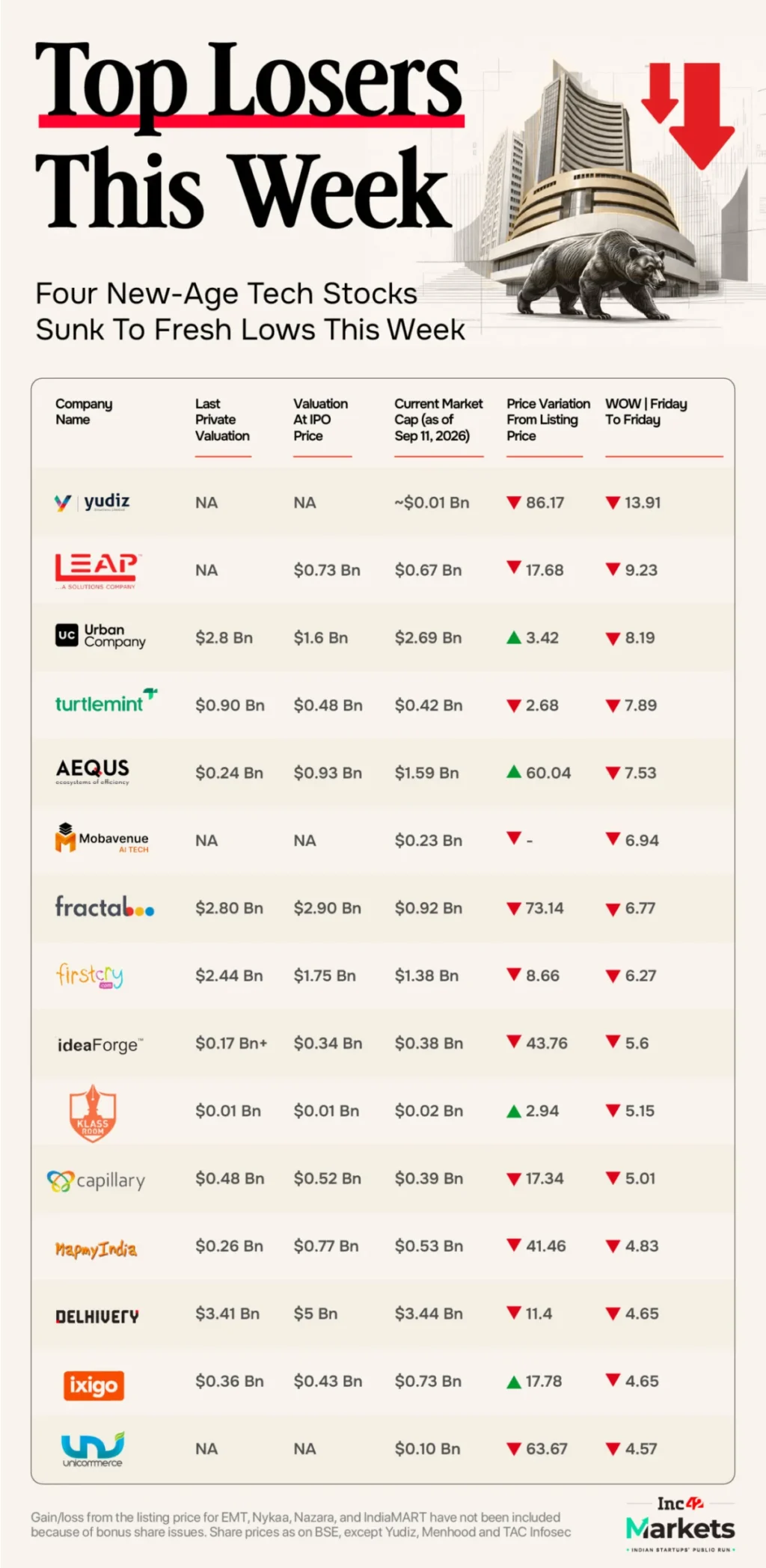
The weekly scoreboard for new-age tech stocks highlighted an almost even split between bulls and bears. Of the 64 companies tracked, 33 finished in the red—declining anywhere from a marginal 0.01% to nearly 14%—while 30 stocks managed to close in positive territory.
The Debuts and Major Movers
- Purple Style Labs (Pernia’s Pop-Up Shop): The company made its public market debut on Monday, September 7, entering the coverage list as the 64th firm. Although it listed at a discount of about 6% on the BSE, it staged a recovery throughout the week to close at ₹570.15, just 0.8% below its IPO price of ₹575.
- ESDS Software: Continuing its phenomenal run during its first full week of public trading, ESDS surged 91.65% to close at ₹1,716.35 on the BSE. The stock hit its upper circuit in every single trading session, bringing its total gains to over 300% above its IPO price.
- Top Losers: NSE SME-listed Yudiz Solutions led the downward spiral for the second consecutive week, shedding 13.91% to close at ₹22.60. It was closely followed by recently listed logistics firm LEAP India, which dropped 9.23% to ₹144.55. LEAP India, alongside FirstCry, Capillary Technologies, EaseMyTrip, and IndiaMART InterMESH, touched fresh intraday lows during the week.
- Bright Spots: Conversely, Lenskart, Paytm, and Nykaa scaled fresh highs, while Swiggy, Honasa Consumer, and Groww posted healthy weekly gains.
2. Chronology of Key Corporate Developments
The week was packed with high-profile corporate announcements, strategic mergers, leadership changes, and upcoming IPO milestones:

- Monday, September 7: Purple Style Labs officially listed on the BSE, marking its entry into the public markets.
- Mid-Week Announcements:
- RentoMojo IPO Closes: Furniture and appliance rental startup RentoMojo wrapped up its initial public offering with an impressive subscription rate of 72.88X, receiving bids for 158.68 Cr shares against the 2.18 Cr shares on offer. Tentative listing is slated for Thursday, September 17.
- Swiggy-Udaan Asset Swap: Swiggy announced a definitive agreement to sell its retail distribution platform, LYNK, to B2B ecommerce unicorn Udaan in a share-swap deal valued at approximately ₹500 Cr. As part of the transaction, Swiggy will secure a ~2.8% stake in Udaan, complemented by a direct cash investment of ₹57 Cr for an additional 0.4% stake, lifting its total holding in Udaan to roughly 3.2%.
- EaseMyTrip Share Pledging: Nishant Pitti, cofounder and chairman of EaseMyTrip, pledged 34.51 Cr shares (valued at approximately ₹211.9 Cr) to Motilal Oswal Financial Services for personal use. This pledge amounts to 8.66% of the company’s total share capital, bringing Pitti’s total encumbered holding to 11.26%.
- Fintech Rallies at GFF 2026: Coinciding with the Global Fintech Fest (GFF) 2026, fintech equities surged following market reports regarding the potential introduction of a Merchant Discount Rate (MDR) on UPI transactions.
- Leadership and Structural Shifts:
- Meesho Restructuring: Ecommerce major Meesho eliminated the role of Chief Product Officer (CPO) as part of a broader product leadership reorganization. Incumbent CPO Prasanna Arunachalam stepped down from his position as a senior management personnel.
- Go Digit Resignation: Independent Director Giridhar Aramane stepped down from Go Digit following an expanded portfolio of responsibilities after being appointed Chairman and Managing Director of Unitech Ltd.
- BlackBuck Expansion: The board of logistics tech firm BlackBuck approved the formation of a wholly owned subsidiary, BlackBuck Transport Services Pvt Ltd, designed to handle trucking services, fleet management, and transport-asset platforms.
- Veefin Solutions Migration: BSE SME-listed fintech SaaS provider Veefin Solutions filed an information memorandum with the BSE to migrate its shares to the mainboard, with plans to subsequently seek a direct listing on the NSE.
3. Supporting Data & Macroeconomic Pressures
The resilience of tech stocks was severely tested by a bleeding broader equity market. Benchmark indices extended their losing streak to a fifth consecutive week, pressured by surging global energy prices, rising US Treasury yields, and escalating geopolitical tensions.
Broader Market Performance
- Sensex: Declined 2.27% over the week to settle at 74,781.76.
- Nifty 50: Slipped 2.09% to close at 23,398.10.
- Broader Indices: Midcap and smallcap gauges fell by 1.40% and 0.88%, respectively.
Macroeconomic Catalysts
- Crude Oil Volatility: Brent crude briefly breached the $110-per-barrel mark before closing the week at $104.61 (up 8.7%). The spike was driven by the intensifying US-Iran conflict and disruptions across critical Middle Eastern maritime logistics corridors. Persistent high oil prices threaten to worsen India’s imported inflation, widen the current account deficit, and exert downward pressure on the rupee.
- US Bond Yields & FPI Outflows: The US 10-year Treasury yield hovered close to the 5% threshold, triggering foreign portfolio investor (FPI) caution. FPIs aggressively pulled out approximately ₹7,443 Cr from Indian equities during the first week of September, reversing net inflows seen in July and August.
- Financial Results (Shiprocket): On the earnings front, logistics tech provider Shiprocket reported a 24% year-on-year drop in its consolidated net loss, which narrowed to ₹13.7 Cr for Q1 FY27. Operating revenues surged 34% YoY to ₹592.1 Cr, helping Shiprocket shares gain 1.99% to close at ₹134.05.
4. Official Responses and Industry Commentary
Market sentiment remained a complex mix of near-term caution and long-term optimism from institutional brokerages and industry stakeholders.

- On ESDS and AI Infrastructure: Choice Institutional Equities initiated coverage on ESDS Software with a ‘Buy’ rating and a target price of ₹1,550, driven by the company’s massive $1.25 Bn contract with Sharon AI and its positioning in the AI infrastructure space. Notably, ESDS blew past this target within five sessions, fueled by stellar QIB subscription rates of 261.51X during its IPO.
- On Fintech and UPI MDR: Bernstein highlighted Paytm as its top sector pick. Analysts noted that potential regulatory clearance for a ~40 basis point MDR on high-value or large-merchant UPI transactions could fundamentally transform the revenue models of payment aggregators, ending the prolonged zero-MDR era.
- At GFF 2026: Prime Minister Narendra Modi championed the cross-border expansion of UPI, urging deeper global integration. Concurrently, the National Payments Corporation of India (NPCI) rolled out novel frameworks for contactless ticketing, automated recurring payments, and international RuPay credit card integration via UPI.
- Long-Term Outlook: Despite prevailing headwinds, major brokerages maintain a constructive long-term thesis on India. Morgan Stanley projected the Sensex to hit 89,000 by June 2027, provided crude oil prices stabilize. Meanwhile, Jefferies emphasized structural growth pillars across Indian manufacturing, semiconductors, space technology, and data center real estate.
5. Strategic Implications
The events of this week signal crucial transitions for India’s digital economy and public markets:
- Maturation of Niche Sectors: The stellar listings and valuations commanded by specialized infrastructure plays like ESDS demonstrate that public investors are willing to pay a premium for high-margin, scalable B2B tech and AI-adjacent business models, even during broader market drawdowns.
- Regulatory and Revenue Shifts in Fintech: The prospect of an MDR on UPI represents a monumental shift for India’s digital payments landscape. If implemented, it will transition payment gateways and fintech operators away from a heavy reliance on ancillary cross-selling toward direct transaction monetization, potentially reshaping profitability timelines for platforms like Paytm and Pine Labs.
- Prudence Amid Volatility: With foreign capital retreating temporarily in response to US yield spikes and Middle Eastern supply shocks, Indian tech startups eyeing public listings—such as RentoMojo—will need to navigate valuation expectations carefully. Institutional sentiment suggests that solid operational metrics, narrowing losses (as observed with Shiprocket), and clear paths to profitability will remain the ultimate litmus test for market success.