Beyond the Bot: How to Train Artificial Intelligence to Think, Reason, and Scale Like You
By the Editorial Team
Co-created by Max Bernstein and Michael Stelzner
As artificial intelligence rapidly permeates every facet of the modern workplace, a pervasive anxiety has gripped knowledge workers across industries. The prevailing narrative paints a bleak picture: AI is an impending commodity engine designed to replicate, replace, and devalue human expertise. For years, the standard prescription for leveraging these tools has involved writing superficial prompt instructions, feeding chatbots static resumes, or enduring tedious self-assessment interviews where users attempt to manually type out their own communication styles and professional philosophies.
According to AI specialist Max Bernstein, however, this standard approach is fundamentally flawed. When humans try to consciously articulate how they think in a structured interview setting, they capture only a tiny fraction of their actual cognitive capability.
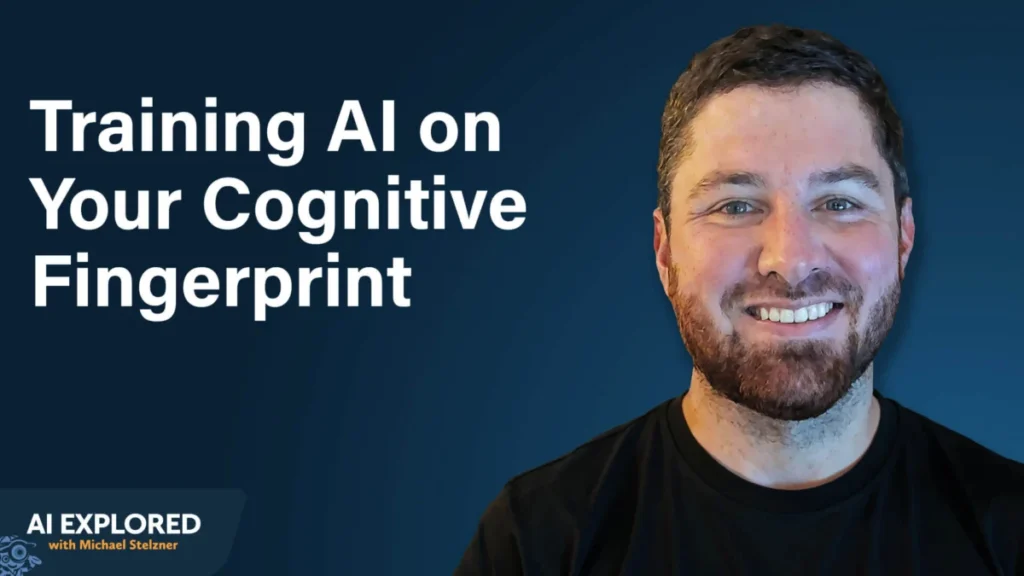
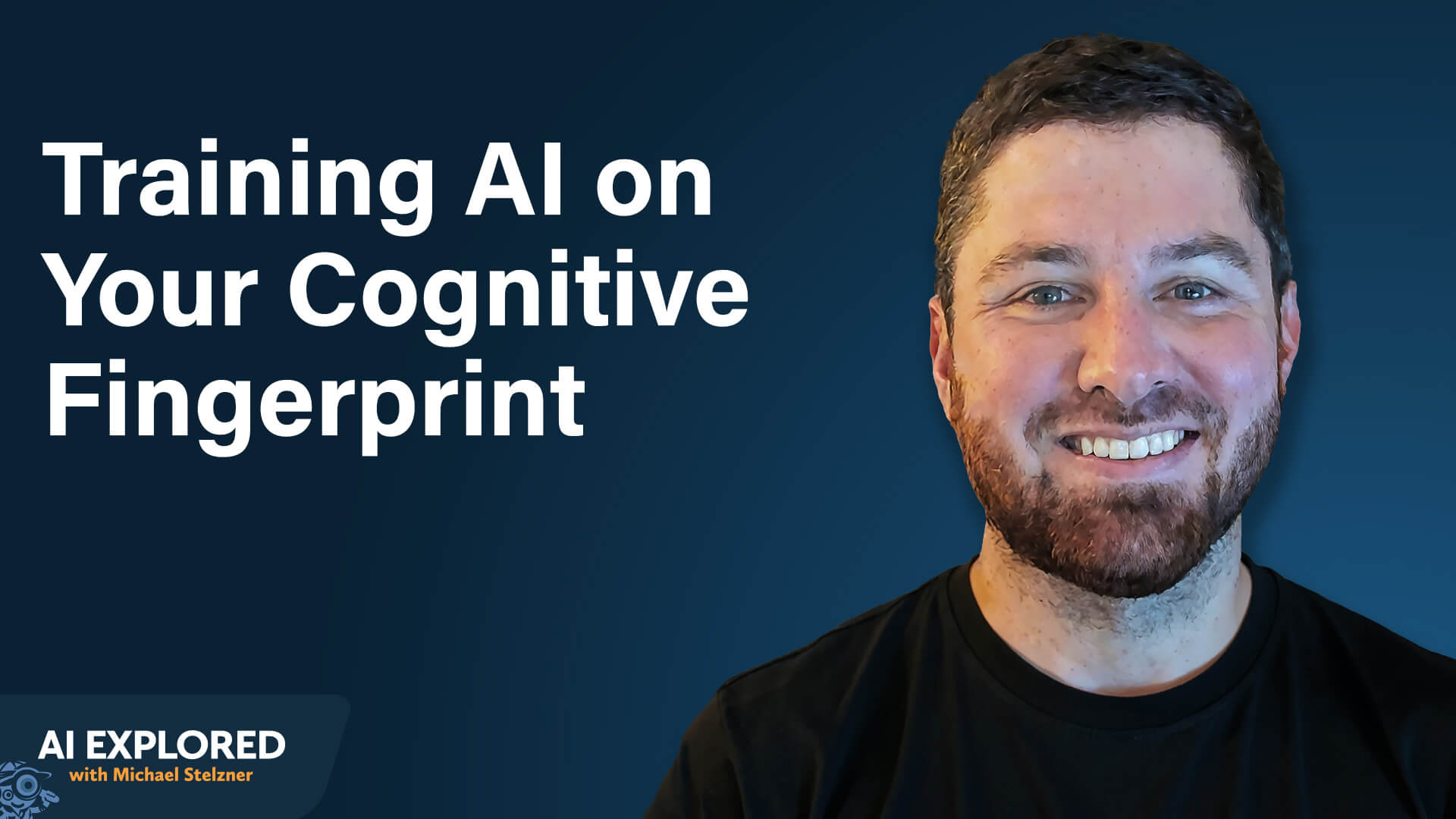
In a recent comprehensive deep-dive on the AI Explored podcast, Bernstein introduced a paradigm-shifting methodology: the Cognitive Fingerprint. Rather than forcing professionals to work harder at describing themselves to a machine, this framework extracts deep, unscripted reasoning patterns from everyday meeting transcripts. The resulting profile allows users to scale their authentic voice, decision-making logic, and unique mental models across any generative AI platform.
Main Facts: Capturing the Unseen Expert
At its core, the Cognitive Fingerprint framework addresses a foundational limitation of current AI personalization techniques: the inability of humans to consciously access and explain their own deepest expertise.
Grounding his work in cognitive science—specifically philosopher Michael Polanyi’s decades-old concept of "tacit knowledge"—Bernstein argues that true expertise operates largely below the threshold of conscious awareness. Experts invariably know far more than they can readily articulate. Tacit knowledge surfaces organically during unscripted moments: when solving an urgent client problem, coaching a team member, navigating a high-stakes negotiation, or pacing through a solo voice memo while driving.
By analyzing transcripts from these natural environments rather than relying on curated questionnaires, advanced AI models can reverse-engineer an individual’s "decision DNA." The resulting document—often spanning 20 to 30 pages of detailed psychological and procedural mapping—serves as a portable context layer. When loaded into tools like ChatGPT, Claude, or Google Gemini, this file ensures that the AI stops sounding like a generic, overly polite robotic assistant and instead reasons, writes, and operates with the user’s distinct professional fingerprint.
Chronology: The Evolution of Personalizing AI
To understand the necessity of the Cognitive Fingerprint, it helps to examine how the relationship between professionals and generative AI has evolved over the past several years.
- Phase 1: The Generic Prompt Era (Early Adoption). When large language models first burst onto the mainstream scene, users relied on basic prompts and persona assignments ("Act as an expert marketer…"). The outputs were heavily stylized, formulaic, and easily identifiable as machine-generated.
- Phase 2: The Self-Assessment Questionnaire. Recognizing the generic nature of early outputs, experts advised users to feed custom instructions into AI tools by answering lists of questions about their tone, preferred vocabulary, and professional background. While this improved stylistic output, it failed to capture deeper problem-solving logic.
- Phase 3: The Data-Starved Workflow. Knowledge workers began uploading random work artifacts—blogs, whitepapers, and formal reports—hoping the AI would absorb their voice. However, heavily edited, polished content reflects packaged outcomes rather than live, critical thinking, leading to flatter, uninspired AI interactions.
- Phase 4: The Cognitive Fingerprint Methodology (Present Day). Introducing a structured, four-layer extraction framework built entirely on unscripted, raw conversational data. By targeting real-time problem-solving transcripts, this approach bridges the gap between surface-level writing styles and deep, cognitive reasoning architectures.
Supporting Data: The Current State of AI Adoption
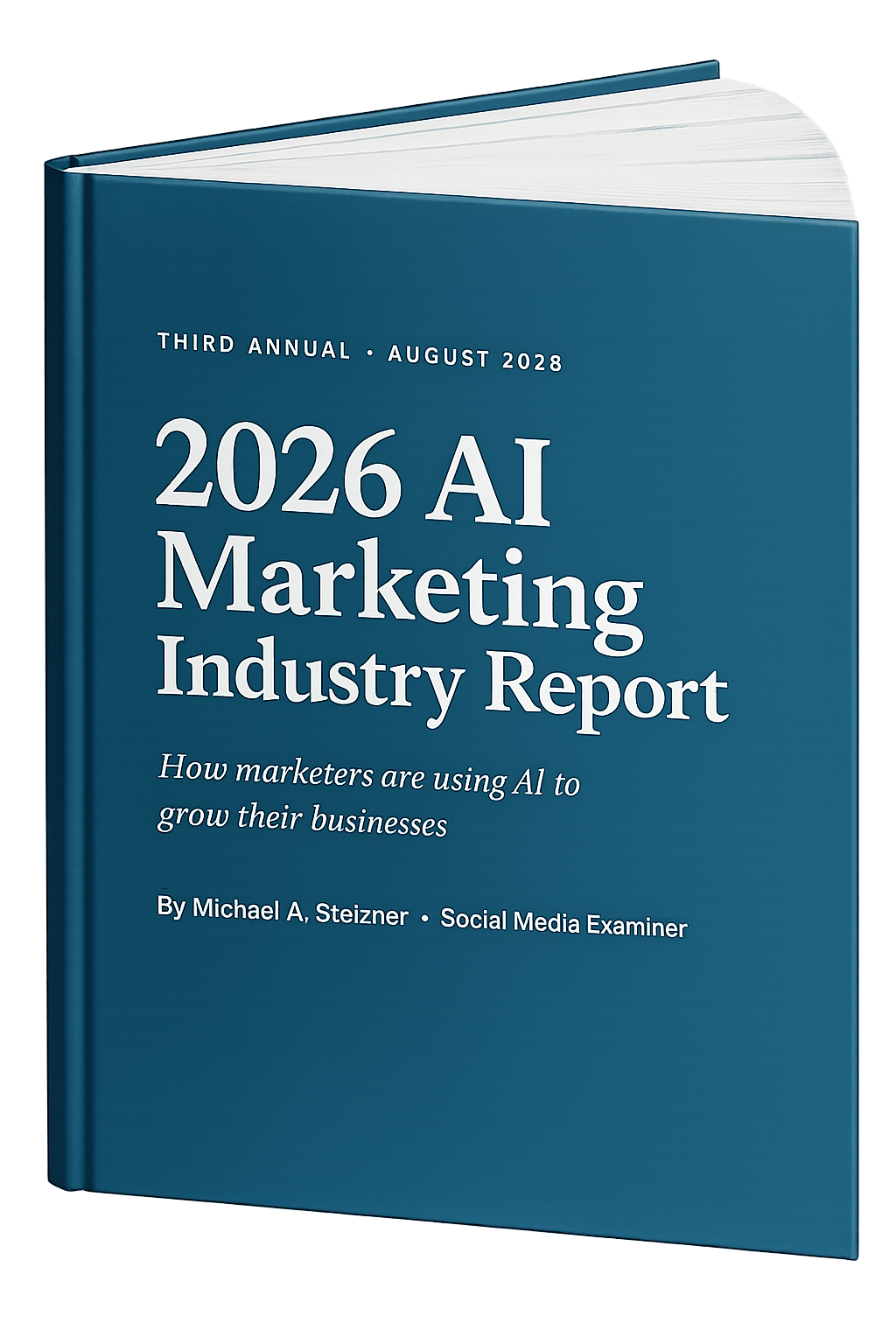
The urgency for sophisticated AI training methods is underscored by recent industry findings. A comprehensive survey of 681 marketers conducted for the Third Annual AI Marketing Industry Report highlights a stark reality regarding how professionals are navigating the AI revolution:
- 85% of marketers are forced to learn and master AI entirely through independent experimentation.
- Only 7% receive formal, structured training from their employers.
- More than 50% of professionals routinely spend their own personal funds on software tools and subscriptions to stay competitive.
These figures illustrate a massive corporate training deficit. Without institutional roadmaps or advanced frameworks like the Cognitive Fingerprint, the vast majority of knowledge workers are left to guess how to bridge the gap between basic automation and genuine professional augmentation.
Official Insights and Frameworks: The Four Layers of Knowledge
To successfully build a cognitive fingerprint, Bernstein established a rigorous four-layer framework. Each layer represents a progressively deeper dimension of human cognition. Extracting all four simultaneously is what separates a superficial AI profile from an authentic cognitive mirror.
1. Declarative Knowledge (The Surface Layer)
Declarative knowledge covers what professionals typically state when asked what they do. It is the job-description version of expertise—the exact type of biographical data found on LinkedIn profiles or corporate "About Us" pages. Most rudimentary AI personalization attempts begin and end here.
2. Procedural Knowledge (The Execution Layer)
This layer captures how an expert executes tasks. It details the step-by-step sequences, standard operating procedures (SOPs), and operational workflows used to reach a known destination. While declarative knowledge names the outcome, procedural knowledge maps the method.
3. Conditional Knowledge (The Decision DNA)
Conditional knowledge is where AI personalization becomes truly unique. It governs the internal if-then logic that dictates how an expert responds to shifting variables. When a specific type of client enters a room, or particular project parameters emerge, an automatic behavioral sequence triggers. This accumulated judgment forms an expert’s unique decision DNA.
4. Metacognitive Knowledge (The Mental Models)
The deepest and most valuable layer for AI training is metacognition: how someone thinks about thinking. These are the overarching mental models that govern problem formulation. Interestingly, humans are notoriously poor at self-diagnosing this layer. When clients are asked to describe their mental models before undergoing transcript analysis, their self-assessments rarely match what their actual conversational data reveals. This is why external auditing—whether by a seasoned human coach or an advanced AI transcript parser—is critical.
Step-by-Step Implementation: How to Build and Deploy Your Fingerprint
Creating a functional cognitive fingerprint requires a deliberate pipeline of data collection, tool selection, and advanced prompting.
Step 1: Curate the Right Raw Material
Discard prepared presentations, webinars, and heavily scripted talks. Instead, gather unscripted transcripts from real conversations where expertise operates without active curation. High-yield sources include:
- Client coaching sessions and advisory calls.
- Live sales conversations that capture real-time audience reading and adjustments.
- Team brainstorms and internal strategy debates.
- Solo voice memos recorded while walking, driving, or processing thoughts between tasks.
Experts recommend compiling a minimum of 3 to 5 transcripts from genuinely distinct contexts. Furthermore, adding a brief context note at the top of each file (e.g., "Client coaching session" or "Team brainstorm") helps the AI accurately parse operational modes.

Step 2: Leverage Modern Transcription Infrastructure
Advanced tools have transformed how raw audio is captured and structured:
- Virtual Meetings: Platforms like Google Meet, Zoom, and Fathom offer robust automated transcription. For deeper customization, Granola operates as an audio-only background process without visible meeting bots, integrating seamlessly with Notion and shared workspaces.
- In-Person Interactions: Wearable hardware like Plaud clips discreetly to clothing or attaches to mobile devices to capture live dialogues.
- Solo Processing: Voice-to-text engines like Wispr Flow allow users to speak ideas directly into AI sessions rather than typing. Notably, spoken prompts consistently yield richer, more natural context than typed instructions.
Step 3: Prompt the AI for Extraction
Upload the labeled transcripts into an advanced AI workspace (such as a ChatGPT project, a Claude project, or a Gemini Gem). Provide a prompt outlining the four-layer framework, instructing the model to scan the texts for declarative statements, procedural sequences, conditional decision rules, and underlying metacognitive patterns. Additionally, ask the AI to flag blind spots or unstated assumptions in the reasoning. As subsequent transcripts are added, the AI builds cumulatively upon previous findings, culminating in a comprehensive profile document.
Step 4: Deploy and Maintain the File
Once compiled into a 20-to-30-page reference document, a condensed working version of the fingerprint can be loaded into any modern AI environment. Because the file acts as a portable context layer, users are protected against rapid shifts in the software landscape; as new, superior AI models launch, the core fingerprint travels with the user unchanged.
Implications: Scaling Expertise and Redefining Value
The implementation of a cognitive fingerprint extends far beyond day-to-day writing assistance. Industry analysts point to several profound organizational and individual implications:
- Restored Professional Confidence: Once an expert’s intuitive logic is made explicit and legible in organized language, the persistent impostor syndrome surrounding differentiation fades. Professionals gain a clearer vocabulary to articulate their unique market value.
- Intellectual Property Generation: Implicit insights locked inside a fingerprint file can be systematically transformed into robust corporate assets—including high-end coaching programs, proprietary sales frameworks, internal training courses, and structured facilitation guides.
- Enterprise Scaling: When adopted across an entire team, cognitive fingerprints illuminate organizational patterns. Leaders can instantly identify who naturally approaches challenges analytically, who excels at narrative framing, and whose unstructured brainstorming complements another’s focused execution. This data fundamentally optimizes project assignments, internal pitches, and team blind-spot mitigation.
As the boundaries between human expertise and artificial intelligence continue to blur, frameworks like the Cognitive Fingerprint offer a compelling path forward. Rather than succumbing to the commoditization of knowledge work, professionals now possess the technical capability to scale their most authentic, human reasoning—ensuring that the technology adapts to the thinker, rather than the thinker adapting to the machine.