The Digital Shadows of Enschede: Inside the Dutch Crackdown on Pro-Russian Cyber Infrastructure

In a sweeping operation that has sent shockwaves through the European cybersecurity landscape, Dutch financial crime investigators have dismantled a critical node of Russian hybrid warfare. On May 18, the Tax Intelligence and Investigation Service (FIOD) arrested two individuals—a 57-year-old Amsterdam resident and a 39-year-old native of The Hague—on charges of violating international sanctions. The arrests mark the culmination of a high-stakes investigation into a network of hosting companies accused of providing the digital scaffolding for Russian intelligence agencies to launch cyberattacks, orchestrate disinformation campaigns, and destabilize the European Union.
The operation, which involved raids across multiple locations in Enschede and Almere, as well as high-security data centers in Dronten and Schiphol-Rijk, resulted in the seizure of over 800 servers, laptops, and a trove of telecommunications equipment. The arrests underscore a growing resolve among Western authorities to hold "bulletproof" hosting providers—companies that operate with a deliberate disregard for the legality of their clients’ activities—accountable for their role in state-sponsored digital aggression.
The Players: A Network of Convenience
The investigation centers on a complex web of corporate entities, most notably the hosting provider "Stark Industries Solutions." Stark, which emerged with suspicious velocity just two weeks prior to the Russian invasion of Ukraine in 2022, quickly gained notoriety as a "staging ground" for Distributed Denial-of-Service (DDoS) attacks against European government institutions and critical infrastructure.
At the heart of the Dutch criminal investigation are two men: Andrey Nesterenko, a 39-year-old Russian-born tech entrepreneur, and Youssef Zinad, a 57-year-old associate based in Amsterdam. Nesterenko operates MIRhosting, a Netherlands-based provider that served as the final, persistent conduit for Stark Industries’ operations after other partners were cut off by international sanctions.
Nesterenko’s professional trajectory is as curious as the companies he manages. A former piano prodigy from Nizhny Novgorod, Nesterenko founded Innovation IT Solutions Corp. in 2004. The firm holds the dubious historical distinction of hosting stopgeorgia.ru, a hub used to coordinate cyberattacks against Georgia during the 2008 Russo-Georgian War—a conflict widely regarded by historians as the first instance of a physical military invasion synchronized with large-scale, state-backed cyber warfare.
A Chronology of Evasion
The saga of these hosting providers is a case study in corporate obfuscation and the cat-and-mouse game played with international regulators.
- February 2022: Stark Industries Solutions is established, quickly becoming a primary infrastructure provider for Russian-aligned hacking collectives.
- May 2024: Investigative reports, including deep-dives by KrebsOnSecurity, expose Stark’s role as a provider of proxy and anonymity services for Russian intelligence-linked groups.
- May 2025: The European Union formally sanctions Moldovan brothers Ivan and Yuri Neculiti and their company, PQHosting, for their role in facilitating Russia’s hybrid warfare.
- Late May 2025: Sensing the closing net, the Stark network assets are rapidly transferred from the sanctioned PQHosting to a new entity, "the.hosting," managed by WorkTitans BV.
- September 2025: Investigations reveal that WorkTitans is under the control of Nesterenko and Zinad. Despite the sanctions on the Neculitis, Stark remains active, utilizing MIRhosting’s infrastructure to bypass the EU’s blockades.
- November 2025: Data analyzed by de Volkskrant identifies WorkTitans and MIRhosting as the most active networks in cyberattacks targeting Danish government bodies during the week of the country’s municipal elections.
- May 18, 2026: The FIOD conducts coordinated raids, arresting Nesterenko and Zinad and seizing 800 servers, effectively pulling the plug on the infrastructure supporting the.hosting.
Supporting Data: The Anatomy of a Breach
The evidence against the suspects is not merely circumstantial. Reports from de Volkskrant indicate that the infrastructure provided by WorkTitans and MIRhosting was instrumental in sustained, high-volume DDoS attacks during the Danish elections in late 2025. These attacks were not random; they were targeted attempts to disrupt the democratic process by overwhelming government digital portals, effectively silencing public access to election information during a critical window.
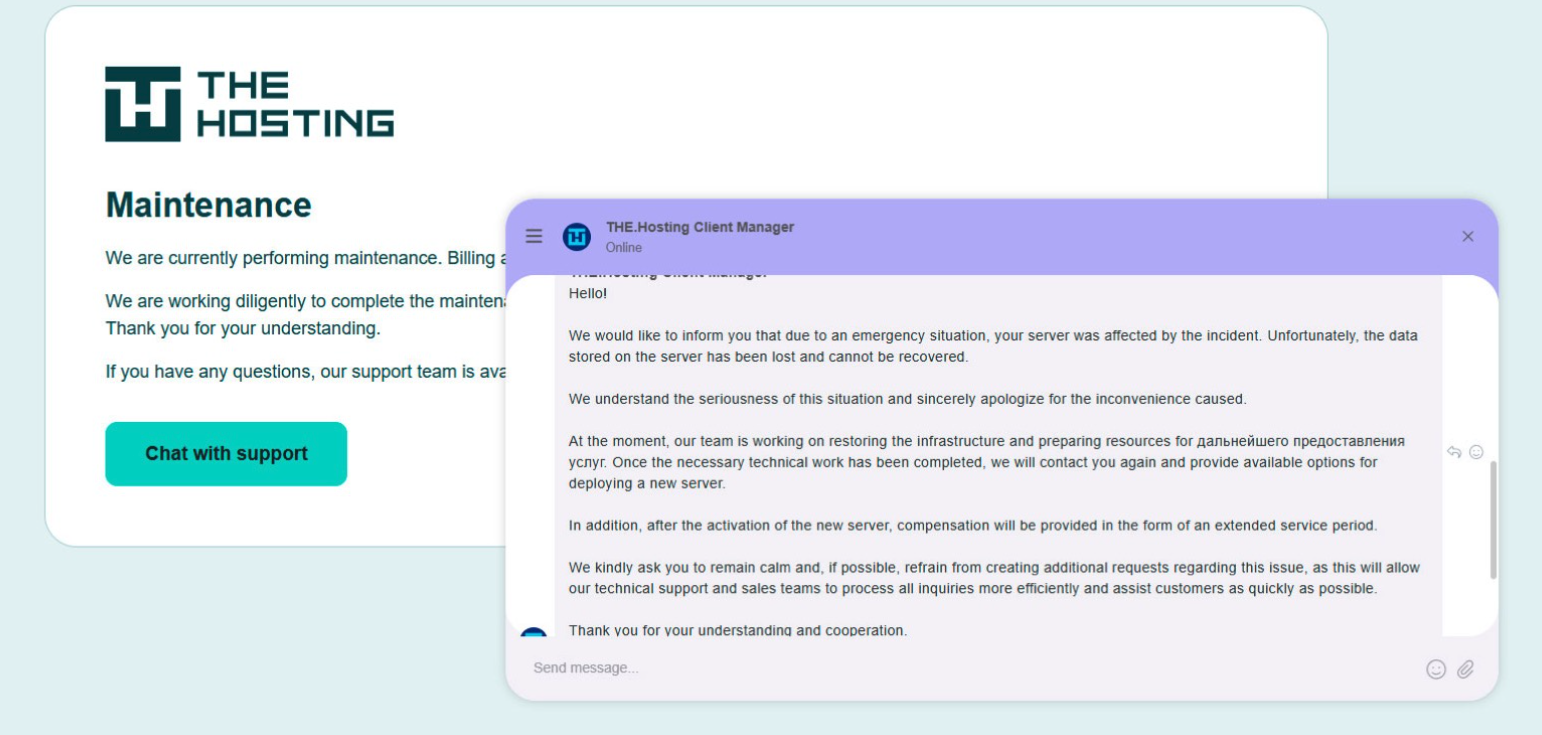
The seizure of 800 servers has resulted in an immediate and permanent loss of data for the customers of "the.hosting." While the company issued a notice to its clients stating that the data was unrecoverable, the move serves as a stark reminder of the risks associated with utilizing shadow hosting providers. For the investigators, these servers are a goldmine of metadata, connection logs, and communication records that could link specific attacks directly to the Russian intelligence services (FSB/GRU) that have long utilized such platforms as their primary operational base.
Official Responses and Denials
In the wake of the arrests, the atmosphere surrounding MIRhosting and the surviving elements of the network has been one of frantic damage control. In a statement released via LinkedIn, MIRhosting attempted to distance itself from the alleged electoral interference.
"Based on our preliminary findings, there are no indications that the services over which we exercise control were actually used to influence the Danish elections," the company claimed. They further argued that they had observed no "anomalies or spikes" in network traffic that would suggest a large-scale cyber offensive.
Andrey Nesterenko, speaking through legal counsel, maintained his innocence in email correspondence. "The transition to the.hosting was not intended to evade sanctions," Nesterenko asserted. "The hardware and customer portfolio had already been transferred to WorkTitans before the sanctions appeared. Closing or damaging a legitimate Dutch infrastructure company will not stop cybercrime, but it will harm many people who have done nothing wrong."
Youssef Zinad, by contrast, has remained a ghost. Having retreated from public life, blocked his digital footprint, and seemingly abandoned his registered office, Zinad’s arrest at an Amsterdam residence came after months of evading journalists and inquiries. His role as the bridge between MIRhosting’s official business and the clandestine operations of WorkTitans remains a focal point for investigators.

Implications: The New Frontline of Sanctions
The crackdown by the Dutch authorities represents a paradigm shift in how European nations respond to "bulletproof" hosting. Historically, such companies operated in a legal gray area, citing the "neutrality" of network providers. However, as the lines between private IT infrastructure and state-sponsored cyber warfare blur, the European Union is increasingly viewing these providers not as neutral conduits, but as active participants in hybrid conflicts.
The implications for the broader tech industry are profound. First, it puts hosting providers on notice that they have an affirmative duty to monitor their traffic for malicious state-sponsored activity. Second, it signals that the physical location of a server within the EU does not grant immunity from sanctions enforcement.
As the legal proceedings against Nesterenko and Zinad begin, the case will likely serve as a blueprint for future prosecutions. By tracing the financial and logistical threads back to the individuals who profited from providing "safe harbor" to the enemies of the state, the FIOD has proven that the digital battlefield has real-world consequences. The 800 seized servers are now evidence in a case that extends far beyond the borders of the Netherlands, reaching directly into the heart of Russia’s digital strategy to undermine the stability of the West.
The era of "no questions asked" hosting within the EU is rapidly drawing to a close. As investigators continue to sift through the terabytes of data seized from the Dronten and Schiphol-Rijk data centers, the full extent of the damage caused by Stark Industries and its facilitators will become clearer—and with it, the potential for a new wave of international sanctions against those who trade in the digital chaos of the modern world.