Paradigm Shift for India’s Digital Economy: Unpacking the New UPI MDR Framework and Its Ecosystem-Wide Ripple Effects
India’s financial landscape is bracing for a monumental shift. For nearly a decade, the Unified Payments Interface (UPI) has reigned supreme as the world’s most celebrated real-time payment system, largely built on the bedrock of a zero-cost model for merchants. That foundational economic architecture is set to change fundamentally.
Effective October 15, a new Merchant Discount Rate (MDR) framework will transform how large-scale person-to-merchant (P2M) digital transactions are processed, monetized, and accounted for across the subcontinent. While designed to secure the long-term financial viability of the nation’s digital public infrastructure, the policy has sparked intense debate among retailers, Direct-to-Consumer (D2C) brands, fintech pioneers, and banking heavyweights alike.
Main Facts: What Changes on October 15?
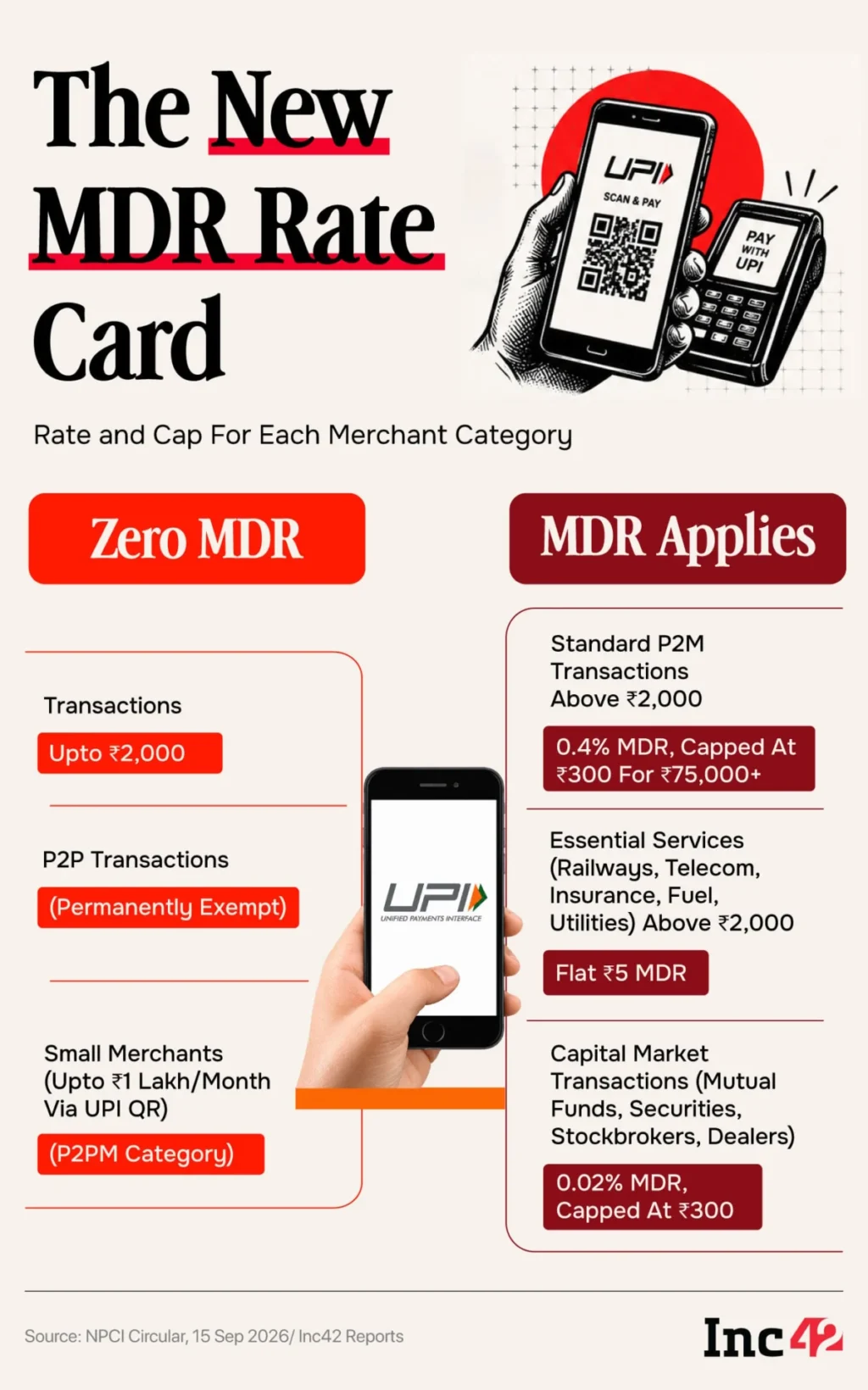
Under the newly notified guidelines, the zero-MDR era for commercial entities is officially giving way to a market-linked pricing model targeted primarily at medium and large-scale enterprises.
- The Core Charge: Banks and payment service providers will levy a 0.4% MDR on UPI P2M transactions that exceed ₹2,000.
- The Cap: To protect high-value commerce from prohibitive costs, the fee is capped at a maximum of ₹300 for individual transactions valued at ₹75,000 and above.
- The Small Merchant Safe Harbour: Micro-merchants and small shopkeepers remain protected. The regime completely exempts merchants who receive up to ₹1 Lakh per month via UPI QR codes.
- The Evaluation Rule: If a merchant exceeds the ₹1 lakh monthly collection threshold for three consecutive months, they are automatically transitioned into the standard P2M category, rendering them liable for MDR deductions.
- The Revenue Distribution Split: The 0.4% collected from the merchant is distributed across the payment chain:
- 0.28% goes to the issuing bank (the customer’s bank).
- 0.12% is retained by the acquiring bank (the merchant’s bank).
- Out of the issuing bank’s share, 0.08% is passed on to the Third-Party Application Provider (TPAP) like PhonePe, Google Pay, or Paytm, while 0.04% goes to the TPAP’s associated Payment System Provider (PSP) bank.
Chronology and Evolution of India’s UPI Economy
To understand the weight of this policy shift, one must look at how India’s digital payments ecosystem evolved from a subsidized experiment into a multi-billion-dollar juggernaut.
Phase 1: The Zero-MDR Growth Engine (2016–2019)
Following its launch by the National Payments Corporation of India (NPCI) in 2016, UPI was deliberately kept free of merchant fees to encourage widespread adoption among reluctant merchants and uninitiated consumers. The strategy worked brilliantly, converting street vendors, auto-rickshaw drivers, and neighborhood kirana stores into digital-first businesses.
Phase 2: Subsidy and Sustainability Concerns (2020–2024)
As transaction volumes skyrocketed into the tens of billions per month, the financial burden of maintaining the infrastructure fell heavily on banks, fintechs, and the Indian government. While the government introduced annual budgetary support (subsidies) to compensate banks for processing low-value UPI transactions, industry stakeholders consistently argued that a zero-MDR environment was unsustainable over the long run.
Phase 3: The Policy Pivot (Late 2024 – October 2025)
Recognizing the widening deficit and the need for private sector innovation to keep pace with soaring demand, regulators and industry bodies laid the groundwork for a targeted monetization strategy. The announcement of the October 15 MDR framework marks the culmination of these deliberations, shifting the financial upkeep of the network away from taxpayers and onto the commercial enterprises that profit from it most.

Supporting Data: The Anatomy of a ₹22,000 Crore Revenue Pool
The financial implications of the new framework are staggering. According to comprehensive estimates by global brokerage Bernstein, a 40-basis-point (0.4%) MDR applied to roughly half of India’s eligible P2M transaction value could unlock a massive annual revenue pool of approximately ₹22,000 Crore by FY28.
How will this capital be distributed among ecosystem participants?
- Commercial Banks: Projected to capture the lion’s share, estimated at around ₹14,000 Crore, driven by their role as issuing and acquiring institutions.
- Fintechs and TPAPs: Third-party giants like PhonePe, Google Pay, and Paytm are expected to pocket roughly ₹7,000 Crore annually, providing them with a sustainable, recurring revenue stream that has long eluded them in core payments.
A Practical Transaction Breakdown
To visualize how the math plays out on the ground, consider a customer purchasing groceries worth ₹2,500 using a popular app like Paytm.
- The Charge: The merchant’s acquiring bank levies a 0.4% MDR on the transaction, amounting to ₹10.
- The Split:
- The issuing bank receives ₹7 (0.28% of the total value).
- The acquiring bank retains ₹3 (the remaining balance).
- Further Distribution of the Issuing Bank’s Share:
- The TPAP (e.g., Paytm/PhonePe) receives ₹2 (0.08%).
- The associated PSP bank takes ₹1 (0.04%).
Official Responses and Industry Perspectives
Reactions to the impending MDR framework are sharply divided along operational lines. While fintech leaders view the policy as a necessary maturity milestone, merchant guilds and traditional retailers have raised significant concerns.
The Fintech Perspective: A "Robin Hood" Move
Fintech executives have largely rallied behind the policy, emphasizing that UPI was never truly "free"—it was simply subsidized by taxpayers.
- Vijay Shekhar Sharma (CEO, Paytm): Reportedly described the framework as a "Robin Hood" policy, noting that it structurally places the financial burden on large corporations, ecommerce platforms, and high-volume retailers while shielding small shopkeepers.
- Bipin Preet Singh (CEO, MobiKwik): Argued that transitioning to a market-linked pricing model removes an unsustainable tax burden and establishes a direct correlation between transaction costs and the large businesses that extract maximum value from the UPI rail.
- Rajesh Londhe (CEO, PhiCommerce): Highlighted that the formal MDR split finally creates a legitimate monetization mechanism for critical financial infrastructure, though he cautioned that compliance burdens regarding the ₹1 Lakh threshold should be handled by software platforms rather than overburdened merchants.
The Merchant and Retailer Perspective: Festive Anxieties
Conversely, merchant associations argue that the timing and structure of the policy could inadvertently stall digital adoption among growing enterprises.
- Kumar Rajagopalan (CEO, Retailers Association of India – RAI): Warned that introducing a fee right at the onset of the festive season—when average transaction values routinely cross the ₹2,000 threshold—will incentivize small and medium retailers to revert to physical cash. The RAI plans to formally lobby the NPCI and the Ministry of Finance for a more graded structure, particularly for credit-linked UPI transactions.
Ecosystem Implications: How Businesses Are Adapting
As October 15 approaches, businesses across diverse sectors are stress-testing their unit economics to absorb or mitigate the incoming MDR shock.

1. High-Ticket B2B and Agritech Enterprises
Companies dealing in higher Average Order Values (AOVs)—such as Delhi-based agritech startup Agrosher, where farm machinery sales typically range between ₹50,000 and ₹75,000—face direct margin erosion. Even with the ₹300 cap, founders worry that the loss of frictionless payments could drive rural customers back toward cumbersome net banking or physical cash operations.
2. D2C Brands and Low-Ticket SKUs
Direct-to-Consumer brands whose individual products sit just below the threshold view the immediate threat as minimal, but note that future bundling strategies will change the game. Sumit Goyal, co-founder of D2C brand Ecosys, noted that while the majority of their items cost under ₹1,999, scaling AOVs will eventually bring them into the MDR net, forcing brands to evaluate total payment processing costs holistically.
3. High-Volume FMCG Importers
For firms handling massive volumes of micro-transactions, the financial impact may be negligible, but the operational hurdle is real. Vikash Singhal, Director at Sunbeam Ventures, noted that 96.3% of their UPI collections are below ₹2,000, limiting the financial impact to roughly 0.06% of total revenue. However, the company must now overhaul its internal reporting and reconciliation software, which has historically treated UPI as a completely zero-cost rail.
4. The Consumer Impact: Will Prices Go Up?
Perhaps the most pressing question for the everyday shopper is whether merchants will pass these costs down the line. While explicit "UPI surcharges" at checkout are likely to be restricted or frowned upon by regulators, industry experts suggest that businesses operating on razor-thin margins may ultimately fold the incremental processing costs into general product price adjustments over time.
Conclusion
The implementation of the new UPI MDR framework on October 15 marks the end of UPI’s infanthood and the beginning of its institutional maturity. By balancing robust protections for micro-merchants with a structured, market-driven revenue pool for banks and fintechs, India is attempting to future-proof its most vital digital utility.
Whether this transition can be achieved without denting the consumer enthusiasm that propelled UPI to global renown will depend heavily on how flexibly payment providers, merchants, and regulators collaborate in the months ahead.