Misinformation Alert: Hyderabad Police Debunk Viral Claims Surrounding ‘Lee Chee Ka Raja’ Ganesh Idol

HYDERABAD – In an era where digital content can amplify local celebrations to a global audience within seconds, the line between festive fervor and deceptive marketing has become increasingly blurred. This week, the Goshamahal police in Hyderabad took decisive action to curb a viral misinformation campaign surrounding the “Lee Chee Ka Raja” Ganesh idol, a centerpiece of the 2026 Ganesh Chaturthi festivities.
Authorities have officially debunked sensationalist claims circulating on social media platforms that suggested the idol was a masterpiece of opulence, allegedly crafted from Panchaloha (a five-metal alloy), layered in 24-karat gold plating, and encrusted with nearly 384,000 American diamonds.
Main Facts: The Anatomy of a Hoax
The controversy erupted following a surge of high-definition photographs and stylized videos on platforms such as Instagram, WhatsApp, and X (formerly Twitter). These posts painted a picture of a 48-kilogram idol that was not merely a religious icon, but a high-value asset.
According to the Goshamahal police, the following claims—which were widely shared across digital networks—are entirely false:
- Material Composition: The idol is not made of Panchaloha.
- Gold Plating: There is no 24-karat gold plating on the structure.
- Gemstone Ornamentation: The assertion that the idol is studded with 383,800 American diamonds has been explicitly rejected by law enforcement as a fabrication.
On September 17, 2026, the Goshamahal police issued a formal statement to clarify that these exaggerated claims were intentionally manufactured to create a spectacle. The police noted that the objective behind these claims appeared to be the promotion of "Lee Chee Pearls and Jewels," the organization reportedly linked to the idol’s installation committee.
Chronology of the Controversy
The rise and subsequent "busting" of the Lee Chee Ka Raja narrative followed a classic pattern of viral misinformation.
Phase 1: The Build-Up (Early September 2026)
As the Ganesh Chaturthi festival approached, social media accounts associated with the organizers began releasing teaser videos. The content featured high-production-value shots of the idol, set to dramatic music, often accompanied by captions highlighting its "unprecedented" material value.
Phase 2: The Viral Peak (September 12–16, 2026)
By mid-September, the claims reached a fever pitch. Influencers and local news aggregators began picking up the story, citing the "48 kg weight" and "3.84 lakh diamond" statistics as facts. The narrative gained traction because it played into the public’s fascination with "crorepati" idols, a trend seen in various parts of Hyderabad, where committees often compete for public attention.
Phase 3: Police Intervention (September 17, 2026)
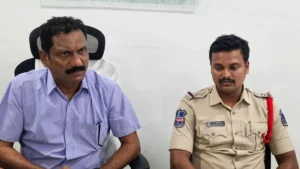
Following a series of internal inquiries and complaints regarding the nature of the publicity, the Goshamahal police investigated the claims. Finding no evidence to support the luxurious descriptions, Inspector B. Sravan Kumar held a press briefing to dismantle the narrative, labeling it as misleading and commercially motivated.
Phase 4: The Official Clarification (September 18, 2026)
Public updates were issued across municipal and law enforcement channels, urging citizens to desist from sharing the unverified videos, citing the potential for public confusion and the exploitation of religious sentiment for commercial gain.
Supporting Data: The Reality Behind the Glitz
While the "Lee Chee Ka Raja" idol is a decorative installation, the disconnect between its actual composition and the viral narrative is significant. Investigative findings from the local authorities suggest that the materials used were standard, decorative, and industrial-grade—a far cry from the precious metals and gemstones claimed by the marketing campaign.
The use of the term "American diamonds" is a common industry euphemism for cubic zirconia (CZ). Even if such stones were used for decorative purposes, the sheer volume of 384,000 pieces is a logistical impossibility for an idol of this size, according to industry experts consulted by the police.

Furthermore, the "Panchaloha" claim—a sacred alloy traditionally used in temple idols—was identified as a deliberate attempt to add a veneer of sanctity and historical value to a commercially driven project. The police have emphasized that the weight of the idol, estimated by the public at 48 kg, is not reflective of a high-density metallic alloy, further debunking the "five-metal" theory.
Official Responses and Legal Implications
The response from the Goshamahal police has been firm. Inspector B. Sravan Kumar has been at the forefront of the outreach, cautioning that using religious festivals as a platform for corporate branding and false advertising constitutes a breach of public trust.
"Publicity intended to promote commercial interests through deception creates an environment of instability," stated the Inspector. "We have clear evidence that committee members associated with the idol were instrumental in propagating these myths to gain an unfair advantage for Lee Chee Pearls and Jewels. This is not just a matter of an exaggerated advertisement; it is a matter of creating a false impression to obtain wrongful gain."
The police are currently monitoring the situation to determine if further legal action under the Indian Penal Code (or the relevant Bharatiya Nyaya Sanhita sections) regarding cheating and public nuisance is warranted against the organizers.
Implications: The Dangers of Digital Misinformation
The Lee Chee Ka Raja incident is a microcosm of a larger societal issue: the susceptibility of digital audiences to "hype culture." In Hyderabad, where the Ganesh festival is a massive cultural event, the competition between pandals often leads to a "bigger is better" mentality. When this is weaponized by commercial entities, the results can be detrimental to the spirit of the festival.
1. Erosion of Religious Sanctity
When an idol is marketed like a luxury product, the focus shifts from the spiritual significance of the deity to the material worth of the object. This commodification risks alienating the traditional base of devotees who view the festival through a lens of faith rather than finance.
2. The Threat of Public Disorder
The police have expressed concerns that claims of "lakhs of diamonds" and "gold plating" could lead to security risks. An idol perceived as being made of precious materials becomes a magnet for potential theft, vandalism, or stampedes, as crowds flock to see the "miracle" construction. This places an unnecessary burden on local law enforcement to provide enhanced security for a fabricated premise.
3. The Responsibility of the Digital Citizen
The case highlights the desperate need for digital literacy. As the police noted, the cycle of misinformation is fueled by the "share" button. Every time a user forwards a post without verifying its authenticity, they contribute to the dilution of truth.
Conclusion: A Call for Caution
As the 2026 festival season continues, the Goshamahal police have issued a final, stern appeal: Do not believe or forward unverified claims about the idol on social media. Whether it is WhatsApp, Facebook, Instagram, or X, the public must exercise extreme caution.
The message from the authorities is clear: the Ganesh festival is a time for devotion and community unity, not for the spread of deceptive narratives designed to enrich private jewelers. By relying on official information and ignoring the siren song of viral, "gold-plated" lies, the public can help ensure that the festivities remain grounded in their original, sacred purpose.
As of September 18, 2026, the situation remains under close observation by the police, who have committed to preventing any further exploitation of the festive atmosphere. The "Lee Chee Ka Raja" saga serves as a timely reminder that in the digital age, the most valuable commodity is not gold or diamonds, but the truth.
For ongoing updates regarding this investigation and other festive safety protocols, citizens are encouraged to follow the official handles of the Hyderabad Police and the local municipal corporation.