The Reverse Logistics Revolution: Navigating the Complexities of E-commerce Returns in Europe
The modern e-commerce landscape is often defined by the "click-to-buy" experience, but for the savvy merchant, the transaction is far from complete when the payment is processed. In the European market, the post-purchase phase—specifically the return of goods—has evolved into a critical business pillar. What was once considered a minor operational inconvenience has transformed into a strategic imperative that dictates brand loyalty, operational profitability, and environmental footprint.
As European consumers become increasingly accustomed to frictionless shopping experiences, the "return culture" has reached a tipping point. With return rates in some regions exceeding 60%, businesses are finding that their ability to manage reverse logistics is as vital to their survival as their ability to generate sales.
1. The Current State of Returns: A Quantitative Overview
E-commerce returns have become an inseparable element of the European commercial fabric. While the convenience of online shopping is a major driver of growth, it has birthed a consumer expectation of "risk-free" shopping, where the act of ordering multiple sizes or colors to "try at home" is common practice.
Statistical Reality in the European Market
Current data paints a stark picture of the scale of the challenge. Across Europe, the average return rate for online purchases fluctuates between 30% and 40%. However, this is not a monolithic trend; it varies significantly by geography and product category.
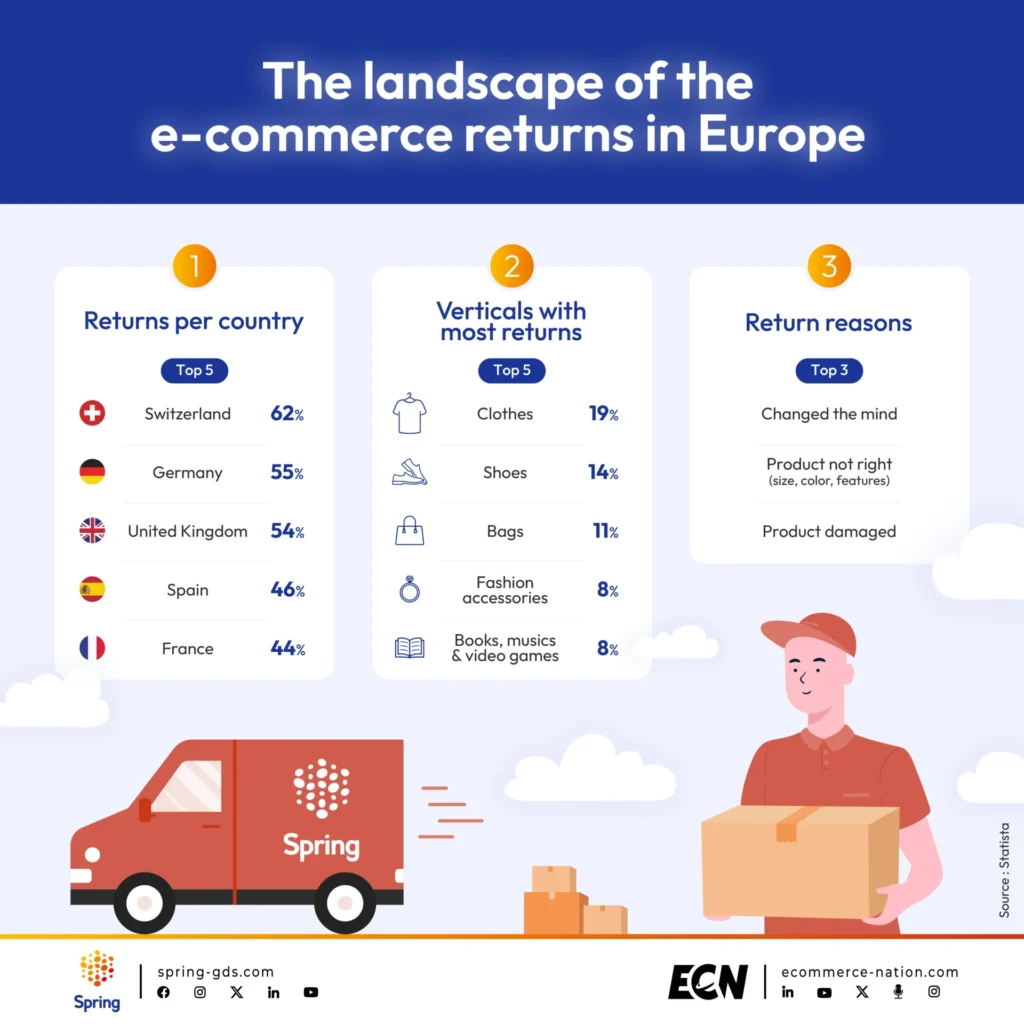
According to data from Statista (2023), Switzerland leads the continent with a staggering 62% return rate per online buyer. Germany follows closely at 55%, with the United Kingdom at 54%. These figures are largely driven by a cultural expectation of high-quality service and, in the case of Germany, a long-standing tradition of versandhandel (mail-order retail) that prioritized consumer ease.
Impact on Profitability and Customer Loyalty
For retailers, the financial impact of this trend is twofold. First, there are the direct "hard" costs: processing, restocking, shipping, and the labor required to inspect returned items. Second, there are "soft" costs: the depreciation of value for items that cannot be sold as new, and the loss of potential revenue during the time the item is in transit.
Conversely, retailers cannot afford to be overly restrictive. Research consistently demonstrates that a transparent, easy-to-use return policy is a primary driver of customer acquisition. A shopper who knows they can return an item with minimal effort is significantly more likely to complete the initial purchase. Thus, merchants face a "profitability paradox": making returns too easy hurts the bottom line, but making them too difficult destroys customer lifetime value.
2. Sector-Specific Challenges: Why Products Return
Not all goods are created equal in the eyes of the consumer. The fashion and apparel sector consistently reports the highest return rates, often reaching up to 50% for specific categories like footwear and high-end fashion. The primary driver here is the "subjective fit"—the inability of a consumer to verify the feel and drape of a garment through a digital screen.
Electronic goods and household items, while generally having lower return rates (around 6%), present a different set of challenges. These returns are often driven by technical incompatibility, "dead-on-arrival" defects, or the complexity of the product, which requires better customer support rather than just a simple return label.
3. The Anatomy of a Return: Chronology of the Process
To optimize, one must first map the journey. The typical return lifecycle follows a distinct chronological path:
- Initiation: The customer requests a return via a portal or customer service.
- Logistical Routing: The package enters the courier network. This is where "cross-border" complexity spikes.
- Receipt and Inspection: The item arrives at a warehouse or 3PL facility to be assessed for damage or wear.
- Disposition: The business decides whether to restock, refurbish, donate, or recycle the item.
- Reconciliation: The financial transaction is reversed, and inventory levels are updated.
Every minute spent in this cycle represents a loss of capital. Companies that reduce the "time-to-restock" are the ones currently leading the market.
4. The Four Pillars of Complexity: Challenges Facing Merchants
Logistical and Cross-Border Hurdles
Operating in the European Union provides a common market, but it is not a uniform one. Differences in VAT, customs regulations for non-EU countries (like the UK or Switzerland), and varying labor laws make cross-border reverse logistics a nightmare for the uninitiated. A retailer based in France selling to customers in Poland must navigate vastly different courier preferences and return point availability.
The Financial Squeeze
As shipping costs rise and labor becomes more expensive, the "free returns" model is being reconsidered. Many major retailers have begun implementing return fees or ending "no-questions-asked" policies to discourage "bracketing"—the practice of ordering multiple items with the intent of returning most of them.
The Ecological Imperative
The environmental cost of returns is no longer a footnote; it is a brand-defining issue. The carbon emissions generated by reverse logistics, combined with the waste from single-use packaging, have put pressure on retailers to innovate. When returned products are sent to landfills because it is "cheaper than processing," the brand damage can be irreparable in an era of conscious consumerism.
The "Bracketing" Trend
Bracketing has emerged as a major challenge. When consumers treat their living rooms as fitting rooms, the carbon footprint of the order effectively doubles. Retailers are now using AI-driven size advisors and 3D imagery to mitigate this behavior, aiming to get the customer to the "right" choice before the order is ever placed.
5. Strategic Recommendations: Optimizing for the Future
To navigate these challenges, merchants must move from a reactive to a proactive strategy.
Data-Driven Personalization
The most effective way to reduce returns is to prevent them. By utilizing data, retailers can identify which specific products have high return rates and investigate why. Is the size chart misleading? Are the photos failing to show the true color? Using data to refine product pages can reduce returns by 10–15% within a single quarter.
Technological Integration
Implementing automated return management platforms allows customers to self-serve. These systems can provide real-time tracking, offer instant store credit instead of a refund, and even suggest "keep the item" vouchers for low-value goods, which saves the cost of return shipping entirely.
Adopting a Circular Strategy
Forward-thinking brands are moving toward circularity. This includes:
- Eco-friendly packaging: Using materials that can be reused for the return journey.
- Batch Shipping: Incentivizing customers to drop off returns at designated points, where shipments are consolidated, significantly reducing the carbon footprint per item.
- Refurbishment Programs: Creating dedicated channels to sell "pre-loved" or refurbished items, ensuring that a return does not equal a waste of resources.
6. Official Industry Perspectives and Implications
Industry analysts and logistics experts generally agree that the era of "unlimited, free, and fast" returns is coming to an end. The implication for the industry is a move toward more disciplined, customer-centric, but cost-conscious policies.
Companies that treat returns as a "marketing expense"—a way to prove the brand’s commitment to the customer—are the ones most likely to survive the current economic climate. The goal is no longer to eliminate returns, as that is impossible in a healthy, competitive market, but to manage them in a way that minimizes friction for the customer and maximizes efficiency for the business.
Conclusion
The European e-commerce market is at a crossroads. As returns continue to climb, the merchants who thrive will be those who view reverse logistics not as a back-end cost, but as a critical part of the customer journey. By investing in technology, embracing sustainable practices, and using data to bridge the gap between digital expectations and physical reality, retailers can turn the challenge of returns into a competitive advantage. The future belongs to those who make the return process as seamless as the purchase itself, while remaining steadfast in their commitment to profitability and the planet.