Global Open-Source Education: How WordPress Initiatives Are Empowering Students Across Four Continents
By Global Education Desk
In classrooms, community halls, and rural outposts spanning Bangladesh, Uganda, Costa Rica, Spain, and Japan, a quiet revolution in digital literacy is taking shape. Powered by the open-source ethos that underpins over 40 percent of the internet, two flagship education initiatives—WordPress Campus Connect and WordPress Credits—are fundamentally reshaping how young people learn technology.
Rather than relying solely on abstract theory or costly proprietary platforms, these programs place real-world web development tools directly into the hands of students. From building 108 websites in a single fortnight in South Asia to adapting open-source software for local dialects in Central America, these initiatives demonstrate that digital inclusion is most potent when it is practical, accessible, and community-driven.
Main Facts: Breaking Down the Global Impact
The scale of the July initiatives highlights the rapid international adoption of WordPress educational programs. Designed to eliminate financial and technical barriers, these workshops and internships operate entirely free of charge for participants, frequently introducing absolute beginners to the fundamentals of web architecture.
- Massive Output in Bangladesh: Across two campuses in Kishoreganj, students successfully designed and launched 108 functional websites over a two-week period in July.
- Scaling Academic Credits: The WordPress Credits program—which places university and high school students into mentored internships contributing directly to the core software—surpassed 226 graduates in July, up from 199 the previous month. The initiative now collaborates with 38 partner institutions across 16 countries.
- Zero-Cost, High-Engagement Model: Campus Connect provides local organizers with standardized, ready-made curricula, presentation materials, and certificates of completion, ensuring that students from rural Uganda to urban Spain receive a standardized, high-quality introduction to web development.
- Peer-to-Peer Mentorship: Advanced students and recent program alumni are increasingly stepping into teaching roles, designing replicable guides, and leading workshops for younger demographic groups, particularly targeting female participation in STEM.
Chronology of July’s Global Milestones
The momentum of the July education drive unfolded across multiple time zones, showcasing the adaptability of the open-source community when faced with logistical challenges.
Early July: The Kishoreganj Sprint in Bangladesh
The month began with an intensive web development push in Kishoreganj, Bangladesh, orchestrated by local organizer Muhibul Haque. Over a two-week window, Haque brought the Campus Connect program to two distinct educational institutions.
In the initial session at Kishoreganj University, students built 38 working sites. This was followed by a larger event at the Kishoreganj Polytechnic Institute, where guest speaker Shipon Karmakar traveled more than 80 kilometers to mentor attendees. By the end of the sprint, students had collectively built nearly 70 additional sites, pushing the regional total to 108.

Mid-July: Vocational Innovation in Spain
In mid-July, the focus shifted to Europe. Josep Morán conducted two intensive four-hour vocational sessions at Escola Pia Sta. Anna in Mataró, Spain. Engaging 100 vocational students, Morán utilized modern tools like WordPress Playground and AI-assisted workflows to guide participants through the process of building a functional plugin. The utility developed by the students calculated optimal shore-fishing times for local conditions, directly connecting abstract coding concepts to local economic and recreational realities.
Late July: Overcoming Adversity in Eastern Uganda
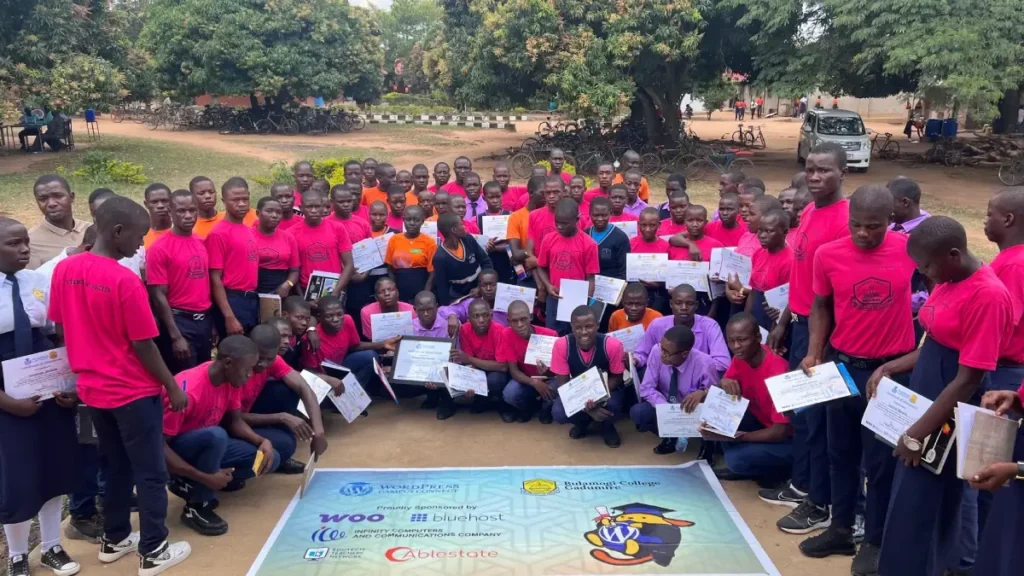
On July 29, a Campus Connect team arrived at Bulamogi College Gadumire in Kaliro, eastern Uganda—an event brought to fruition by alumna Mariam Nairuba, who had requested the program after attending a previous workshop.
Upon arrival, organizer Moses Ssebunya and his team, alongside first-time volunteer John Wayera, discovered that the school completely lacked electricity. With laptops, projectors, and extension cables rendered useless, the educators pivoted. Instead of canceling, they turned the event into an interactive forum. The resulting dialogue electrified the student body, proving that engagement relies as much on curiosity and human connection as it does on hardware.
Late July into August: Peer-Led STEM Initiatives in Costa Rica
Closing out the month, Rita Robles Loaiza published two pilot programs highlighting peer-to-peer instruction. In the first pilot, three students from Universidad Fidélitas designed a specialized WordPress workshop for 40 high school girls attending Patrones Hermosos, a prominent science and engineering camp brought to Costa Rica by Tecnológico de Monterrey and MIT.
Concurrently, 13 students at Liceo Experimental Bilingüe José Figueres Ferrer began working with the Costa Rican Spanish Polyglots team to translate WordPress core elements into the regional es_CR dialect, fulfilling their community service requirements.
Supporting Data and Operational Metrics
The quantitative growth of the WordPress Education initiatives underscores a maturing global infrastructure designed to bridge the digital divide.
| Metric / Indicator | Current Status (As of July) | Previous Baseline | Growth / Expansion |
|---|---|---|---|
| WordPress Credits Graduates | 226 total graduates | 199 graduates | +27 graduates (+13.5%) |
| Institutional Partners | 38 partner institutions | Regional pilot phase | Spanning 16 countries |
| Kishoreganj Website Output | 108 live sites in 2 weeks | N/A (New regional spike) | 150+ active student participants |
| Uganda Workshop Attendance | 100+ learners engaged | N/A | Successfully executed off-grid |
| Costa Rica STEM Workshop | 40 high school girls | N/A | 100% satisfaction rate recorded |
The data reveals a deliberate focus on regions historically underserved by traditional tech-sector recruitment pipelines. By establishing partnerships with polytechnic institutes, vocational schools, and regional high schools, the programs target demographic segments most likely to benefit from employable, localized digital skills.

Official Responses and Community Perspectives
The success of these global initiatives relies heavily on the dedication of volunteer organizers, educators, and student leaders who champion open-source values within their local communities.
Reflecting on the unexpected hurdles faced in Uganda, the organizing team noted the resilience of the students in their official event recap:
"The team had brought laptops, a projector, and extension cables, none of which were useful now. Rather than cancel, they put two questions to the room instead: what do you already know about WordPress, and what would you like to know? The room exploded."
The enthusiasm was mirrored in institutional responses across other regions. Following the workshop in Mataró, both students and faculty emphasized the immediate practical value of the curriculum. Participants noted that receiving a formal certificate alongside skills directly mapped to existing local job markets provided a tangible boost to student confidence.
In Costa Rica, the focus on localized contribution was highlighted by program leads. By tying translation efforts to school community service hours, the initiative effectively aligned civic duty with digital empowerment, ensuring that future generations of Costa Ricans will interact with software tailored to their linguistic nuances.
Broader Implications for Global Digital Literacy
The implications of the Campus Connect and WordPress Credits programs extend far beyond the immediate lines of code written in classrooms. By democratizing access to open-source tools, these initiatives address several critical challenges in modern education:
1. Bridging the Infrastructure Gap
As demonstrated at Bulamogi College Gadumire, access to electricity and high-end hardware remains unevenly distributed globally. However, the ability to foster conceptual understanding, critical inquiry, and digital literacy through non-traditional delivery methods proves that pedagogical frameworks can adapt to adverse conditions.

2. Economic Mobility and Regional Relevance
Traditional computer science curricula often focus on abstract theories that may feel disconnected from local job markets. By teaching practical web publishing, plugin development, and localization, these programs empower students to build digital portfolios, launch freelance micro-businesses, or support local enterprises looking to establish an online presence.
3. Fostering Open-Source Stewardship
The philosophy of the open-source movement relies on active contribution rather than passive consumption. Programs like WordPress Credits ensure that students are not merely users of technology, but active maintainers, translators, and developers of the global web infrastructure.
Looking Forward
As highlighted in the Monthly Education Buzz Report for July 2026, the momentum shows no signs of slowing. Upcoming initiatives include student-led Campus Connect sessions at institutions like the Kyoto University of Advanced Science and student-run clubs in Dhaka taking charge of their own regional events.
For schools, universities, or community groups interested in adopting the curriculum, the barrier to entry remains intentionally low. With standardized guides, mentor networks, and a scalable framework, WordPress Education is proving that the future of the web belongs to anyone willing to learn how to build it.