The Architecture of Intelligence: Merging Traditional Machine Learning with Agentic Reasoning
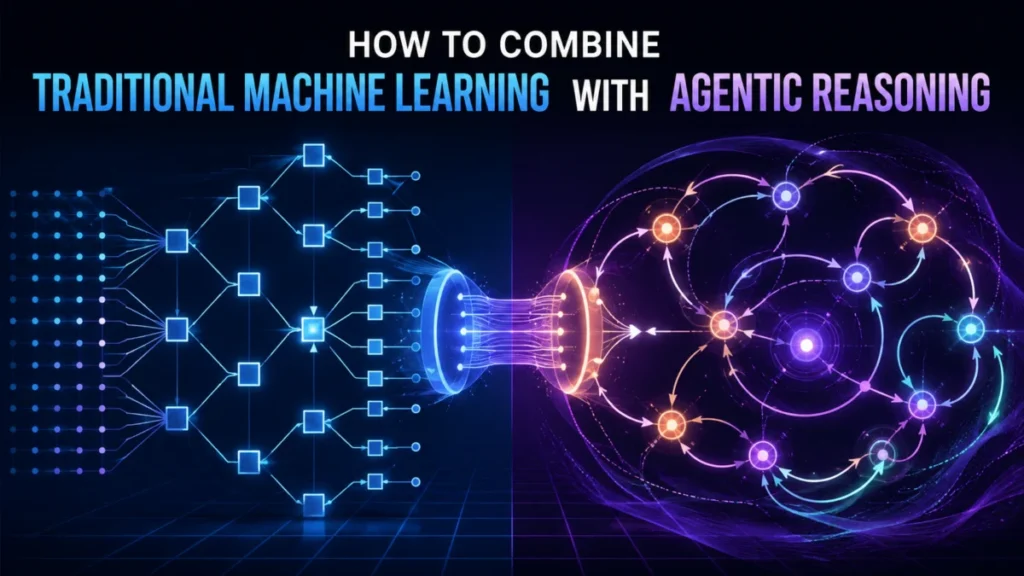
In the rapidly evolving landscape of artificial intelligence, we are witnessing a fundamental shift in how systems are architected. For years, the gold standard of AI was the high-performance, single-purpose predictive model. Today, however, the industry is moving toward "agentic" systems—AI capable of reasoning, planning, and taking autonomous action. This transition does not mark the end of traditional machine learning (ML); rather, it signals the birth of a hybrid era where deterministic precision meets cognitive flexibility.
The Foundation: The Power and Limits of Traditional ML
To understand where the industry is headed, we must first appreciate the bedrock upon which modern predictive systems are built. Traditional machine learning—specifically supervised learning—is the undisputed champion of pattern recognition.
The Precision of the Static Model
At its core, a supervised learning model is a mathematical function designed to map specific inputs to outputs. Whether it is a gradient-boosted tree predicting credit default risk or a deep neural network classifying medical imaging for early-stage malignancy, these systems excel at high-speed, high-volume inference.
Their primary strength lies in their reliability and auditability. Because these models operate on fixed, pre-defined features, their outputs are consistent. In high-stakes environments like banking or healthcare, this consistency is not just a feature; it is a regulatory requirement. These models can process millions of transactions per second, providing an objective probability score that serves as the basis for automated decision-making.
The Inherent Rigidity
Yet, this reliability comes at a cost: static operation. A traditional model is a snapshot of the world as it existed during its training phase. It lacks the "agency" to handle ambiguity. If a fraud detection model encounters a transaction that deviates significantly from its training distribution, it simply returns a confidence score based on the closest pattern it can find. It cannot pause to ask, "Why does this transaction look unusual?" or "Should I verify this with another database?"
For many real-world business problems, the "input-output" paradigm is insufficient. The real world is messy, non-linear, and requires iterative inquiry—characteristics that traditional ML is simply not designed to handle.
The Advent of Agentic Reasoning
If traditional ML is the "calculator" of the AI world, agentic reasoning is the "strategist." An agentic system is an AI entity capable of perceiving its environment, setting goals, decomposing those goals into actionable steps, and modifying its strategy based on the results of its own actions.
The Four Pillars of Agency
The rise of Large Language Models (LLMs) has provided the "reasoning engine" necessary to power these agents. Unlike a standard classifier, an agentic system leverages the reasoning capabilities of an LLM to manage four core functions:
- Planning: Agents can break down a complex, high-level request (e.g., "Investigate this suspicious insurance claim") into a series of logical sub-tasks.
- Tool Use: This is perhaps the most critical evolution. Agents can interface with APIs, SQL databases, search engines, and even traditional ML models to gather information that wasn’t present in their initial prompt.
- Adaptation (The Feedback Loop): If an agent attempts to retrieve a piece of data and fails, it does not simply crash or provide a wrong answer. It evaluates the failure, adjusts its query, or attempts an alternative path.
- Action: The output of an agent is not limited to a probability score. It can execute changes in the environment—updating a record, sending an email, or triggering a payment.
Chronology of the Shift: From Prediction to Orchestration
The transition toward agentic systems has followed a clear evolutionary path over the last decade.
- 2015–2019: The Era of Specialization. Focus was almost exclusively on optimizing predictive accuracy. Companies invested heavily in feature engineering and model fine-tuning to squeeze every percentage point of precision out of supervised models.
- 2020–2022: The Rise of Foundation Models. The introduction of Transformer-based architectures proved that massive, general-purpose models could perform well across a wide range of tasks, but they were still largely "chat-based" or "input-output" driven.
- 2023–Present: The Agentic Pivot. With the integration of "function calling" and reasoning chains (like Chain-of-Thought), the industry began to realize that LLMs could serve as the "brain" or orchestrator of a system, while smaller, specialized ML models acted as the "limbs" that perform specific, data-heavy tasks.
Supporting Data: Why Hybrid Systems Win
Research into industrial AI deployment indicates that businesses using hybrid architectures—those combining traditional ML with agentic workflows—see significant performance improvements in complex operational environments.
- Latency vs. Capability: While an agentic workflow is inherently slower than a single-model inference, the total time to resolution for complex tasks is reduced by as much as 60-70% because the agent eliminates the need for human "middlemen" to manually connect the dots between disparate systems.
- Error Rates: In multi-step processes, relying on a single large model to do everything often leads to "hallucinations." However, when an agent delegates the math and classification to specialized, deterministic models, the hallucination rate drops significantly, as the agent is merely the orchestrator, not the sole source of truth.
Case Study: The Insurance Claims Lifecycle
To illustrate the implications, consider the modern insurance claims lifecycle.
Without Agentic Reasoning: An automated system flags a claim as "high fraud risk" based on a traditional model. It then sends an alert to a human adjuster. The adjuster must manually log into three different databases, read the policy document, check the provider’s history, and draft a summary. This is a bottleneck.
With Agentic Reasoning:
- Orchestration: The agent receives the notification.
- Tool Invocation: It queries the internal database for the policy details.
- Specialized Inference: It sends the specific claim data to a traditional ML fraud-detection model.
- Synthesis: Based on the model’s score (e.g., 85% risk), the agent cross-references the provider’s history in a separate system.
- Action: It generates a summary document for the adjuster, including the "reasoning trace" (a step-by-step log of why it reached the conclusion), and pre-fills the rejection or investigation form.
The human adjuster now moves from being a data-gatherer to being a decision-maker. They don’t have to hunt for information; the agent has already done the legwork.
Implications for Industry and Enterprise
The move toward agentic systems has profound implications for enterprise architecture and the future of work.
1. The Death of "Brittle" Automation
For years, companies relied on rigid, rule-based workflows (e.g., "If X, then Y"). These systems were notoriously difficult to maintain and broke whenever the business process changed. Agentic systems, by contrast, are flexible. If the business process changes, you update the agent’s instructions rather than rewriting thousands of lines of procedural code.
2. The New Role of Traditional ML Models
Traditional models are not becoming obsolete; they are becoming components. A machine learning engineer’s job description is shifting from building standalone models to building "tools" that agents can utilize. The value of a high-accuracy model actually increases in an agentic ecosystem, because the agent relies on the quality of that model’s output to make reliable decisions.
3. Human-in-the-Loop 2.0
The goal of agentic AI is not to remove humans from the loop, but to elevate them. By automating the "connective tissue" of business operations—the gathering, formatting, and summarizing of information—AI allows humans to focus on the high-level judgment calls that require empathy, ethics, and strategic foresight.
Conclusion: A Collaborative Future
The dichotomy between traditional machine learning and agentic reasoning is a false one. The most powerful AI systems of the next decade will not choose one over the other. Instead, they will use traditional machine learning for the heavy lifting of pattern recognition and statistical inference, and use agentic reasoning for the complex, multi-step orchestration that characterizes human work.
As we look toward the future, the winners in the AI space will be those who stop viewing AI as a "black box" that produces a single number, and start viewing it as an "agent" that participates in the workflow. By embedding precision-engineered models into dynamic, reasoning-capable agents, organizations can finally bridge the gap between AI’s predictive potential and the operational reality of the enterprise. The era of the "AI Worker" has arrived—and it is built on the strength of both the calculator and the strategist.