Breaking Language Barriers: The Evolution of Multilingual Text Classification with Scikit-LLM
In the rapidly evolving landscape of Natural Language Processing (NLP), the challenge of building global-scale machine learning applications has long been a significant bottleneck. Traditionally, developers aiming to create text classifiers for a worldwide audience faced a grueling choice: build and maintain individual models for every language in their target market, or rely on costly, latency-prone machine translation services to standardize data into a single tongue.
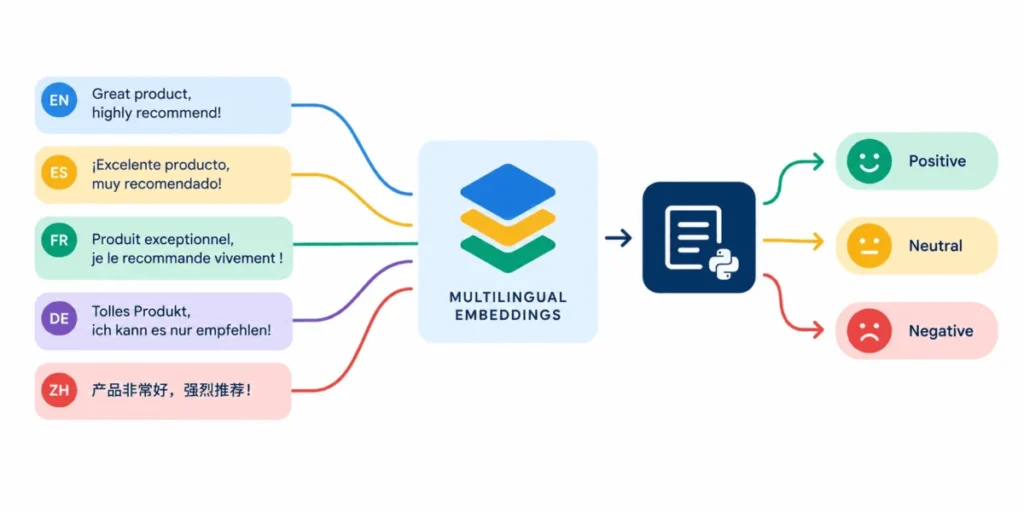
Today, that paradigm is shifting. Through the convergence of Large Language Model (LLM) embeddings and user-friendly frameworks like Scikit-LLM, developers can now deploy sophisticated, multilingual classification pipelines that operate with unprecedented agility. By leveraging "barrier-free" embeddings—numerical representations that map disparate languages into a shared vector space—we can bypass the need for language-specific training entirely.
The Paradigm Shift: From Monolingual Silos to Universal Embeddings
The core of this innovation lies in multilingual embedding models, such as the state-of-the-art BGE-M3. Unlike older techniques that treated text as a bag of words or language-dependent features, modern LLM-based embeddings focus on semantic meaning.
When a model like BGE-M3 encodes text, it doesn’t just look at the syntax or vocabulary; it maps the underlying concept into a high-dimensional vector. Consequently, the vector for "This product is fantastic!" in English and "¡Este producto es fantástico!" in Spanish end up being mathematically proximal in the embedding space. This allows a downstream classifier, such as a Logistic Regression model, to perform its duties without ever needing to "know" which language it is processing.
Implementation: A Technical Chronology
Building this pipeline requires a strategic setup that prioritizes local execution to avoid the privacy and cost pitfalls of proprietary cloud APIs.
1. Environment Orchestration
The first step in our implementation is establishing the infrastructure. For developers working in environments like Google Colab or local IDEs, utilizing Ollama—a distribution platform for local LLMs—is the most efficient path. By installing the necessary Python dependencies (scikit-llm and datasets) and triggering the Ollama server, we create a private, high-performance environment for inference.
# Installing Python dependencies
pip install scikit-llm "datasets==2.19.1" -q

# Starting the Ollama server in the background
import subprocess
import time
subprocess.Popen(["ollama", "serve"])
time.sleep(5)
ollama pull bge-m3
2. Data Acquisition and Normalization
To demonstrate the efficacy of this approach, we utilize the Amazon Multi-language Reviews dataset. By extracting a balanced sample of 2,000 reviews—1,000 in English and 1,000 in Spanish—we create a testbed for the model. Shuffling this data is critical; it ensures that the model learns to identify sentiment based on the quality of the review rather than the linguistic structure associated with a specific language cluster.
3. Constructing the Pipeline
The pipeline architecture is elegant in its simplicity. By wrapping the GPTVectorizer (configured to use the BGE-M3 model) and a LogisticRegression classifier into a single Scikit-learn Pipeline object, we create a seamless flow from raw text input to classification output.
from skllm.models.gpt.vectorization import GPTVectorizer
from sklearn.pipeline import Pipeline
from sklearn.linear_model import LogisticRegression

pipeline = Pipeline([
    ("vectorizer", GPTVectorizer(model="bge-m3", batch_size=32)),
    ("classifier", LogisticRegression(max_iter=1000))
])
Supporting Data: Assessing Model Performance
Following the training phase, the model was evaluated against a held-out test set. The results provide a compelling snapshot of current capabilities in zero-shot cross-lingual transfer.
| Metric | Performance |
|---|---|
| Accuracy | 0.57 |
| Macro Avg F1-Score | 0.56 |
| Weighted Avg F1-Score | 0.56 |
The metrics reveal that the model demonstrates high proficiency in identifying extreme sentiment—specifically, 1-star (0) and 5-star (4) reviews. However, the nuance of intermediate ratings (2, 3, and 4 stars) presents a higher degree of difficulty.
Analyzing the Performance Gap
The variance in performance can be attributed to two primary factors:
- Semantic Overlap: Intermediate reviews often contain ambiguous language that is harder to categorize without significant domain-specific fine-tuning.
- Class Imbalance/Dataset Size: While 2,000 samples are sufficient for a proof-of-concept, modern LLM-based classifiers typically benefit from larger datasets to capture the subtle linguistic cues that differentiate a 3-star "mediocre" review from a 4-star "good" review.
Implications for Global Business
The implications of this technology for modern enterprises are profound. In the past, a global e-commerce entity would have needed to hire language-specific data science teams to maintain models for every major market they entered. This was not only expensive but slowed the "time to market" for new product categories.
By utilizing a universal pipeline, companies can now:
- Scale rapidly: Launching in a new region requires no new model training; the existing BGE-M3 pipeline handles the new language immediately.
- Reduce infrastructure costs: By offloading the heavy lifting to open-source embedding models run on local or private cloud infrastructure, companies eliminate the "per-token" costs associated with commercial LLM APIs.
- Maintain consistency: A single, centralized model ensures that the definition of a "positive review" remains consistent across the entire organization, regardless of the customer’s native language.
Future Outlook: Moving Beyond Linear Models
While the current implementation uses Logistic Regression for its speed and interpretability, the pipeline is highly modular. As we move forward, the "classifier" stage of the pipeline can be easily upgraded to more complex models, such as Gradient Boosting Machines (XGBoost) or even small Neural Networks, to further refine accuracy on the intermediate sentiment classes identified in our evaluation.
Furthermore, as embedding models like BGE-M3 continue to iterate, the "barrier-free" nature of these vectors will only improve. We are entering an era where the language in which a customer writes is no longer a filter through which data must pass, but rather just another attribute of the user experience.
Conclusion
The shift toward multilingual embedding pipelines represents a maturation of the machine learning field. By moving away from the cumbersome, siloed models of the past and toward a unified, LLM-powered architecture, developers can build systems that are as diverse as the audiences they serve.
The pipeline we have constructed here—leveraging the synergy between scikit-learn and the Scikit-LLM framework—serves as a robust blueprint for any organization looking to streamline its multilingual NLP operations. It is a testament to the fact that when we simplify our infrastructure, we don’t just reduce complexity; we open the door to a more connected and data-driven global digital ecosystem. Whether you are a solo developer or part of a multinational enterprise, the tools to bridge the language divide are no longer out of reach—they are ready to be deployed.