Unlocking the Black Box: Building a Vector Database from Scratch
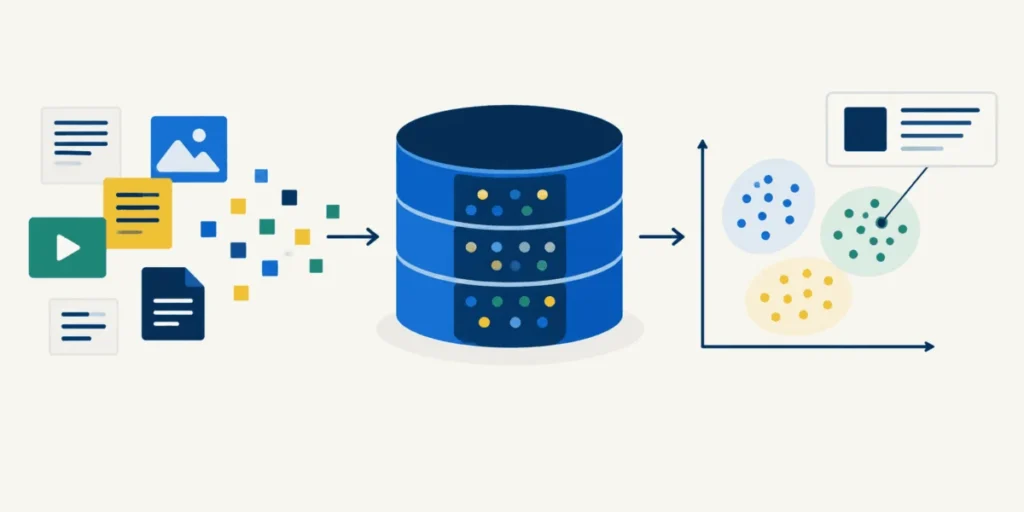
In the rapidly evolving landscape of modern artificial intelligence, the vector database has emerged as the unsung hero of the generative era. While Large Language Models (LLMs) provide the reasoning power, vector databases serve as the "long-term memory," allowing systems to retrieve relevant context in milliseconds. But how do these systems actually function beneath their polished, API-driven surfaces?
By stripping away the complex abstractions, we can reveal that at its heart, a vector database is not magic—it is a study in linear algebra. In this comprehensive guide, we will deconstruct the architecture of a vector database by building a functional version from the ground up using nothing more than Python and NumPy.
The Paradigm Shift: Meaning Over Keywords
Traditional database systems rely on exact keyword matching. If you search for "energy production in cells," a traditional index looks for those specific strings. A vector database, conversely, operates in the realm of semantic meaning.
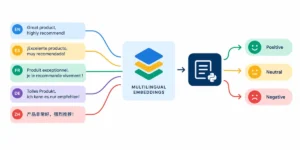
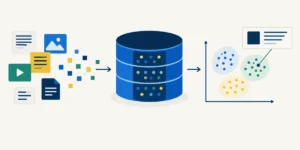
It achieves this by converting text into "embeddings"—high-dimensional vectors of numbers. When a query is made, it is also transformed into a vector. The database then calculates the mathematical distance between the query vector and the document vectors. If two vectors point in a similar direction, they are deemed semantically related. This allows for powerful "fuzzy" matching, where a query for "superheroes" can successfully retrieve documents about Tony Stark or Bruce Banner, even if the word "superhero" never appears in the text.
Chronology of Development: A 10-Step Implementation
To demystify this process, we follow a ten-step incremental development path. This journey requires no GPUs and no expensive cloud subscriptions; it is a purely computational exercise.
Phase 1: Foundation and Setup
The journey begins by establishing a clean workspace. By utilizing the sentence-transformers library to handle the heavy lifting of embedding generation and NumPy for the matrix operations, we create a robust environment. We define two helper functions: header(), to organize our console output, and show(), which formats our retrieval results into a readable table containing scores, topics, and snippets.
Phase 2: Indexing and Dimensionality
When we call the add() function, the database processes our corpus. A critical insight here is the consistency of the index: regardless of whether a document is a single sentence or a lengthy essay, the embedding model flattens it into a fixed-length vector (e.g., 384 dimensions). This fixed size ensures that the index remains predictable in memory and computationally cheap to scan, regardless of the input text length.
Phase 3–5: Search Mechanics and Scoring
The initial search experiments reveal the true power of this architecture. In our tests, we queried "what keeps a cell supplied with energy?" and successfully retrieved results regarding mitochondria—despite the query and the documents sharing minimal linguistic overlap.
We also observe the nature of "scores." Unlike keyword matches, vector scores represent similarity levels. In production environments, this allows developers to set a "confidence floor," ensuring that the system only returns results that meet a specific threshold of semantic relevance, thereby reducing "hallucinations" in downstream applications.
Phase 6–8: Bookkeeping and Safety
A database is only as good as its management features. We implement metadata filtering, which allows users to constrain searches by specific categories—such as "bio" or "music." We also introduce "guard rails" to prevent common developer errors, such as misaligned metadata arrays or incorrect input types. These safeguards ensure the integrity of the index, preventing the "silent corruption" of data that often plagues hastily built systems.
Phase 9–10: Persistence and Scalability
The final steps involve saving the index to disk using .npy for raw vector storage and .json for metadata. We conclude by testing the system’s scalability. By generating a synthetic corpus of 100,000 vectors, we demonstrate that the time taken to scan the data scales linearly, proving that the underlying math is capable of handling production-level loads with minimal latency.
Supporting Data: The Performance Breakdown
The efficiency of a vector database is largely dictated by the speed of the matrix multiplication. When we measure the performance of our implementation, the results are illuminating.
| Documents | Memory | Scan Time | Rank Time |
|---|---|---|---|
| 1,000 | 1.5 MB | 0.01 ms | 0.04 ms |
| 10,000 | 14.6 MB | 0.36 ms | 0.55 ms |
| 100,000 | 146.5 MB | 3.73 ms | 8.90 ms |
As shown above, the "scan" operation—the process of comparing the query vector against the entire corpus—is remarkably fast. Even with 100,000 documents, the entire operation completes in under 13 milliseconds. This performance is a direct result of NumPy’s optimized C-based back-end, which performs batch matrix operations far more efficiently than standard iterative loops.
Official Perspective: The Role of Managed Services
While building a vector database from scratch is an invaluable educational exercise, industry experts note that the transition from a prototype to a massive, distributed system involves significant challenges.
"The core logic we’ve built—the cosine similarity search—is the engine," says a lead engineer in the field of vector search. "But when you scale to millions of documents, you encounter the ‘curse of dimensionality.’ At that point, you move away from exhaustive linear scans to Approximate Nearest Neighbor (ANN) algorithms like HNSW (Hierarchical Navigable Small World). This is the primary value proposition of managed vector databases: they handle the complex indexing structures that allow for logarithmic, rather than linear, search times."
Implications for Future AI Development
The implications of this technology are profound. By understanding that semantic search is essentially a series of dot products, developers can stop treating vector databases as "black boxes" and start treating them as tunable, predictable components of their software stack.
The Democratization of Search
As we have demonstrated, you do not need a massive R&D budget to implement state-of-the-art semantic search. The barrier to entry for building sophisticated, context-aware AI applications has been significantly lowered. This enables smaller teams to build custom RAG (Retrieval-Augmented Generation) pipelines that are highly specialized, private, and efficient.
The Future of Data Storage
The design we explored—the decoupling of the embedding model from the search index—is the blueprint for the next generation of data storage. We are moving toward a future where "data" is no longer just text or images, but a fluid representation of meaning that can be queried, filtered, and analyzed with mathematical precision.
Conclusion
The architecture of a vector database is a testament to the power of simplicity. By scaling embeddings to a unit length, we turn the complex problem of semantic understanding into the straightforward operation of a dot product. Every feature we added—metadata filters, serialization, and input validation—served only to ensure that the mathematical integrity of the index remained intact.
Whether you are managing 25 documents or 25 million, the fundamental principles remain identical. The only difference is the sophistication of the index structure beneath the surface. By mastering these basics, you are not just learning how to build a database; you are learning how to organize the knowledge of the digital age.