Two Decades in the Cloud: How Amazon EC2 Redefined Global Computing Infrastructure
SEATTLE — Two decades ago, a single blog post quietly published by Jeff Barr fundamentally altered the trajectory of the technology industry. On that day, Amazon Web Services (AWS) launched the beta version of Amazon Elastic Compute Cloud (EC2). It was an offering that seemed deceptively simple: resizable Linux virtual servers hosted in the cloud, billed strictly by the hour, accessible via a single instance type (m1.small) restricted to a solitary geographical region (US East).
Yet, that minimalist framework carried a radical proposition. By untangling software infrastructure from physical hardware, Amazon EC2 democratized access to enterprise-grade computing power. Startups no longer needed to mortgage their offices to buy servers, and multinational enterprises could spin up infrastructure in minutes instead of months.
Today, as AWS celebrates EC2’s 20th anniversary, the service has evolved from an experimental cloud utility into the invisible, beating heart of the modern internet. Powering everything from simple web applications to massive, trillion-parameter artificial intelligence training clusters, EC2 has transformed into an expansive, global ecosystem that underpins nearly every major technological leap of the 21st century.
Main Facts: The Genesis and Scale of a Cloud Titan
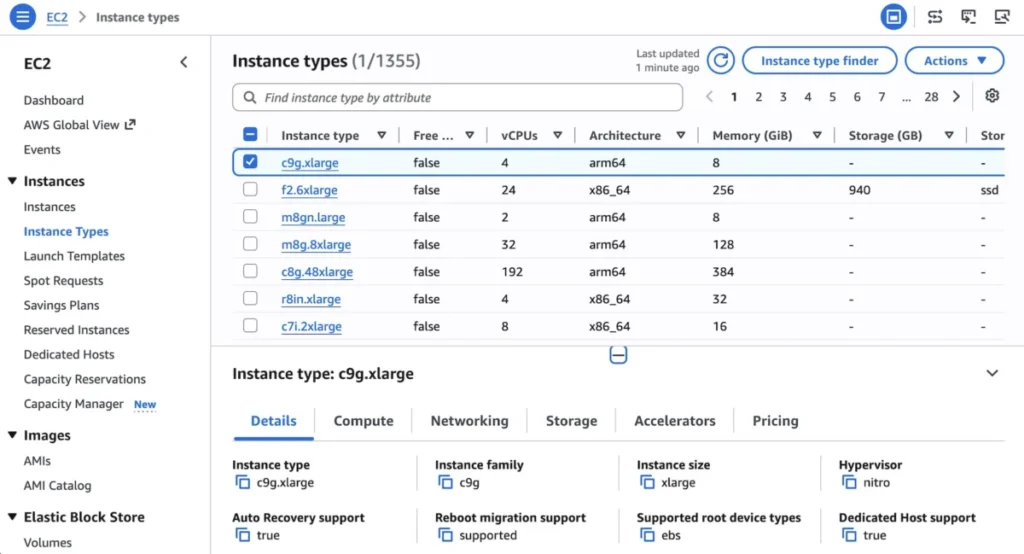
The scale of Amazon EC2 today defies the modest expectations of its 2006 debut. What began as one instance type in one region has ballooned into an astonishing portfolio of over 1,200 distinct instance types. These optimized configurations cater to virtually every computational niche imaginable, spanning general-purpose computing, memory-intensive operations, storage-heavy databases, high-performance computing (HPC), and specialized accelerated computing for machine learning.
Geographically, EC2’s footprint has expanded in tandem with its technical capabilities. From its lone US East origin, the service now operates across 39 distinct AWS Regions worldwide. Furthermore, AWS has aggressively pushed the boundaries of traditional data center models, extending EC2 directly into customers’ on-premises data centers via AWS Outposts, placing computing power closer to end-users through AWS Local Zones, and embedding instances directly inside global 5G telecommunications networks with AWS Wavelength.
Despite two decades of hyper-evolution, the core value proposition of Amazon EC2 remains remarkably steadfast. Customers retain the ability to provision secure, resizable compute capacity in mere minutes, pay exclusively for the resources they consume, and scale dynamically on demand without ever entering into rigid, long-term physical hardware contracts.
Chronology: Milestones That Shaped the Cloud Era
The journey from a basic virtual private server beta to a globally distributed compute grid was forged through a series of foundational architectural breakthroughs. Examining EC2’s 20-year timeline reveals how AWS systematically solved enterprise computing challenges, layer by layer:
2006–2008: Establishing Persistence
- August 2006: Jeff Barr launches the Amazon EC2 Beta, introducing on-demand virtual Linux servers billed hourly.
- 2008: The introduction of Amazon Elastic Block Store (EBS) solves a critical limitation by providing persistent, low-latency block storage that can be attached independently to running EC2 instances, making database workloads viable in the cloud.
2009–2011: Scalability, Availability, and Isolation
- 2009: AWS introduces Elastic Load Balancing (ELB), Auto Scaling, and Amazon CloudWatch, giving architects the native tools to automatically distribute incoming application traffic, scale compute capacity up or down based on real-time demand, and monitor system health comprehensively.
- 2009: The launch of Amazon Virtual Private Cloud (VPC) revolutionizes enterprise cloud adoption by allowing customers to provision logically isolated virtual networks, bringing enterprise-grade security perimeters to public cloud infrastructure.
2017–2018: Hardware Offloading and Custom Silicon
- 2017: AWS debuts the AWS Nitro System, a revolutionary combination of dedicated hardware and custom security chips. By offloading virtualization, storage, and networking functions from the host CPU to Nitro cards, AWS unlocks near-bare-metal performance, drastically enhanced security, and rapid innovation cycles.
- 2018: Breaking away from traditional x86 duopolies, AWS introduces AWS Graviton processors, custom-designed ARM-based chips optimized to deliver superior price-to-performance ratios for scale-out workloads.
- 2018: AWS Outposts bridges the physical gap, allowing customers to run native EC2 infrastructure seamlessly on-premises.
2019–Present: Edge Computing and AI Scaling
- 2019: AWS expands past traditional data centers with AWS Local Zones for ultra-low latency applications and AWS Wavelength, embedding EC2 compute directly inside 5G carrier networks.
- 2020–2026: EC2 scales massively to support modern artificial intelligence. Custom silicon families—such as AWS Trainium and Inferentia—are integrated into EC2 accelerated computing instances, forming the backbone for modern generative AI and foundational model training.
Supporting Data: The Architecture Beneath the Entire AWS Stack
To fully understand the monumental impact of Amazon EC2, one must look at how it functions as the bedrock of the entire AWS product portfolio. While end-users often interact with higher-level abstractions, nearly every modern AWS service relies on EC2 capacity under the hood.
- Containerization and Orchestration: Services like Amazon ECS (Elastic Container Service), Amazon EKS (Elastic Kubernetes Service), and serverless container engines like AWS Fargate all utilize underlying EC2 compute infrastructure to run containerized workloads at scale.
- Serverless and Batch Computing: AWS Lambda (serverless functions) and AWS Batch manage resource abstraction layers, yet their execution environments ultimately depend on finely tuned EC2 hypervisor architecture.
- Big Data and Analytics: Amazon EMR (Elastic MapReduce) spins up clusters of EC2 instances to process petabytes of data using frameworks like Apache Spark and Hadoop.
- Artificial Intelligence and Machine Learning: High-end AI training and inference pipelines executed through Amazon SageMaker AI and Amazon Bedrock rely fundamentally on GPU- and accelerator-packed EC2 instances to handle the staggering computational demands of trillion-parameter neural networks.
Every technological pattern built over the past two decades—ranging from rudimentary corporate websites to the most sophisticated global AI platforms—ultimately traces back to a single architectural decision: launching an EC2 instance.
Official Responses and Reflections
Reflecting on the milestone, AWS leadership and veteran architects emphasize that the secret to EC2’s enduring success lies in restraint, rapid iteration, and a relentless focus on customer utility.

In a retrospective essay marking the anniversary, AWS representatives noted that the foundational decisions made in 2006 deliberately left room for exponential service growth. By committing to a philosophy of building minimal-yet-useful primitives, launching quickly, and iterating rapidly based on community feedback, AWS established a blueprint that continues to dictate product development today.
"We made strong foundational decisions in 2006, and we left room for the service to grow," AWS engineering leads shared in an official blog post. "Twenty years later, that strategy… continues to guide how we build. The next twenty years of cloud computing will demand capabilities we have not yet imagined. Amazon EC2 will continue to be the foundation where your workloads run."
Industry analysts and early cloud pioneers have similarly lauded the platform. Many note that while competitors have emerged—including Microsoft Azure, Google Cloud Platform, and numerous specialized providers—Amazon EC2 established the psychological and economic baseline that transformed IT from a localized capital expenditure model into a global, on-demand utility.
Implications: The Next Twenty Years of Cloud and AI Computing
As Amazon EC2 enters its third decade, the implications of its ongoing evolution point toward an increasingly automated, intelligent, and distributed computing future.
The AI Imperative
When EC2 was launched in 2006, the primary bottlenecks for companies were storage, server provisioning speeds, and network scaling. Today, the frontier has shifted entirely to accelerated computing. As generative AI models grow exponentially in scale and complexity, EC2 has had to reinvent itself. The integration of specialized silicon—such as AWS Graviton for general-purpose efficiency, alongside Trainium and Inferentia chips for machine learning—demonstrates that EC2 is no longer just a virtual machine rental service. It has evolved into a hyper-specialized supercomputing engine capable of training the next generation of artificial general intelligence.
Edge and Hybrid Dominance
The expansion of EC2 via Outposts, Local Zones, and Wavelength signals a clear industry trajectory: computation is moving closer to where data is generated. As Internet of Things (IoT) devices, autonomous vehicles, and real-time 5G applications proliferate, the traditional centralized data center model is insufficient. By pushing EC2 nodes to the network edge, AWS ensures that ultra-low-latency applications can execute locally while maintaining a seamless management bridge to the broader cloud infrastructure.
The Undiminished Core Promise
Despite these seismic shifts in technology, the ultimate implication of EC2’s longevity is the validation of the cloud utility model. Enterprises no longer view infrastructure as a differentiator requiring heavy capital investment; instead, raw compute has become as reliable and ubiquitous as electricity or running water.
For developers, architects, and global enterprises, the message twenty years on remains unchanged: whether deploying a basic container or training a foundational AI model that spans thousands of nodes, the journey begins the same way it did in August 2006—with a single, powerful command to launch an instance.