Beyond the Next Token: Mastering Chain of Thought and Tree of Thoughts for AI Agents
In the rapidly evolving landscape of Large Language Model (LLM) deployment, the difference between a functional AI agent and a transformative one often comes down to a single, critical factor: how the model "thinks."
Large language models are fundamentally probabilistic engines. By design, they are trained to predict the next most likely token based on the preceding context. While this architecture produces remarkably fluent prose, it is inherently ill-equipped for the kind of deep, iterative reasoning required for complex problem-solving. Left to their own devices, LLMs tend to jump from a prompt to a conclusion, a "reflexive" response that works for simple queries but falters under the weight of multi-step logical requirements.
To bridge this gap, the industry has pivoted toward structured reasoning frameworks. Two primary methodologies—Chain of Thought (CoT) and Tree of Thoughts (ToT)—have emerged as the gold standards for enhancing AI performance. Understanding when to deploy these techniques is no longer just a technical nuance; it is a fundamental requirement for building robust, reliable, and high-performance AI agents.
The Core Problem: Why "Next Token" Prediction Isn’t Enough
The primary architectural limitation of standard LLMs is their lack of a "scratchpad." When a human faces a complex mathematical proof or a convoluted strategic planning task, we break the problem into components, test hypotheses, and verify intermediate results. Standard LLMs, however, are essentially linear.
When a model is asked to solve a multi-layered problem without guidance, it attempts to generate an answer in one continuous stream. This results in the "confident but wrong" phenomenon: the model produces a response that sounds linguistically perfect but is logically hollow. Because the model lacks a mechanism to pause, verify, or pivot, an error made at the start of a sequence inevitably cascades into the final output.
Chain of Thought (CoT): The Architecture of Linear Logic
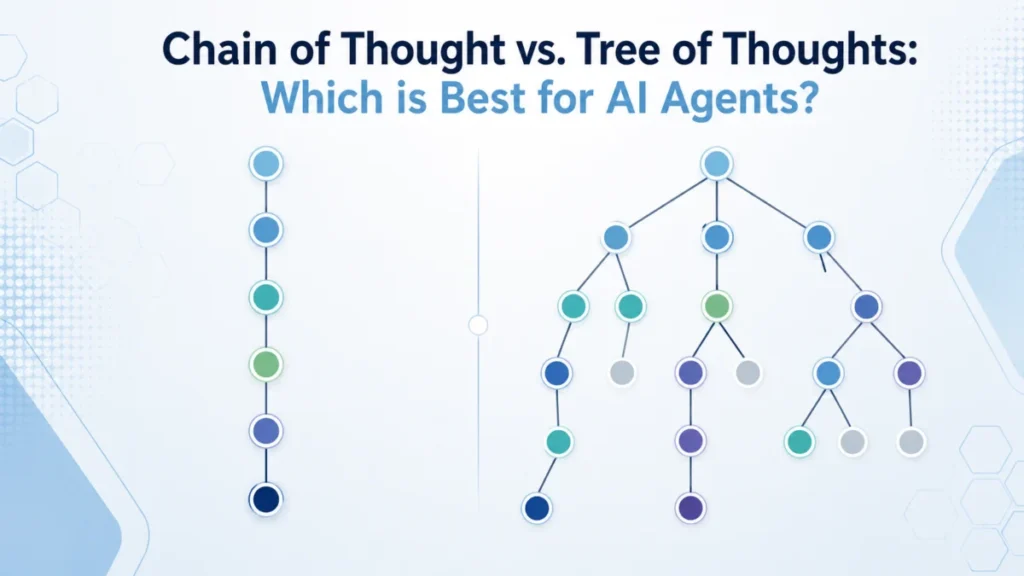
Chain of Thought is the foundational approach to improving LLM reasoning. At its core, CoT forces the model to externalize its internal process. By generating a sequence of intermediate reasoning steps before arriving at a final answer, the model effectively "shows its work."
How it Works
The simplest implementation of CoT is "zero-shot prompting," often triggered by the iconic phrase: "Let’s think step by step." This simple instruction recalibrates the model, shifting its focus from generating an immediate conclusion to drafting a logical progression. More advanced implementations use "few-shot prompting," where developers provide the model with a series of examples demonstrating the desired logical format.
Chronology and Development
- Initial Discovery: Early researchers identified that models performed significantly better on arithmetic and symbolic reasoning tasks when forced to generate intermediate chains.
- Scaling: As models grew in parameter count, the effectiveness of CoT became more pronounced, leading to its integration into standard prompting libraries for major LLMs like GPT-4 and Claude.
- The Limitation: Despite its success, CoT is strictly linear. It assumes that the path to the solution is a straight line. If the model takes a wrong turn at step two, it has no native mechanism to realize the error until the entire sequence is completed—often too late to fix.
Tree of Thoughts (ToT): The Architecture of Deliberate Exploration
Tree of Thoughts represents a significant leap in sophistication. If CoT is like a student showing their work on a math test, ToT is like a grandmaster chess player considering multiple variations of a game.
The Mechanics of Branching
ToT breaks a problem into "thought units." At each step, the model generates multiple potential next steps or "branches." A search algorithm—often modeled on classic computer science techniques like Breadth-First Search (BFS) or Depth-First Search (DFS)—then evaluates these branches.
- Generation: The model creates several candidate paths.
- Evaluation: Each path is assigned a score or a qualitative assessment of its probability of leading to a correct solution.
- Search & Selection: The system selects the most promising path.
- Backtracking: If a path hits a dead end or receives a low evaluation score, the system "prunes" that branch, backtracks to a previous, more promising state, and explores an alternative route.
Why ToT Changes the Game
The ability to backtrack is the defining feature of ToT. It transforms the reasoning process from a "guess-and-check" linear model into a dynamic search process. This is particularly vital for tasks where the "solution space" is vast and ambiguous, such as creative writing, complex software architecture, or high-level strategic planning.
Supporting Data: Costs vs. Benefits
The decision to implement one framework over the other involves a calculated trade-off between accuracy and computational overhead.
| Feature | Chain of Thought (CoT) | Tree of Thoughts (ToT) |
|---|---|---|
| Complexity | Low (Linear) | High (Branching) |
| Computational Cost | Minimal | Very High (Multiple calls) |
| Error Recovery | None (Inherits errors) | High (Backtracking enabled) |
| Ideal Task | Math, logic, summarization | Strategic planning, coding, design |
Implications of Cost:
ToT requires multiple model calls per problem. If an agent explores five branches at three different steps, it might trigger 15-20 calls to the LLM. For businesses running agents at scale, this introduces significant latency and increases API costs exponentially. Therefore, ToT is rarely used for "chatty" tasks and is reserved for mission-critical, high-complexity operations.
AI Agent Integration: From Prompting to Systems
When transitioning from simple chatbots to autonomous AI agents, the reasoning framework becomes the "brain" of the operation.
Chain of Thought as the Agent’s Default
For most agents, CoT is the primary reasoning layer. When an agent is tasked with basic operations—such as "Search for this email and summarize it"—the logic is straightforward. A linear chain of thought allows the agent to break the command into discrete steps:
- Search database.
- Retrieve relevant content.
- Synthesize summary.
- Present to user.
This is efficient, auditable, and cost-effective.
Tree of Thoughts for Specialized Agentic Tasks
Conversely, an agent tasked with, for example, "Develop a marketing campaign for a new product with a $50,000 budget, accounting for current market volatility," requires ToT. The agent must:
- Generate multiple campaign hypotheses.
- Evaluate each against the budget constraints.
- Simulate potential market outcomes for each.
- Discard the weaker strategies.
- Refine the best-performing strategy.
In this scenario, the "cost" of using ToT is an investment in the quality of the strategic outcome. The ability to simulate consequences before committing to an action is the difference between a high-performing agent and one that generates generic, unusable content.
Official Perspectives and Industry Trends
Leading AI research institutions, including OpenAI and DeepMind, have increasingly moved toward "System 2" thinking frameworks. This concept, popularized by Daniel Kahneman, distinguishes between intuitive, fast thinking (System 1) and analytical, slow thinking (System 2).
CoT and ToT are essentially implementations of System 2 thinking for AI. Industry leaders suggest that the future of agentic AI lies in "hybrid architectures." In these systems, the agent assesses the difficulty of a prompt in real-time. If the query is simple, it defaults to a rapid CoT path. If the query is identified as complex or high-stakes, the agent automatically "spins up" a ToT search process to ensure accuracy.
Implications for the Future
As AI agents become integrated into the core of enterprise workflows, the ability to select the right reasoning framework will define the competitive advantage of a company.
- Reliability: By utilizing ToT for high-stakes decision-making, organizations can reduce the "hallucination" rates that currently hinder the adoption of autonomous agents in fields like law, medicine, and engineering.
- Resource Allocation: The future of AI development will rely on optimizing these reasoning paths to reduce the cost of ToT, potentially through smaller, specialized models that handle the evaluation step, while the primary LLM focuses on generation.
- Governance: As agents begin to "think" in branches, auditability becomes paramount. Logging the reasoning tree allows human supervisors to understand not just what the agent decided, but what other paths it considered and rejected, providing a new layer of transparency.
Conclusion
The evolution from simple "next-token" prediction to sophisticated reasoning frameworks like Chain of Thought and Tree of Thoughts marks a maturation of the AI industry. We are moving away from the era of "brute force" scaling and into an era of "architectural intelligence."
For developers and stakeholders, the goal is not to choose between CoT and ToT, but to master the orchestration of both. Chain of Thought provides the necessary efficiency for the day-to-day, while Tree of Thoughts provides the intellectual depth required to solve the most intractable problems of our time. By matching the reasoning framework to the complexity of the task, we empower AI agents to be not just faster, but genuinely smarter.