Mastering LLM Lifecycle Management: Versioning and Tracking Scikit-LLM Pipelines with MLflow
In the rapidly evolving landscape of artificial intelligence, the transition from experimental notebook code to production-grade machine learning systems is often fraught with complexity. This is particularly true when integrating Large Language Models (LLMs) into traditional machine learning workflows. As developers increasingly rely on scikit-learn for its simplicity and modularity, the need for robust tools to manage, version, and register these pipelines has never been more critical.
This article provides a comprehensive exploration of how to build, track, compare, and register scikit-learn pipelines that leverage the power of LLMs. By combining the Scikit-LLM library—which bridges the gap between LLMs and the familiar scikit-learn API—with MLflow, the industry-standard open-source platform for the ML lifecycle, developers can ensure reproducibility, maintainability, and operational excellence.
The Strategic Imperative: Why Versioning Matters in LLM Workflows
In modern data science, "model drift" is a well-understood phenomenon, but in the era of LLMs, we face a new challenge: "backend instability." Whether you are calling an API or running a quantized local model like gpt4all, the underlying LLM configuration—the weights, the quantization method, or even the prompt engineering strategy—can change.
Without a systematic approach to versioning, a pipeline that performs exceptionally today may become unpredictable tomorrow due to a subtle change in the LLM backend. By implementing a formal tracking strategy using MLflow, engineering teams can:
- Ensure Reproducibility: Pin exactly which LLM version and parameter set produced a specific output.
- Enable A/B Testing: Compare the performance of different model backends (e.g., Orca-Mini vs. Falcon) in a side-by-side, data-driven environment.
- Simplify Deployment: Move from a "lab" environment to a production registry with a clear, audited audit trail.
Phase I: Foundational Setup and Configuration
Before diving into the logic of the pipeline, one must establish a stable foundation. The environment requires the scikit-llm library (configured for local execution) and mlflow for orchestration.
The Installation Stack
For those operating in cloud-based environments like Google Colab or managed Jupyter instances, the installation is straightforward but requires specific care regarding dependencies. Using the [gpt4all] extra ensures that the necessary local inference engine hooks are correctly linked.
pip install "scikit-llm[gpt4all]" mlflowInitializing the Backend
With the libraries installed, the first step is to configure the SKLLMConfig. While Scikit-LLM is designed to work with massive cloud models, it also provides seamless support for local models. By setting dummy keys, we enable the library to operate in a local-only context, which is essential for privacy-focused or cost-sensitive applications.
Simultaneously, we configure the MLflow Tracking URI. By pointing this to a local SQLite database (sqlite:///mlflow.db), we create a persistent, lightweight registry that acts as our "Source of Truth" for all experimental runs.
Phase II: Building the Baseline Pipeline
The core of our approach involves wrapping the ZeroShotGPTClassifier within a scikit-learn Pipeline. This design is intentional: it treats the LLM as just another step in a data transformation process, allowing it to be easily integrated into larger pre-processing workflows (e.g., text cleaning, feature engineering, or ensemble voting).
The Baseline Execution
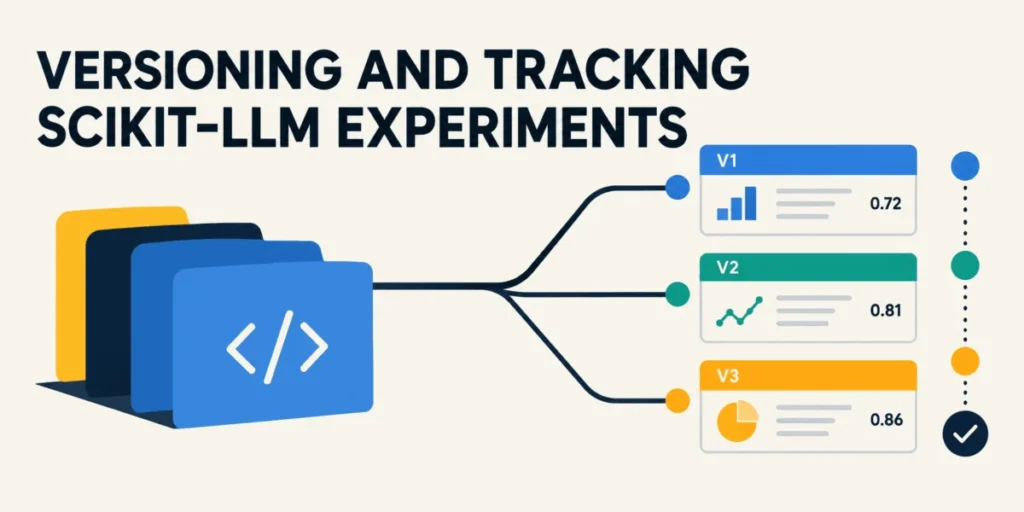
We initialize our first experiment, naming it "Scikit-LLM-Versioning". Within the MLflow context manager, we log specific parameters: the backend type and the specific model file. This metadata is the secret sauce for future reproducibility.
We use cloudpickle as our serialization format. Because LLM-integrated pipelines are more complex than standard linear models, standard pickle can occasionally fail due to strict type-checking issues. cloudpickle excels at serializing complex Python objects, making it the ideal choice for these hybrid pipelines.
Phase III: Comparative Analysis and Model Upgrading
A critical part of the model lifecycle is the transition from a "baseline" model to a more performant "upgraded" version. In this scenario, we pivot from the lightweight orca-mini to the more robust falcon model.
The Mechanics of Comparison
When we run the upgraded pipeline, MLflow captures a new run_id. The power of this approach lies in the ability to search across these runs. By utilizing the MLflow search API, we can programmatically extract a Pandas DataFrame that juxtaposes our historical runs.
This allows engineers to:
- Filter by Status: Identify which runs were successful (
FINISHED) versus those that crashed. - Audit Parameters: Quickly verify which model file was used in which experiment.
- Perform Post-Mortem Analysis: Understand why an experiment might have failed by looking at the tagged metadata.
Phase IV: From Experimentation to Production
The transition from a "logged" run to a "registered" model is the defining moment in the machine learning lifecycle. Simply having a model saved in a file system is insufficient for production; one needs a registry that manages versions, stages (Staging, Production, Archived), and metadata.
Formal Registration
By using mlflow.register_model(), we promote our chosen pipeline to the Production_ZeroShot_Classifier registry. This creates an official, versioned artifact that can be consumed by downstream services.
Selecting the "Winner"
In a mature workflow, selection should not be based on a hunch but on metrics. By using mlflow.search_runs with an order_by=["metrics.accuracy DESC"] clause, we can ensure that we are always promoting the most accurate version of our pipeline to production. This programmatic approach eliminates the risk of human error in model selection.
Implications for Engineering Teams
Implementing this versioning strategy has profound implications for the velocity and reliability of AI teams:
1. Reduced "Technical Debt"
By tracking every iteration of the pipeline, teams avoid the "lost notebook" syndrome, where a successful model is trained, but the parameters used to create it are forgotten. Every model in the registry is linked back to the exact code and configuration that created it.
2. Operational Transparency
For compliance-heavy industries, the ability to audit the history of a model is non-negotiable. With the SQLite backend and MLflow’s tracking, you have a permanent record of who trained which model, when it was trained, and what parameters were used.
3. Accelerated Development Cycles
Because the pipeline is standardized via scikit-learn, data scientists can swap out LLM backends or add pre-processing steps without needing to rewrite the entire training harness. This modularity is the hallmark of professional-grade machine learning engineering.
Conclusion
Building, tracking, and registering LLM-integrated pipelines is no longer a luxury—it is a necessity for any organization looking to deploy AI reliably. By leveraging the synergy between Scikit-LLM and MLflow, teams can transition from chaotic experimentation to a disciplined, production-ready lifecycle.
The process detailed here provides a blueprint for success: start with a clear experimental setup, log every variable that influences your model’s performance, use comparative auditing to select the best candidate, and finally, formalize your deployment through the Model Registry. By following these steps, you not only ensure the quality of your current models but also build a robust foundation for the future of your AI infrastructure.