Beyond the Hype: Choosing Between AI Workflows and Autonomous Agents
In the rapidly evolving landscape of artificial intelligence, terminology often outpaces technology. Today, "agent" has become the industry’s favorite buzzword—a catch-all term applied to everything from simple rule-based scrapers to sophisticated, self-correcting neural systems. This linguistic inflation has led to a common pitfall: developers and enterprise architects are increasingly deploying complex, autonomous agents for tasks that could be handled more reliably, cheaply, and transparently by structured workflows.
Before committing to a specific architectural path, it is essential to distinguish between these two paradigms. Understanding the fundamental mechanics of workflows versus agents is the difference between building a robust, production-ready system and creating a "black box" that is prone to unpredictable behavior and spiraling costs.
The Architectural Divide: Definitions and Mechanics
What Is a Workflow?
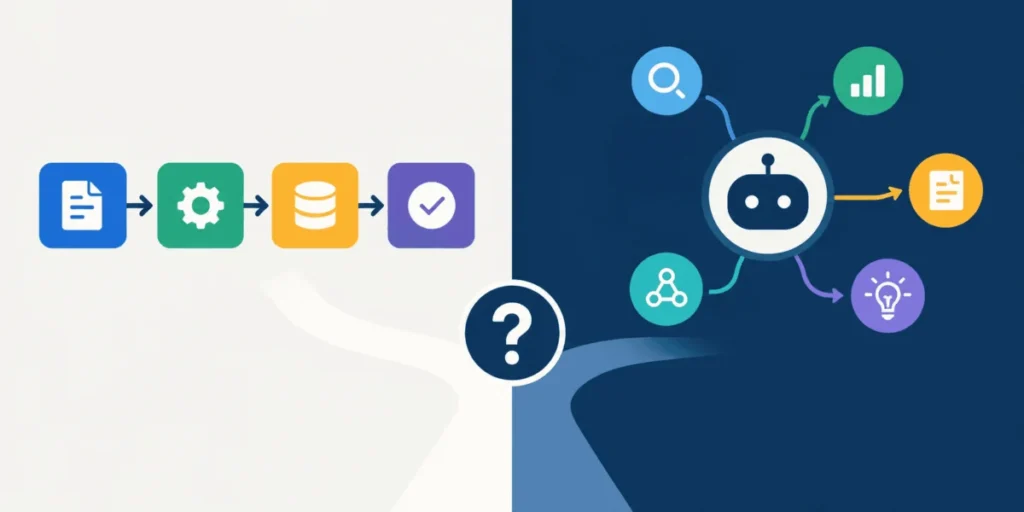
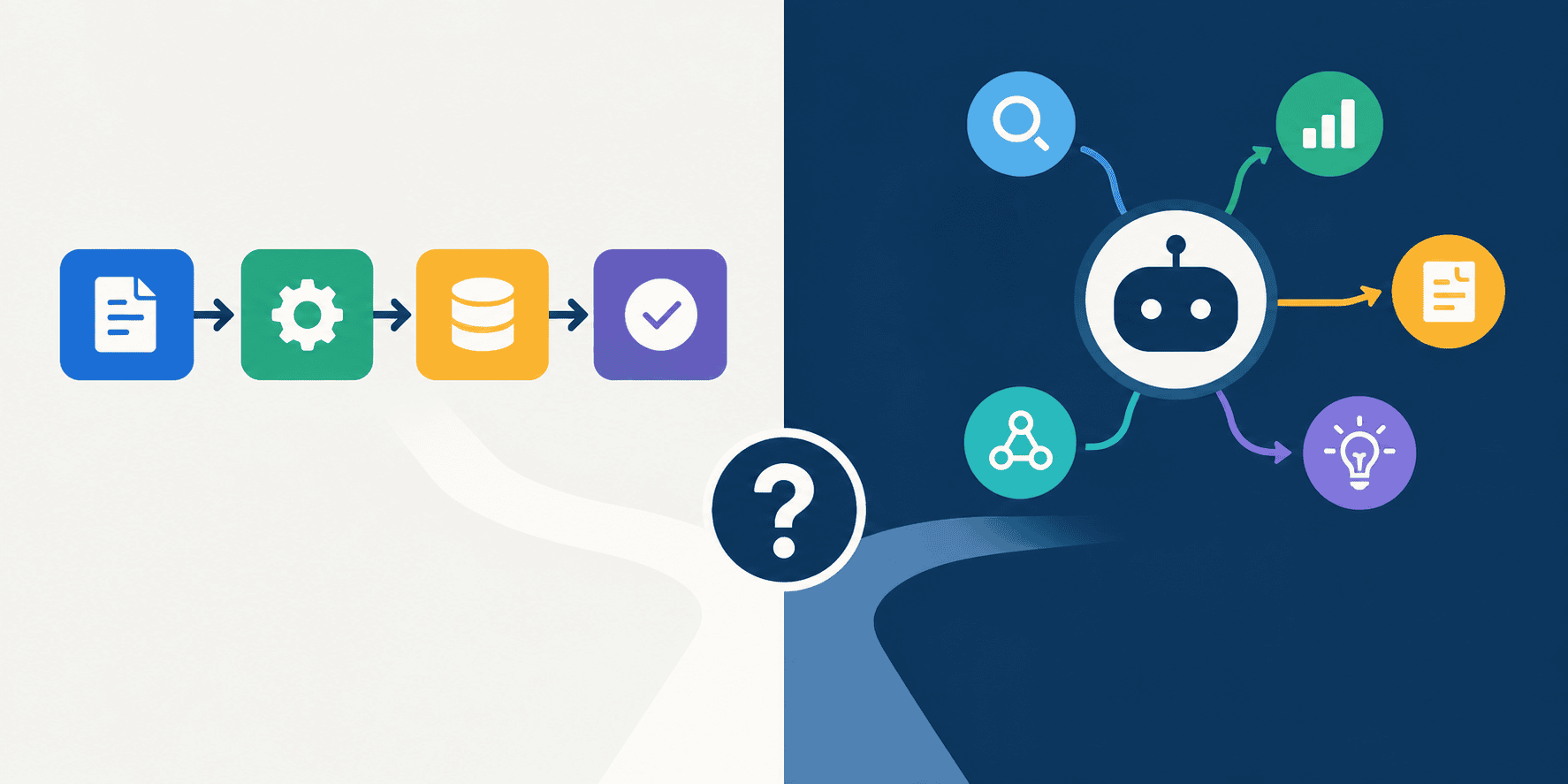
A workflow—often referred to as a pipeline or a chain—is a deterministic system where the control flow is established at design time. In this architecture, the developer acts as the architect of the process. Every step, decision branch, stop condition, and error-handling mechanism is mapped out before the system executes.
While a workflow often incorporates Large Language Models (LLMs) to perform specific tasks like classification, summarization, or data extraction, the LLM is a component of the process, not the controller of the process. The path from Input A to Output B is rigid. If the system encounters a scenario not explicitly accounted for in the flow, it will either fail gracefully or route the data to a predefined exception handler.
What Is an Agent?
An agent, by contrast, is a system where the control flow is determined at runtime by the LLM itself. When an agent is given a goal, it acts as a reasoning engine. It utilizes available tools—such as web searches, database queries, or code execution environments—to formulate a plan, observe the outcome of each action, and adjust its strategy accordingly.
The agentic loop is dynamic: Plan → Act → Observe → Reflect → Repeat. The control logic lives within the model’s weights, not in the developer’s code. If the first attempt to solve a problem fails, the agent assesses why, re-evaluates its approach, and chooses a different tool or sequence of actions.
The Chronology of Decision-Making: A Practical Framework
To avoid the common trap of over-engineering, developers should utilize the "Flowchart Test." Before writing a single line of code, ask this: "Can I draw a complete, functional flowchart of this task before the LLM ever runs?"
Phase 1: The Design Phase (Workflow Strategy)
If you can map the logical progression of the task on a whiteboard, you have the blueprint for a workflow. For instance, in a customer refund process, the steps are well-defined: verify customer credentials, check the transaction database, assess the refund policy, and execute the payment. Because these steps follow a logical, documented progression, implementing them as a workflow ensures consistency, auditability, and ease of maintenance.
Phase 2: The Discovery Phase (Agentic Potential)
If the task is open-ended—such as "Figure out why checkout failures spiked in the last 30 minutes"—the path to a resolution is not linear. One incident might be solved by checking a recent deployment, while another requires inspecting CDN logs or regional DNS errors. In this scenario, the system must "discover" the path to the solution. This is where an agent provides genuine value, as it can adapt its investigation based on real-time observations.
Supporting Data: Why "Simplicity" is Often Superior
There is a pervasive, incorrect assumption that "Workflow equals simple" and "Agent equals sophisticated." This binary is misleading.
A production-grade workflow can be incredibly sophisticated, incorporating multiple LLM calls, retrieval-augmented generation (RAG), complex business logic, and human-in-the-loop approval gates. Conversely, a very simple agent can be chaotic and unpredictable.
Performance and Cost Metrics:
- Token Consumption: Agents are inherently "chatty." They require repeated reasoning cycles, internal scratchpads, and multiple tool calls, leading to a significantly higher token footprint compared to a single-pass workflow.
- Latency: Because an agent requires a sequence of request-response loops, the time-to-first-answer is inherently higher than a direct, multi-step pipeline.
- Reliability: Workflows are inherently easier to test via unit and integration testing. Agents, due to their non-deterministic nature, are notoriously difficult to regression test, as the model may choose a different, yet technically "correct," path every time it runs.
Official Industry Perspectives: When to Use Which?
Leading AI researchers and engineers often advocate for a "layered" approach to system design.
The Checklist for Architects
Before moving to an agentic architecture, evaluate your project against these five criteria:
- Predictability: Can you list the major branches before runtime? If yes, build a workflow.
- Input Variability: Is the input stable? If the inputs are highly varied and unpredictable, an agent may be necessary.
- Efficiency Requirements: If your application is high-volume or latency-sensitive, the overhead of agentic reasoning will likely be a bottleneck.
- Compliance and Auditing: In industries like finance or healthcare, where every decision must be traceable and replicable, workflows are the only viable option. Agents often struggle to provide the "paper trail" required by regulators.
- The "LLM Judgment" Test: Have you tried using a fixed workflow with an LLM simply acting as a "judge" at specific, controlled nodes? This often provides the intelligence of an agent with the stability of a workflow.
Implications for the Future of AI Development
The industry is currently shifting toward a more nuanced understanding of AI deployment. The initial "agent fever" is cooling as organizations realize that business value is rarely found in the complexity of the model, but in the reliability of the output.
By prioritizing workflows, companies can build systems that are:
- Maintainable: Code is easier to debug when the logic flow is explicit.
- Cost-Effective: By avoiding unnecessary reasoning cycles, businesses can scale AI applications without a linear increase in API costs.
- Transparent: Clearer paths allow for better observability and easier integration with existing enterprise monitoring tools.
Conclusion: The "Start Constrained" Philosophy
The most successful AI applications of the coming years will likely be hybrids. The best advice for developers is to start constrained. Begin by mapping your process. Build it as a series of targeted workflows with discrete, well-defined LLM calls. Only when you encounter a problem that cannot be solved by a decision tree—a problem that requires true, iterative discovery—should you introduce an agentic layer.
In the final analysis, an agent is a tool, not a default setting. If you can define the path before the model begins to reason, you don’t need an agent; you need a well-engineered workflow. Complexity should be earned, not assumed, and the simplest solution that meets the business requirement will almost always be the one that survives the test of production.