The Dawn of the Auditory Interface: A Comprehensive Roadmap to Mastering AI Voice Agents
Voice interfaces have transcended their status as tech-world novelties to become the primary frontier of human-computer interaction. From sophisticated customer service automated systems and clinical healthcare scribes to intuitive smart-home controllers, the ability to communicate with machines through natural spoken language is no longer a futuristic dream—it is an industrial standard.
For developers already well-versed in Large Language Models (LLMs) and text-based agent architecture, the transition to voice represents a logical evolution. However, voice agents are not merely text bots with a microphone; they are complex, real-time systems that require a paradigm shift in engineering, design, and user experience. This article explores the anatomy of voice agents, the technical challenges of the auditory medium, and provides a definitive seven-stage roadmap for mastering this transformative technology.
The Anatomy of a Voice Agent: Breaking Down the Pipeline
At its most fundamental level, a voice agent is an artificial intelligence system designed to facilitate bidirectional, spoken communication. While it shares the "brain" of a text-based agent—the LLM—it requires an entirely different sensory apparatus to function.
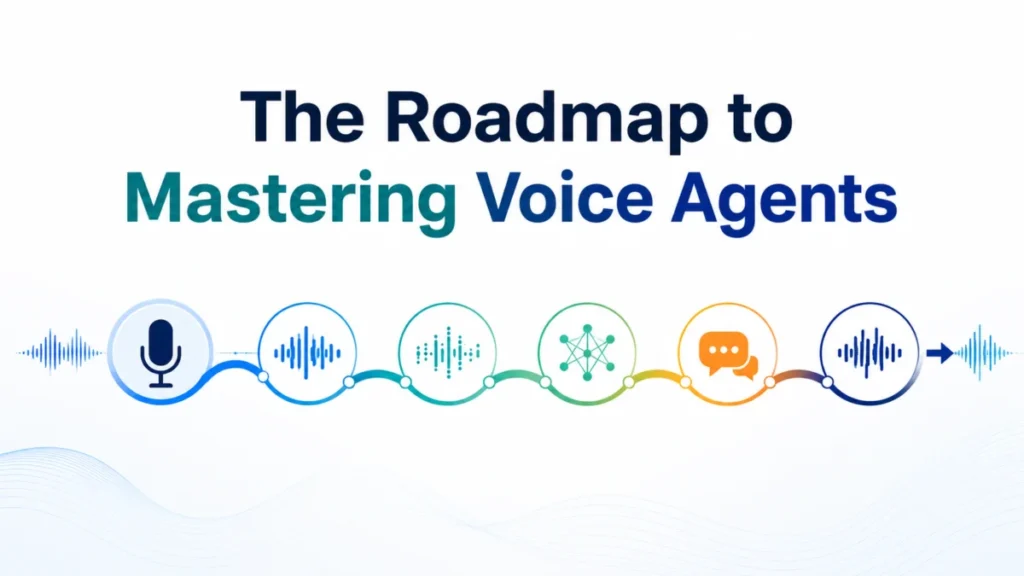
A voice agent operates as a three-stage pipeline, acting as a bridge between analog sound waves and digital logic:
- Speech-to-Text (STT): Also known as Automatic Speech Recognition (ASR), this is the "listening" layer. It converts volatile, time-based audio data into a structured text format that the machine can parse.
- Language Understanding and Response: This is the "cognition" layer. The transcribed text is ingested by an LLM, which interprets the intent, retrieves necessary data, and generates a coherent, context-aware response.
- Text-to-Speech (TTS): This is the "voice" layer. The system converts the digital text output into synthesized human-like speech, delivering the response back to the user through a speaker or telephonic interface.
The Criticality of Latency
In text-based interfaces, users have grown accustomed to "thinking time," where a loading spinner is socially acceptable. In a spoken conversation, however, a one-second pause feels like an eternity. If the pipeline from STT to TTS is not meticulously optimized, the agent loses its conversational rhythm, leading to a "robotic" experience that users inevitably abandon. This latency constraint is the primary design constraint that dictates every architectural decision in voice development.
The Evolution of Voice: A Chronology of Progress
The history of voice technology is a testament to the convergence of three distinct scientific fields: digital signal processing, natural language understanding (NLU), and deep learning.
- The Early Era (1990s–2010s): Initial voice systems relied heavily on hard-coded grammars and rule-based logic. These systems were rigid, requiring users to learn specific command structures to be understood.
- The Statistical Turn (2010s): The advent of Hidden Markov Models and early deep learning allowed for broader vocabulary recognition, leading to the rise of voice assistants like Siri and Alexa. However, these systems remained limited to simple command-and-control tasks.
- The LLM Integration (2022–Present): The integration of Transformer-based LLMs changed the landscape. Suddenly, voice agents were no longer limited by hard-coded scripts; they could engage in open-ended, fluid conversation. We are currently in the era of "Agentic Voice," where systems can reason, call external APIs, and maintain long-term memory across complex, multi-turn interactions.
Supporting Data: Why Voice is the Future
The market data surrounding voice technology is compelling. According to industry analysis, the global voice and speech recognition market is expected to grow at a compound annual growth rate (CAGR) of over 15% through 2030.
- Efficiency: Voice interfaces are roughly 3x faster than typing, allowing users to convey complex instructions with minimal effort.
- Accessibility: Voice agents remove barriers for users with motor impairments or those who are in environments where screens are not accessible or safe (e.g., while driving).
- Consumer Adoption: Studies indicate that nearly 60% of consumers prefer voice-based interactions for simple customer service tasks because it avoids the friction of navigating multi-layered mobile app menus.
The Seven-Stage Roadmap to Mastery
To build a professional-grade voice agent, one must move through a structured learning process that builds upon existing software engineering and AI foundations.
Stage 1: Mastering the Core Pipeline
Start by dissecting the STT-LLM-TTS loop. Learn how to handle different audio codecs (e.g., PCM, WAV, MP3) and understand the impact of Word Error Rate (WER). You must become comfortable with the physics of audio—how ambient noise and microphone gain impact transcription accuracy.
Stage 2: Refining the Language Processing Layer
While the LLM is similar to text-based applications, the "voice-first" prompting strategy is unique. You must learn to optimize prompts for brevity and auditory clarity. Since your agent lacks visual aids like bolding or bullet points, the language model must be trained or prompted to speak in conversational, linear structures.
Stage 3: Real-Time and Streaming Architectures
Latency is the enemy. This stage focuses on architectural patterns like Streaming, where the system begins generating audio for the first part of a sentence while the LLM is still "thinking" about the second part. This pipelining technique is essential for achieving human-like responsiveness.
Stage 4: The Art of Conversation Design
This is the most overlooked aspect of development. Conversation design is a multidisciplinary field drawing from linguistics and psychology. You will learn to manage "turn-taking"—the delicate dance of knowing when a user has finished speaking and when it is appropriate for the agent to interrupt or yield the floor.
Stage 5: Integrating Tools and Memory
An agent that cannot "do" anything is just a conversational parlor trick. Here, you will integrate function calling (or tool use), enabling your voice agent to query databases, check inventory, or execute transactions. Adding memory layers allows the agent to maintain context, creating the feeling of a personalized assistant.
Stage 6: Deployment and Telephony
Transitioning from a development environment to a production environment involves complex infrastructure, such as WebSockets for real-time data flow or SIP (Session Initiation Protocol) for integration with legacy telephony systems. You will also learn to monitor "conversational health" metrics, such as turn duration and sentiment analysis.
Stage 7: Advanced Frontiers
The final stage involves pushing the envelope with voice cloning, emotional state detection, and multilingual support. By learning to modulate the tone of the TTS engine based on the user’s emotional input, you transform an agent from a tool into a partner.
Implications for Industry and Developers
The shift toward voice-native AI has profound implications. For the developer, the "full-stack" role is being redefined. You are no longer just a backend or frontend engineer; you are now an "experience architect" who must balance high-performance compute requirements with the nuances of human communication.
For industries, the implications are equally significant. Companies that fail to incorporate natural-language voice interfaces risk losing their competitive edge in the user experience space. However, this power comes with responsibility. The ability to manipulate voice—through cloning and highly persuasive, context-aware responses—demands rigorous ethical guardrails to ensure user privacy and data security.
Conclusion
Building a voice agent is a discipline of synthesis. It requires the precision of a software engineer, the curiosity of a researcher, and the empathy of a designer. By following this seven-stage roadmap, you transition from the abstract theory of LLMs to the concrete reality of deployed, real-time voice systems.
As we look toward the future, the boundary between machine and human will continue to blur, and the voice agent will be the primary vessel for that connection. Whether you are building the next generation of customer service tools or a personal digital companion, mastering the voice pipeline is the most critical step you can take in the current era of artificial intelligence.