Navigating the Reverse Logistics Maze: The State of E-commerce Returns in Europe
The digital transformation of retail has fundamentally rewritten the rules of commerce. For the modern consumer, the "buy button" is merely the beginning of the journey, not the end. In the European market, where consumer protection laws are among the most stringent globally, the management of product returns—reverse logistics—has evolved from a back-office nuisance into a strategic imperative. As return rates climb, European e-commerce merchants are finding themselves at a critical crossroads: how to maintain the high-friction convenience expected by shoppers while safeguarding profitability and environmental sustainability.
1. The Landscape of European Returns: Main Facts and Data
In the European commercial ecosystem, returns are not an anomaly; they are a systemic feature. While the growth of online retail has been meteoric, it has been accompanied by a "try-before-you-keep" culture that has pushed average return rates in Europe to between 30% and 40%.
Regional Disparities and Statistics
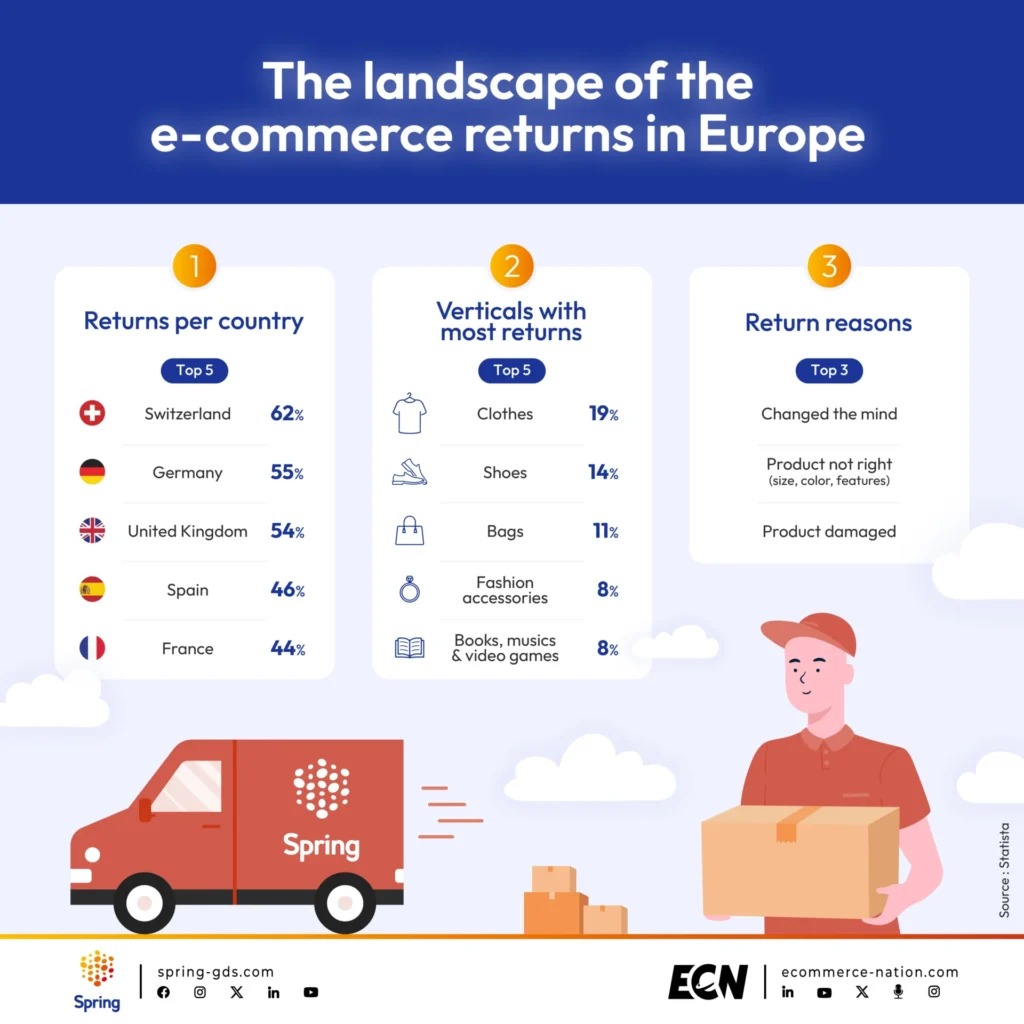
The appetite for returns is not uniform across the continent. Data from 2023 highlights a striking variance in consumer behavior:
- Switzerland: Leading the pack with an average return rate of 62%, Swiss consumers display a high propensity for returning goods, often attributed to high purchasing power and strict quality expectations.
- Germany: With a return rate of 55%, the German market is characterized by a mature e-commerce infrastructure where free returns have long been a competitive standard.
- United Kingdom: Following closely at 54%, the UK market reflects a highly competitive fashion retail sector where "bracketing"—the practice of buying multiple sizes or colors with the intent to return most of them—is commonplace.
Sectoral Vulnerabilities
Not all goods are created equal in the eyes of the logistics chain. The fashion and apparel sector remains the most volatile, with return rates often exceeding 50% in specific segments like footwear and evening wear. This is primarily driven by the subjective nature of fit and style. Conversely, consumer electronics and household goods typically see lower return rates (around 6%), yet these returns are often more complex, involving technical diagnostics, potential refurbishment, and significant depreciation in value.
2. Chronology of the Return Evolution
To understand the current state of affairs, one must look at the evolution of the return policy over the last decade:
- 2014–2017: The Era of "Free Returns" as a Marketing Tool. During this period, major retailers used free, no-questions-asked return policies as a primary lever for customer acquisition, effectively training consumers to view returns as a risk-free extension of the shopping experience.
- 2018–2021: The Scaling Crisis. As volumes spiked during the pandemic, the logistical strain of processing millions of returns became apparent. The environmental cost—the "hidden" carbon footprint—began to enter the public consciousness.
- 2022–Present: The Shift to Rationalization. Faced with inflationary pressures and rising operational costs, retailers have begun to pivot. We are now in a period of "Return Rationalization," where brands are introducing restocking fees, shortening return windows, and utilizing AI-driven data to predict and prevent returns before they occur.
3. The Complex Challenges of Reverse Logistics
The logistics of getting a product back to the warehouse is exponentially more difficult than sending it out. Unlike forward logistics, which is highly standardized, reverse logistics is unpredictable in timing, volume, and condition of the returned item.
The Cross-Border Regulatory Web
Operating within the European Single Market offers many advantages, but it does not equate to a uniform regulatory environment for returns. Companies must navigate a labyrinth of:
- VAT and Customs: For merchants selling from the UK to the EU (or vice versa), post-Brexit regulations have introduced significant friction, with customs declarations required for returned goods to avoid double taxation.
- Consumer Rights: While the EU’s Consumer Rights Directive provides a baseline, local implementations often differ, particularly regarding who bears the cost of return shipping and the duration of the "right of withdrawal."
The Financial and Environmental Toll
The financial impact is twofold: the direct cost of logistics (shipping, labor for inspection, and restocking) and the indirect cost of inventory devaluation. A returned item is rarely as valuable as a new one. Furthermore, the ecological impact is no longer a peripheral concern. The carbon emissions generated by the "round-trip" journey of a package, coupled with the excessive use of single-use plastic packaging, have drawn the ire of environmental regulators and eco-conscious consumers alike.
4. Official Perspectives and Industry Responses
Industry leaders and policy bodies are increasingly treating return management as a core operational pillar rather than a cost center.
The Shift in Strategy
Major retailers, including fast-fashion giants, have begun implementing "Return Fees." While controversial, this is framed by industry analysts as a necessary step to curb the "bracketing" trend—where consumers order items with the deliberate intention of returning a portion of the order.
From an official standpoint, European trade associations are pushing for more transparency. The goal is to move toward a "circular economy" where return centers are equipped to handle refurbishment, resale, or ethical recycling, rather than the mass disposal of returned goods—a practice that has faced significant public and legislative scrutiny in recent years.
5. Strategic Optimization: A Roadmap for Merchants
For merchants looking to mitigate the impact of returns without alienating their customer base, a multi-pronged approach is required.
Data-Driven Prevention
The most effective return is the one that never happens.
- Enhanced Product Visualization: Using Augmented Reality (AR) to allow customers to "try on" glasses or place furniture in their homes has been shown to reduce return rates by as much as 20%.
- Predictive Analytics: By analyzing return data, retailers can identify "serial returners" or specific product batches that exhibit high defect rates, allowing for proactive intervention.
Technological Integration
Investing in an automated Return Management System (RMS) is now standard for mid-to-large retailers. An effective RMS provides:
- Real-time Visibility: Customers can track their return journey, reducing anxiety and support tickets.
- Automated Quality Control: Streamlining the triage process at the warehouse allows for faster restocking, which is critical for seasonal items that lose value rapidly.
Sustainability as a Competitive Advantage
Sustainability is no longer just for brand image; it is a operational efficiency strategy. By adopting "batch returns" (consolidating shipments) and utilizing eco-friendly, reusable packaging, companies can lower their shipping costs and satisfy the growing demand for green commerce. Educating the consumer on the environmental cost of a return can also nudge them toward more thoughtful purchasing decisions.
Conclusion: The Path Forward
The "return" is an inseparable component of the modern e-commerce lifecycle. While the challenges—logistical, financial, and environmental—are substantial, they are not insurmountable. The retailers that will thrive in the coming decade are those that move beyond viewing returns as a failure of the sale and start viewing them as an opportunity to deepen customer loyalty.
By balancing friction-free consumer experiences with robust, technology-driven, and environmentally conscious management systems, European merchants can navigate the reverse logistics maze, transforming a traditional cost center into a strategic engine for long-term growth. The era of unchecked, free-flowing returns is closing; the era of intelligent, sustainable reverse logistics has begun.