Beyond the Hustle: How Data-Driven Strategy is Replacing the ‘Do More with Less’ Myth
The marketing landscape is currently defined by a paradox: as corporate budgets tighten and resources face unprecedented scrutiny, the demands for pipeline growth and lead generation have never been higher. For many marketing professionals, the mantra of "do more with less" has become a source of professional fatigue, a treadmill that demands constant activity without necessarily moving the needle on revenue.
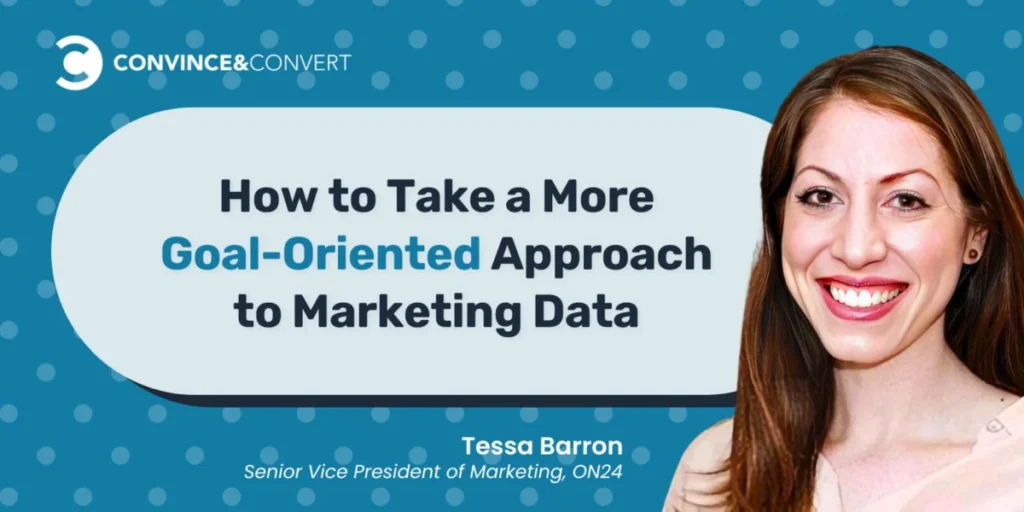
However, a growing consensus among industry leaders suggests that the solution is not to double down on frantic activity, but to fundamentally re-engineer the relationship between data, strategy, and sales. Tessa Barron, former Senior Vice President of Marketing at ON24, recently joined the Data-Driven Decisions podcast to challenge the industry to move away from "tactic-first" thinking. By shifting the focus from output volume to goal-oriented precision, marketers can stop chasing noise and start generating meaningful signals.
The End of the "Tactic-First" Era
For years, the standard marketing playbook has relied on a reliable, if repetitive, cycle of content production. Webinars, whitepapers, blog posts, and podcasts have served as the bedrock of demand generation. While these channels remain effective, the way in which they are deployed has often become stagnant.
Barron argues that the most significant failure in modern marketing is the tendency to prioritize the "what" over the "why." "We as marketers have to check in with ourselves," Barron explains. "If we are doing exactly what we were doing three or four years ago, we cannot expect that doing more of the same will yield better results."
The "tactic-first" trap occurs when a team decides, for instance, to run four webinars in a quarter simply because that is the established rhythm. This approach prioritizes execution over objective. Conversely, a goal-oriented framework begins with the end in mind. Instead of setting a target for content volume, a high-performing team sets a target for business outcome—such as a 10% uplift in pipeline or a specific penetration into a new account segment. Only once that goal is established does the team decide which tactic is best suited to achieve it.
Chronology of a Shift: From Noise to Signal
The post-pandemic market has fundamentally altered consumer behavior. The digital noise floor has risen, making it harder for generic messaging to land. To combat this, marketing teams must stop viewing data as a collection of vanity metrics—like page views or session times—and start viewing it as a collection of "signals."
The Evolution of Data Strategy
- The Legacy Phase (Pre-2020): Marketing relied on broad-net tactics. Success was measured by volume of leads, regardless of their readiness to buy.
- The Noise Phase (2020-2022): The explosion of digital content made it easy to capture data, but difficult to interpret it. Many marketers drowned in "vanity metrics" that failed to predict revenue.
- The Signal-Driven Phase (Current): Modern leaders are now implementing "traps"—strategic interactions within content that force prospects to reveal their intent, pain points, or technological ecosystem.
By embedding interactive elements—such as polls, targeted Q&A, and real-time surveys—directly into the buyer journey, marketers can capture the "signal" that differentiates a casual browser from a high-intent prospect.
Supporting Data: Real-World Applications of Intent Capture
The shift to signal-driven marketing is not merely theoretical; it has yielded measurable results for enterprises across diverse sectors. Barron highlights two distinct case studies that demonstrate how precision questioning can transform a webinar from a passive presentation into a high-octane lead generation tool.
Case Study 1: Technology Sector
A technology firm struggling to regain market share identified a critical correlation: prospects who utilized a specific cloud provider were ten times more likely to convert into a sales opportunity. Instead of blasting generic messaging to their entire database, the marketing team integrated a simple, targeted question into their webinar registration and session flows: "What cloud provider are you currently using?"
By capturing this data point, the marketing team was able to prioritize high-probability prospects for the sales team, effectively shortening the sales cycle and increasing the conversion rate of marketing-qualified leads (MQLs) to pipeline.
Case Study 2: Pharmaceutical Industry
In the healthcare space, a pharmaceutical company aimed to connect with physicians treating high-risk patients. Rather than focusing on general product awareness, they hosted educational sessions on clinical breakthroughs. During these sessions, they asked attendees to rate the risk level of their patient base. Those who identified their patient base as "high-risk" provided the company with an immediate, high-intent signal. This allowed the company to tailor follow-up communications, ensuring that resources were spent on physicians with the most immediate need for the therapy.
Official Perspective: The Sales-Marketing Nexus
A recurring theme in the discourse around pipeline efficiency is the necessity of radical alignment between sales and marketing. Too often, marketing departments operate in a vacuum, developing content based on what they think will appeal to the audience, rather than what the sales team needs to close a deal.
Barron suggests that the most effective way to optimize marketing strategy is to "step outside the silo." Marketers should regularly interview their sales counterparts:
- What questions do they ask to qualify a lead?
- What are the primary points of hesitation or doubt that prospects express during discovery calls?
- What specific information does a prospect need to move from "interested" to "committed"?
These insights are the missing link. Marketing is not responsible for creating the pipeline—that is the domain of the sales professional. However, marketing is entirely responsible for "building the net" that catches the right prospects and providing the salesperson with the clearest, most accurate profile of the buyer before the first call is ever made.
Implications for Future Strategy: Refining the Framework
As organizations look toward the next fiscal cycle, the pressure to demonstrate ROI will only intensify. The implication for marketing leadership is clear: stop measuring activity and start measuring influence.
Implementing the Goal-Oriented Framework
- Audit the Funnel: Identify the "dark spaces" between lead generation and pipeline creation. These are often the areas where conversion rates lag, such as outdated web forms or poorly tailored email sequences.
- Shorten the Path: If a lead form is long and cumbersome, cut it. If a messaging stream is generic, personalize it based on the signals gathered during the discovery phase.
- Presenting to Stakeholders: Data is only as good as its presentation. For executives and board members, noise is the enemy. Present findings in simple, visual formats that show a direct line between a specific marketing action, a change in buyer behavior, and the resulting impact on the pipeline.
By focusing on these intermediate steps—the "micro-conversions" that occur between the first interaction and the final sale—marketers can regain control over their metrics.
Conclusion: The Path Forward
The goal of modern marketing is not to "do more." It is to do what is necessary with greater intelligence. By moving away from the safety of tried-and-tested, legacy tactics and toward a framework defined by clear goals, intentional data capture, and deep alignment with sales, marketers can transform their role from a cost center into a strategic engine for revenue.
In an era of tightening budgets, the ability to discern the "signal" from the "noise" is the most valuable skill a marketer can possess. By focusing on the metrics that truly impact the bottom line, marketing teams can silence the pressure to perform and replace it with the confidence of knowing exactly what drives growth.
For more on how to apply these strategies in your own organization, the full conversation with Tessa Barron can be found on the Data-Driven Decisions podcast, part of an eight-part series dedicated to modernizing the marketing function.