Investigation Launched After TVK MLA Caught Driving TNSTC Bus During ‘Vettri Payanam’ Scheme Launch
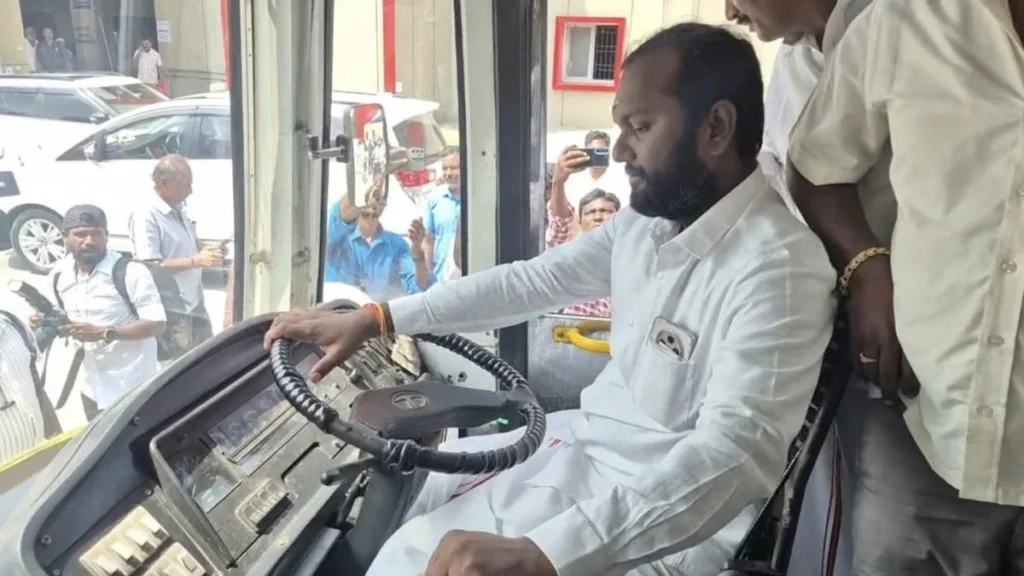
VELLORE, TAMIL NADU — The Tamil Nadu Transport Department has officially initiated a high-level inquiry into a controversial incident involving E. Thendral Kumar, the Tamizhaga Vettri Kazhagam (TVK) Member of Legislative Assembly (MLA) for the K.V. Kuppam constituency. The legislator was captured on video operating a Tamil Nadu State Transport Corporation (TNSTC) bus at a public terminus, an act that has sparked widespread public outcry and raised serious questions regarding road safety and administrative accountability.
The incident occurred during the regional launch of the “Vettri Payanam” scheme, a state-wide initiative championed by Chief Minister C. Joseph Vijay, designed to expand free bus travel for women and transgender persons across Tamil Nadu. While the day was intended to celebrate inclusive public transit, the MLA’s unauthorized decision to take the wheel of a government-owned vehicle has overshadowed the rollout.
Chronology of the Incident
The events unfolded on a Friday at the new bus terminus in Vellore, a bustling transport hub that serves thousands of commuters daily.
The Launch Ceremony: The proceedings began in an atmosphere of official formality. District Collector P.S. Leela Alex, alongside Vellore Corporation Commissioner A. Catherine Saranya, officially flagged off the buses, marking the commencement of the “Vettri Payanam” scheme in the district. MLA E. Thendral Kumar was present on the dais, participating in the ceremonial launch alongside local transport officials.
The Unauthorized Act: Following the conclusion of the formal flagging-off ceremony, the atmosphere shifted. According to witness accounts and viral social media footage, Mr. Kumar approached the driver’s seat of one of the newly launched buses. Despite the presence of trained TNSTC personnel, the MLA took control of the vehicle.
The Short Journey: Initial investigations indicate that the MLA drove the bus across the open portico of the terminus, traversing a distance of approximately 100 meters from the main entrance. During this short trip, the bus was occupied by roughly 30 commuters, many of whom were unaware that the vehicle was being operated by an untrained individual.
Public Reaction: The sight of a government bus maneuvering through a crowded terminal under the control of an elected representative drew immediate alarm. Commuters, including elderly passengers, women, and children, expressed fear as the bus accelerated through the busy terminal area. One commuter stated, "It was scary. The bus was moving faster than it should have within a pedestrian-heavy zone where people were actively waiting to board."
Regulatory Framework and Safety Implications
At the heart of the controversy lies the strict legal framework governing the operation of heavy vehicles in India, specifically under the Motor Vehicles Act (MVA), 1988.
The Licensing Hierarchy
Transport officials have been quick to clarify that driving a heavy commercial vehicle—such as a bus—is a specialized skill that requires specific certification. Under Indian law:
- Light Motor Vehicles (LMV): License holders are permitted to operate cars, vans, and tractors.
- Heavy Motor Vehicles (HMV): To operate a bus, truck, or lorry, a driver must possess a specific HMV license supplemented by a valid "badge."
The badge serves as proof that the driver has undergone rigorous testing and background verification to ensure they can manage the unique physics and safety demands of heavy passenger transport.
The Penalty for Violation
According to current provisions under the Motor Vehicles Act, the unauthorized operation of a heavy vehicle carries significant financial and legal consequences. Officials have noted that the driver in this instance—Mr. Kumar—is likely to face a penalty of ₹5,000 for operating a vehicle without the requisite license and badge.

Furthermore, the act holds the owner of the vehicle accountable for allowing an unauthorized person to take the wheel. In this case, the TNSTC, as the registered owner, faces a potential fine of ₹10,000. These penalties are designed to act as a deterrent, ensuring that the safety of the public is never compromised by unauthorized personnel.
Official Responses and Administrative Inquiry
The Transport Department has adopted a firm stance, emphasizing that no individual, regardless of their political standing, is above the safety regulations that govern public transit.
A senior transport official, speaking on the condition of anonymity, stated, “As per norms, only those drivers who possess a license for heavy vehicles and the required badge are eligible to operate buses. We have taken cognizance of the video footage circulating on social media. A formal probe is currently underway to determine the exact circumstances under which the MLA was allowed access to the driver’s seat.”
The investigation is expected to examine:
- Chain of Command: How the MLA gained access to the ignition and controls of a state-owned vehicle.
- Professional Conduct: Whether any TNSTC staff members were coerced or pressured into surrendering the driver’s seat.
- Breach of Safety: Whether the movement of the bus endangered the lives of the 30 passengers on board and the pedestrians at the terminal.
The District Collector’s office has yet to issue a formal statement regarding the conduct of the MLA, though sources indicate that a report will be submitted to the state government following the completion of the transport department’s inquiry.
The Broader Implications for Governance
This incident has triggered a broader debate regarding the behavior of elected representatives and the culture of "political privilege" in public spaces. Critics argue that when legislators bypass safety protocols, it undermines the rule of law and sets a dangerous precedent for the public.
Impact on the ‘Vettri Payanam’ Scheme
The “Vettri Payanam” scheme is a flagship social welfare program intended to provide dignity and mobility to vulnerable groups. By turning a moment of civic celebration into a scene of regulatory violation, the incident has inadvertently distracted from the scheme’s core mission. Observers note that the focus has shifted from the benefits of the policy to the optics of the MLA’s actions, which may dampen public enthusiasm for the rollout.
Accountability and Public Trust
The incident raises a fundamental question: Should an MLA be held to a higher standard of conduct, or are they simply subject to the same traffic laws as any other citizen? Legal experts suggest that given the MLA’s status as a public servant, his actions represent a breach of the public trust. If the probe concludes that the MLA lacked the necessary documentation, it would reflect poorly on his commitment to the very laws he is expected to uphold in the Assembly.
Conclusion
As the inquiry continues, the public awaits the outcome with interest. While the MLA has not yet issued a public apology or clarification, the video evidence remains a focal point of the ongoing investigation. The Transport Department’s commitment to conducting a thorough probe is seen as a necessary step to restore public confidence in the safety standards of the state’s bus network.
For now, the “Vettri Payanam” scheme continues to move forward, but the episode at the Vellore terminus serves as a stark reminder that in the eyes of the law, the driver’s seat of a public bus is a position of professional responsibility, not a stage for political performance. The final report of the transport officials, expected in the coming weeks, will likely set the tone for how such violations are treated in the future, reinforcing the message that safety on Tamil Nadu’s roads is non-negotiable.