India Bolsters Blue-Water Ambitions: Defence Minister Launches First Indigenous Fleet Support Ship ‘Surya’
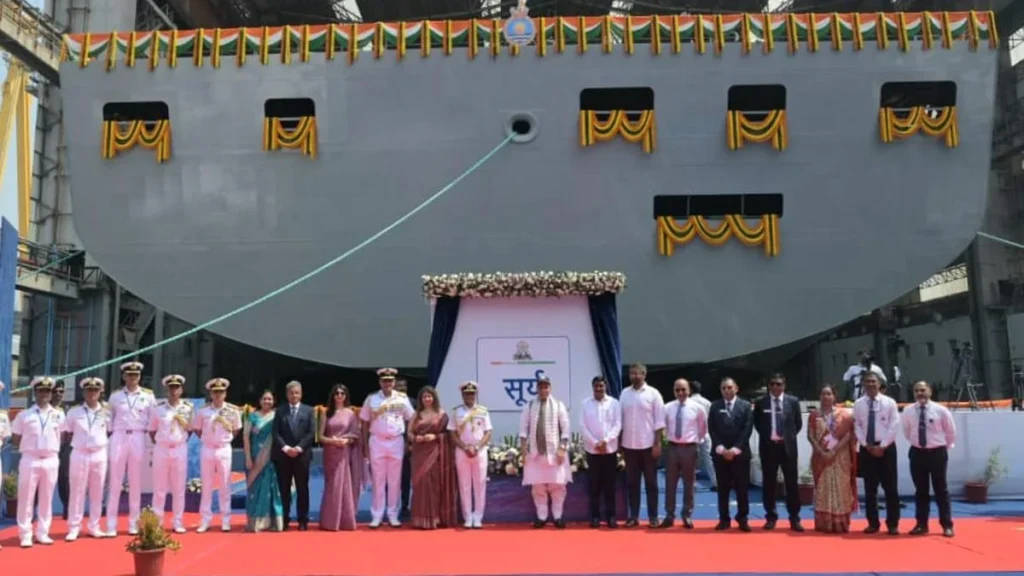
Visakhapatnam, October 6, 2026 – In a landmark development for India’s maritime sovereignty and self-reliance in defence, Union Defence Minister Rajnath Singh presided over a historic ceremony at the Hindustan Shipyard Limited (HSL) in Visakhapatnam. The event marked the official launch of the Surya (FSS-1), the Indian Navy’s first indigenously designed and built Fleet Support Ship (FSS), and the keel-laying for the fifth vessel in the series, FSS-5.
The ceremony, attended by high-ranking officials including Chief of the Naval Staff Admiral Krishna Swaminathan and Defence Secretary Rajesh Kumar Singh, underscores the government’s ‘Aatmanirbhar Bharat’ (Self-reliant India) initiative. The induction of these vessels is set to fundamentally alter the Indian Navy’s operational reach, allowing its carrier battle groups to sustain presence across the Indian Ocean Region and beyond without the necessity of frequent returns to port.
The Strategic Importance of Fleet Support Ships
The Indian Navy currently operates four fleet tankers—INS Shakti and INS Jyoti on the Eastern seaboard, and INS Deepak and INS Aditya on the Western front. While these vessels have served the Navy with distinction, the introduction of the Surya class represents a generational leap in logistics capability.
Fleet Support Ships act as the "lifelines" of the Navy. By providing at-sea replenishment of fuel, lubricants, ammunition, fresh water, and vital spare parts, they enable surface action groups and carrier task forces to remain deployed for extended durations. The Surya is specifically engineered for 60-day missions, designed to support the Navy’s "out of area" contingency operations. With the ability to conduct high-speed transfers of fuel and stores—whether alongside, from the stern, or via vertical replenishment using helicopters—these ships ensure that the Navy’s teeth remain sharp even when operating thousands of nautical miles from their home bases.

Technical Specifications: A Titan of the Seas
The Surya is a marvel of modern naval architecture. Measuring 223.6 metres in length and 31.5 metres in breadth, the vessel boasts a displacement of approximately 43,500 tonnes. Its sheer scale allows for a massive logistics footprint:
- Fuel Capacity: 20,000 tonnes of low-sulphur high-speed diesel and 2,500 tonnes of aviation turbine fuel (ATF).
- Sustainability: 1,000 tonnes of fresh water and 250 tonnes of feed water.
- Versatility: Eight 20-foot containers dedicated to ammunition and essential provisions, alongside sophisticated onboard workshops capable of performing first-line maintenance for the ship itself and the vessels it supports.
Propelled by a robust Combined Diesel and Diesel (CODAD) propulsion system with a single shaft and controllable pitch propellers, Surya can achieve a top speed of 20 knots. Furthermore, the ship is equipped with state-of-the-art self-defence systems to counter missile, torpedo, and mine threats, ensuring its survivability in contested environments. The flight deck is certified for medium-role helicopter operations up to "Sea State 5," providing a critical aerial logistics link.
Modernizing the Cradle of Ships: HSL’s Transformation
The launch of the Surya was accompanied by the inauguration of several critical infrastructure upgrades at HSL. Defence Minister Rajnath Singh unveiled the newly modernized Slipway No. 4, a massive structure measuring 235 metres by 37.5 metres, and a 300-tonne Goliath crane. These additions are not merely superficial; they represent a significant increase in the shipyard’s strategic capacity.
With these upgrades, HSL’s covered building dock capacity has expanded to 80,000 DWT, enabling the construction of naval platforms up to 45,000 DWT. This modernization is a strategic move to ensure that HSL remains competitive in the global shipbuilding market while maintaining the capability to handle the future repair and refit requirements of the Indian Navy’s growing submarine and capital ship fleet.

A Legacy of Eight Decades
Hindustan Shipyard Limited’s evolution from its inception in 1941 as the Scindia Shipyard to its current stature as a cornerstone of India’s maritime defence is a testament to national resilience. Since being incorporated as HSL in 1952, the yard has delivered 203 ships, completed over 2,000 ship repairs, and refitted six submarines.
The shipyard’s infrastructure—a 142-acre main yard, extensive factory extensions, and a 457-metre outfitting jetty—serves as the backbone of this success. By integrating advanced CNC plasma and oxyacetylene cutting machines, as well as automatic welding systems, HSL has transitioned into a highly efficient facility. The current order for five Fleet Support Ships, characterized by 82% indigenous content, utilizes "integrated modular construction," a process that has significantly slashed build times while ensuring stringent naval quality standards.
Implications for Regional Maritime Security
The deployment of the Surya and its sister vessels carries profound geopolitical implications. The Indian Ocean Region (IOR) is currently the theatre of intense maritime competition, with several global powers vying for influence. By enhancing the Navy’s "staying power," the Indian government is signalling a shift toward a more proactive maritime doctrine.
- Extended Presence: The capability to sustain a Carrier Battle Group at sea for months at a time allows the Indian Navy to maintain a persistent presence in the Malacca Strait, the Persian Gulf, and the African coast simultaneously.
- Strategic Deterrence: With the ability to support submarines and surface combatants far from port, the Navy can effectively conduct "out of area" operations, deterring non-state actors and rival naval powers alike.
- Humanitarian Assistance and Disaster Relief (HADR): While designed for combat support, the massive fuel and water capacity of the Surya makes it an ideal platform for large-scale HADR missions, enabling the Navy to provide rapid aid to cyclone- or tsunami-affected regions across the Indian Ocean.
Official Remarks and Future Outlook
During the ceremony, the Defence Minister emphasized that the project is a clear indicator of India’s maturing industrial base. "The Surya is not just a ship; it is a symbol of our collective resolve to shed dependence on foreign technology," an official statement noted. The involvement of various ministries, including Roads and Buildings, alongside naval leadership, highlighted the multi-agency coordination required for such a gargantuan task.

Looking ahead, the keel-laying of the fifth vessel (FSS-5) indicates that the production line at HSL is fully operational and meeting its milestones. The Navy expects all five vessels to be commissioned within the decade, effectively doubling the current replenishment capacity.
As the Surya prepares for sea trials, the sentiment in the Indian defence sector is one of guarded optimism. The shift from importing logistical support to building world-class fleet tankers domestically not only saves billions in foreign exchange but also secures the supply chain of the Indian Navy against external disruptions. In the coming years, as these five ships begin their service, the Indian Navy will find its operational horizon expanded, marking a new chapter in its journey toward becoming a truly global maritime force.
Chronology of Recent HSL Milestones:
- 1941: Founding of Scindia Shipyard.
- 1952: Incorporation as Hindustan Shipyard Limited.
- 2023-2025: Modernization of Slipway No. 4 and installation of the 300-tonne Goliath crane.
- October 6, 2026: Launch of Surya (FSS-1) and Keel-laying of FSS-5.
- 2027-2030 (Projected): Sequential delivery and commissioning of the remaining three Fleet Support Ships.