Innovation at the Entry Level: Honor Unveils the Play20C with Unique Dual-Screen Design
In a move that challenges traditional budget smartphone paradigms, Honor has officially launched the Play20C, a device that brings the niche "rear-screen" concept to the ultra-affordable market segment. By effectively mirroring the hardware architecture of the recently announced Honor X5d s, the company is positioning the Play20C as a global alternative, aiming to capture budget-conscious consumers who prioritize novelty and long-lasting battery performance over raw flagship power.
Main Facts: A Dual-Display Experience on a Budget
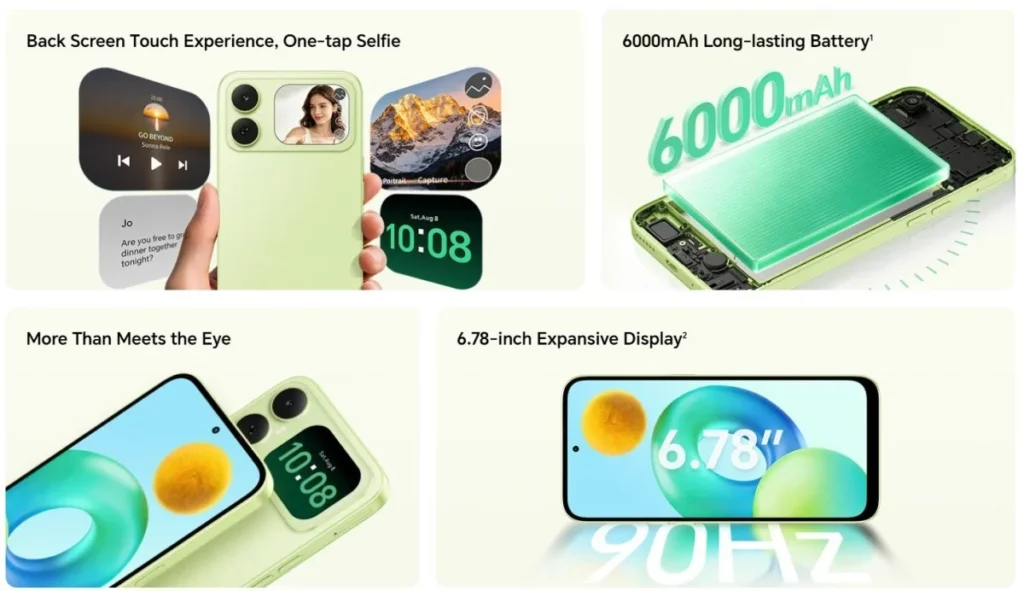
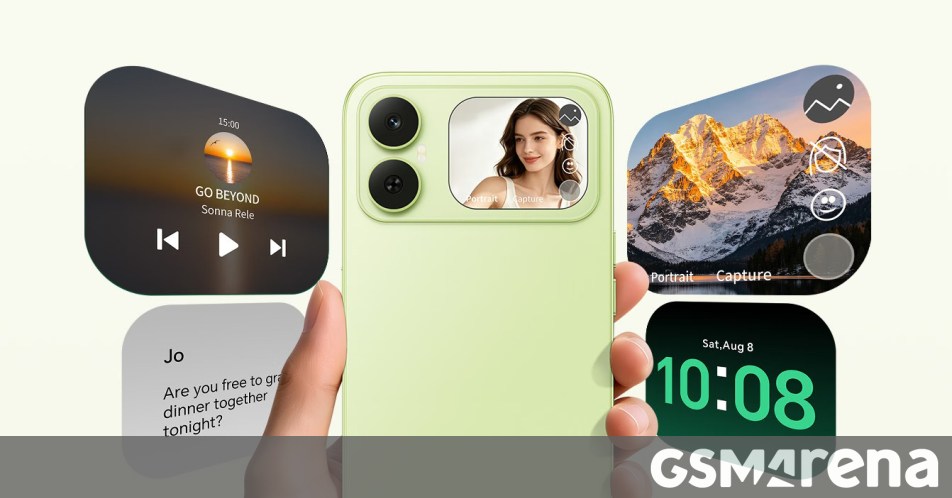
The Honor Play20C distinguishes itself in a crowded entry-level market through its unconventional design choice: a dedicated 2-inch touchscreen panel located on the rear of the device. This secondary display, positioned adjacent to the primary camera module, represents a rare feature for a handset at this price point.
Beyond the novelty of the rear display, the device offers a robust core specification set:
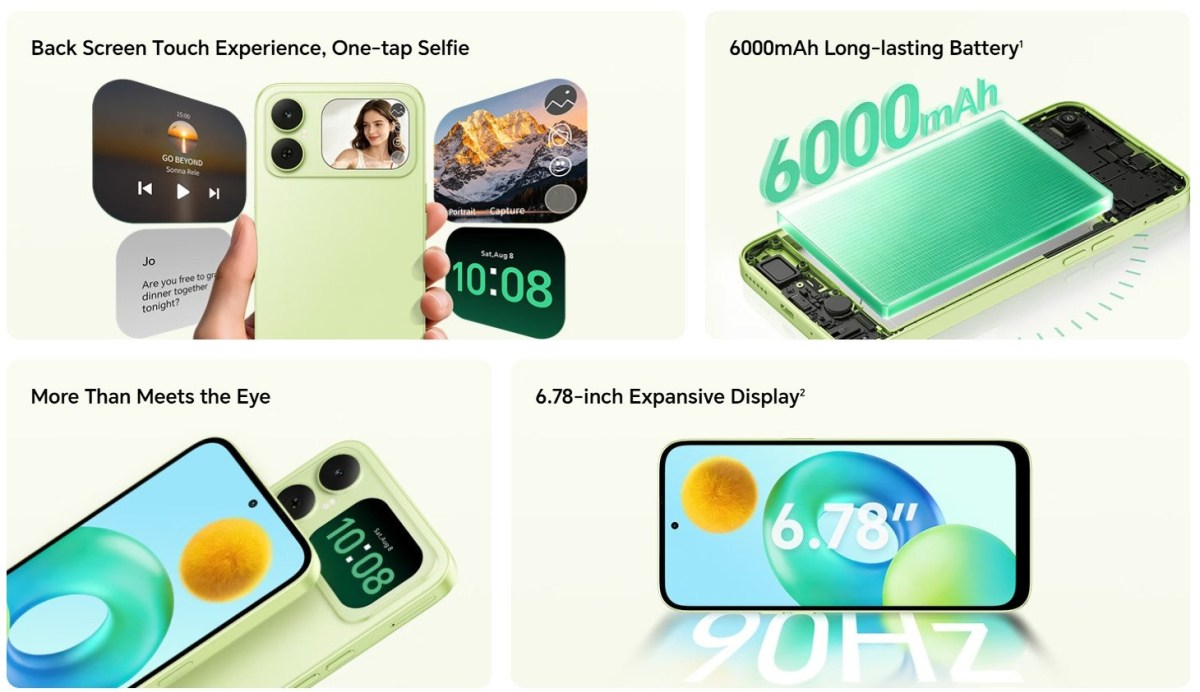
- Primary Display: A large 6.78-inch IPS LCD panel featuring HD+ resolution and a 90Hz refresh rate, providing smooth scrolling and responsive navigation.
- Camera System: A primary 50MP sensor designed to provide clarity for daily photography, augmented by the unique utility of the rear screen for framing high-quality selfies.
- Battery and Power: A massive 6,000 mAh battery capacity, which is increasingly becoming a benchmark for Honor’s budget offerings, paired with 15W charging support.
- Chipset Disparity: In a nuanced move, Honor has split the performance profiles based on configuration. The 4GB RAM/128GB storage model is powered by the Unisoc T615 chipset, while other memory variants utilize the Unisoc T610.
The device is available in a selection of colors, including the striking new "Sunrise Gold"—a colorway exclusive to the Play20C—alongside Forest Green and the classic Midnight Black.
Chronology: The Road to the Global Launch
The development of the Play20C is intrinsically linked to the recent release of the Honor X5d s. While the X5d s serves as the primary announcement, the Play20C acts as its international counterpart.
- Late 2024 Initial Teasing: Industry rumors began circulating about Honor’s intent to bring "flagship-tier" convenience features to lower price brackets.
- The X5d s Debut: Honor first introduced the X5d s, establishing the template for the dual-screen budget phone. This release served as a proof-of-concept for the hardware.
- The Play20C Global Listing: Shortly thereafter, the Play20C appeared on Honor’s official global portal. This expansion signaled the company’s intent to reach emerging markets, specifically targeting regions where high-value, high-durability phones are in high demand.
- Regional Availability: The device has already surfaced in markets like Nigeria, where it is retailing for approximately NGN 149,900 (roughly $113 USD), providing a clear indicator of the intended price-to-performance bracket.
Supporting Data: Hardware Breakdown and Market Positioning
To understand the Play20C, one must look at the technical trade-offs required to keep the price point near the $110 mark while including a secondary screen.
The Unisoc Architecture
The choice of the Unisoc T610 and T615 chipsets is a calculated decision. These SoCs are designed for efficiency rather than high-performance gaming. By utilizing 12nm architecture, they provide sufficient power for social media, light multitasking, and communication tasks, while keeping thermal output low—a necessity for a device with a large 6,000 mAh battery. The marginal upgrade to the T615 in the 128GB trim suggests a minor optimization in memory management or clock speed, tailored to ensure the higher-capacity model remains snappy as storage fills up.
Battery Longevity
The 6,000 mAh battery is arguably the most compelling feature of the device. In an era where 5,000 mAh has become the standard, the additional 1,000 mAh provides a distinct advantage for users in regions where power stability may fluctuate or where access to wall chargers is limited during the day. The 15W charging, while modest, is a compromise to ensure battery longevity and safety, adhering to international standards for entry-level devices.
Display Dynamics
The inclusion of a 90Hz refresh rate on an HD+ panel is a significant upgrade over the 60Hz screens typically found in this price tier. This ensures that the user interface feels modern and fluid, mitigating the perception that this is a "cheap" phone. The 2-inch rear screen functions as a notification hub and a framing tool, bridging the gap between utilitarian budget phones and premium photography-centric devices.
Official Responses and Strategic Intent
Honor has remained relatively quiet regarding the specifics of the dual-screen integration, viewing it as a seamless feature of their design language rather than a "gimmick." On their global website, the company emphasizes "Endurance and Utility."
Analysts suggest that Honor is leveraging its supply chain expertise to include these unique modules at a cost that competitors cannot match. By branding the device as a "Play" series phone, Honor is explicitly targeting a younger demographic that values personalization and social media presence. The "Sunrise Gold" color, in particular, is a marketing push to differentiate the Play20C from the more conservative X5d s, signaling that Honor is tailoring its aesthetic to different regional tastes.
Implications: The Impact on the Budget Smartphone Market
The release of the Play20C carries several implications for the mobile industry:
1. Democratization of Novelty
For years, secondary displays were the domain of ultra-premium folding phones or niche gaming handsets. By introducing this to the entry-level segment, Honor is forcing competitors to rethink what "value" means. If a $113 phone can offer a secondary screen, the industry standard for what constitutes a "basic" smartphone will inevitably shift.
2. The Rise of the "Battery-First" Consumer
The Play20C reinforces the trend of massive batteries in emerging markets. As mobile internet usage grows in Africa, Southeast Asia, and parts of South America, consumers are increasingly prioritizing battery life over high-resolution displays or high-end cameras. The 6,000 mAh cell in the Play20C is a direct response to this consumer demand.
3. Supply Chain Versatility
The minor hardware variation between the Unisoc T610 and T615 suggests that Honor is navigating component shortages or pricing fluctuations with agility. By offering different chipsets based on storage configuration, they can optimize margins without compromising the core user experience. This level of granular supply chain management is a hallmark of Honor’s post-independence strategy.
4. Future Outlook
As the Play20C begins its global rollout, the reception will likely determine whether the rear-screen design becomes a permanent fixture in Honor’s portfolio. If the device achieves strong sales figures in Nigeria and other key markets, it is highly probable that we will see the concept refined in future generations—perhaps with an OLED rear screen or integrated touch-sensitive controls for gaming.
Conclusion
The Honor Play20C is more than just a rebranded X5d s; it is a tactical play by one of the world’s fastest-growing smartphone brands to dominate the entry-level segment. By balancing essential upgrades—such as a 90Hz display and a 6,000 mAh battery—with the "wow factor" of a rear touchscreen, Honor has created a compelling proposition for the cost-conscious buyer.
Whether the secondary screen becomes a standard feature or remains a transient experiment, the Play20C serves as a reminder that the most interesting innovation is no longer limited to the flagship tier. For the consumer, this means more choice, more utility, and, ultimately, a more engaging mobile experience at a price point that was once considered strictly utilitarian. As the device hits global shelves, it will be fascinating to watch how the market responds to a budget phone that dares to be different.