The New Frontier of Inclusion: How AudioEye is Scaling Digital Accessibility in the AI Era
In the rapidly expanding digital landscape, the internet has become the primary gateway to commerce, healthcare, government services, and social connection. Yet, for the 1.3 billion people globally living with a disability, this gateway is frequently obstructed. As businesses scramble to adapt to a shifting legal and technological landscape, AudioEye—a veteran in the digital accessibility space—is redefining how organizations approach inclusion. By fusing sophisticated AI automation with human-led expertise, the company is shifting the narrative from "compliance as a checkbox" to "accessibility as a business imperative."
The Mission: Building an Accessible Default
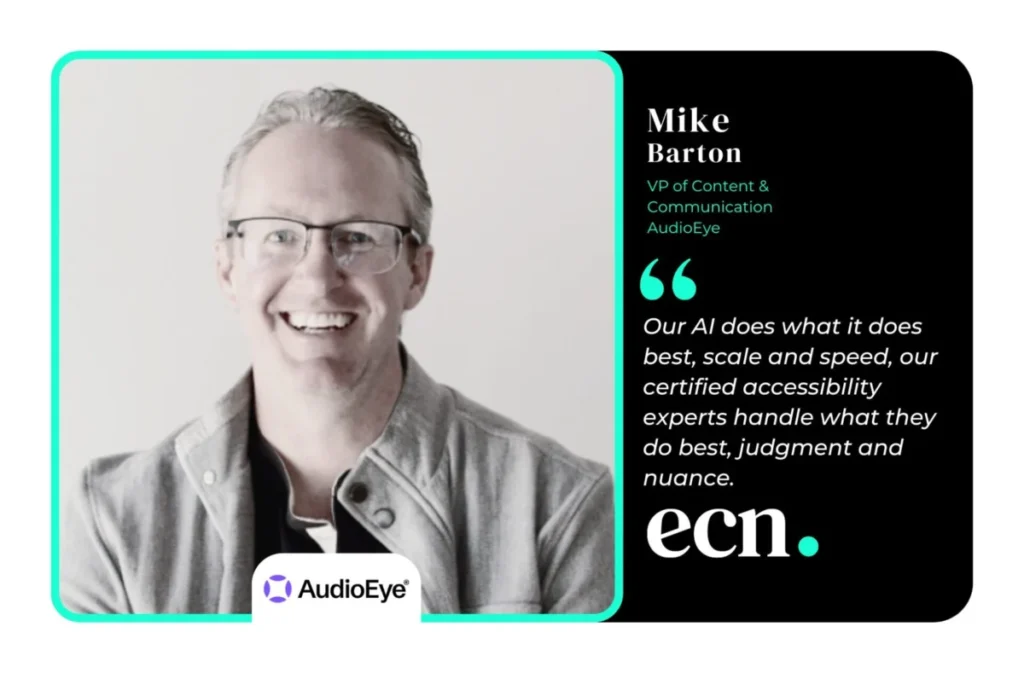
AudioEye’s core philosophy is deceptively simple: every person, regardless of ability, should be able to navigate the web with ease. According to Mike Barton, VP at AudioEye, the company’s vision extends beyond meeting legal standards. "Our vision is a digital world where accessibility isn’t an afterthought or a legal scramble, but the default," says Barton.
Today, that vision supports over 127,000 organizations. By leveraging a hybrid model that combines high-speed AI detection with the nuanced judgment of human experts, AudioEye has positioned itself as the gold standard for businesses looking to protect their brand while opening their digital doors to a massive, often underserved, customer base.
A Chronology of Change: From Niche to Necessity
To understand the current state of digital accessibility, one must look at its evolution. Two decades ago, when AudioEye was founded, accessibility was treated as a peripheral concern—a "nice-to-have" rather than a foundational requirement.
The Shift in Stakes
- 2000s–2010s: Accessibility was largely ignored or treated as a low-priority checkbox for web developers.
- 2020–2024: A massive surge in digital reliance, accelerated by the pandemic, brought accessibility to the forefront. U.S.-based digital accessibility lawsuits have doubled since 2020, signaling that the legal system is no longer treating the issue with leniency.
- 2025–Present: The introduction of the European Accessibility Act (EAA) has expanded the regulatory footprint, turning accessibility into a cross-border requirement. Furthermore, the rise of AI-driven web development has created both a challenge and an opportunity, as automated tools now generate inaccessible code faster than ever before.
Supporting Data: The Business Case for Inclusion
For businesses, the argument for accessibility has shifted from moral obligation to economic necessity. The data supporting this transition is compelling:
- Spending Power: People with disabilities represent an estimated $18 trillion in global spending power.
- Customer Retention: Research indicates that 70% of people with disabilities will abandon a website that is not accessible.
- The "Known-Works" Phenomenon: 83% of users with disabilities limit their shopping to platforms they already know are accessible. If a business fails to accommodate them, it is not just losing a sale; it is losing a lifelong customer to a competitor who does.
- Efficiency Gains: Through AudioEye’s hybrid approach, roughly 97% of accessibility issues are resolved before a company’s internal development team even needs to intervene, saving hundreds of engineering hours annually.
Official Responses: How the Hybrid Model Works
The efficacy of AudioEye’s platform lies in its "automation-first, expert-validated" architecture. When asked how the system functions in practice, Barton explains that it acts as an intelligent layer above the existing web infrastructure.
"Our platform finds accessibility issues and fixes them before customers even notice," says Barton. The process is streamlined: a single line of JavaScript—similar to a standard cookie banner—deploys the software. The platform scans the rendered page against the Web Content Accessibility Guidelines (WCAG), detecting up to 2.5 times more issues than competing tools.
The Human-AI Symbiosis
While AI handles the high-volume, repetitive tasks—such as fixing missing alt-text or correcting broken form labels—the "gray areas" require human intervention. "The barriers that put real revenue at risk often live in context and intent," Barton notes. "Our certified specialists, many of whom have lived experience with disabilities, handle the nuances that AI cannot yet master. Software finds the patterns; experts find what hides between them."
Implications for the Future: AI, Discovery, and Regulation
The future of the internet is being shaped by two competing forces: the global tightening of regulations and the rise of autonomous AI agents.
The Global Regulatory Landscape
The implementation of the European Accessibility Act (EAA) in 2025 serves as a bellwether for the rest of the world. Companies that previously operated under the assumption that accessibility was only a concern for U.S. litigation are now realizing that their compliance map has expanded globally. AudioEye’s strategy is to provide a "compliance-by-default" framework, where meeting regulations is the natural byproduct of maintaining a high-quality, usable site.
The AI-Discovery Paradox
Perhaps the most intriguing implication for the future is the role of AI in search and discovery. We are moving toward a world where AI agents navigate the web on behalf of human users. These agents rely on a site’s "accessibility tree" to understand content, products, and services.
"If your site isn’t accessible, you are effectively invisible to one of the fastest-growing discovery channels online," Barton warns. "Accessibility and AI discovery are going to be the same conversation in a few years."
Conclusion: A New Standard for Digital Equity
The evolution of AudioEye reflects the broader evolution of the internet itself. We are moving away from an era of static, exclusionary digital spaces toward an era of dynamic, inclusive experiences.
For the modern enterprise, the message is clear: accessibility is not merely a legal hurdle to be cleared or a cost center to be minimized. It is a growth engine. By integrating accessibility into the core of their digital strategy, businesses are not only protecting themselves from the rising tide of litigation but are also capturing a significant portion of the global market that has been historically overlooked.
As the lines between AI-driven discovery and human-centric accessibility continue to blur, platforms like AudioEye provide the essential infrastructure to ensure that the internet remains a universal resource. The mission is, and remains, the same: to ensure that the web is not just open, but truly usable for everyone. As Mike Barton puts it, "The internet should work for everyone who uses it. Our job is to make sure it does."