Beyond the Noise: Why Marketing Leaders Are Choosing Curation Over Content
In an era defined by information saturation, the primary challenge for marketing leaders is no longer the acquisition of data, but the mastery of filtration. The modern CMO’s inbox is a battlefield, cluttered with an endless barrage of white papers, tactical frameworks, and "must-read" industry reports. Yet, in this relentless stream of information, the most valuable commodity remains focus.
The consensus among industry strategists is shifting: the market is exhausted by content density. Instead, there is a profound, growing appetite for high-fidelity curation. This pivot is driving a renaissance in email marketing, as brands realize that the most effective way to serve a time-starved audience is not to provide more, but to provide better.
The Death of the Generic Newsletter
For years, the standard playbook for corporate email marketing remained static: a curated list of links, a few blog headlines, and perhaps a promotional banner. While this "link-heavy" model served its purpose in the early 2010s, it has reached a point of diminishing returns. As audience expectations for quality rise, content that requires a user to click away to derive value is increasingly being ignored.
The fundamental issue is that most newsletters are designed for the sender’s convenience, not the reader’s cognitive load. They treat the inbox as a repository for links rather than a destination for insight. Modern marketing leaders, however, demand more than a summary of what happened—they require an analysis of what it means and why it matters to their bottom line.
Data-Driven Evolution: The Case of Convince & Convert
Convince & Convert (C&C), a leading consultancy in the digital marketing space, recently underwent a radical transformation of its own email strategy. Recognizing that its long-running newsletter, ON, was no longer meeting the evolving needs of its readership, the firm leveraged internal audience research to build a successor: The Trendline.
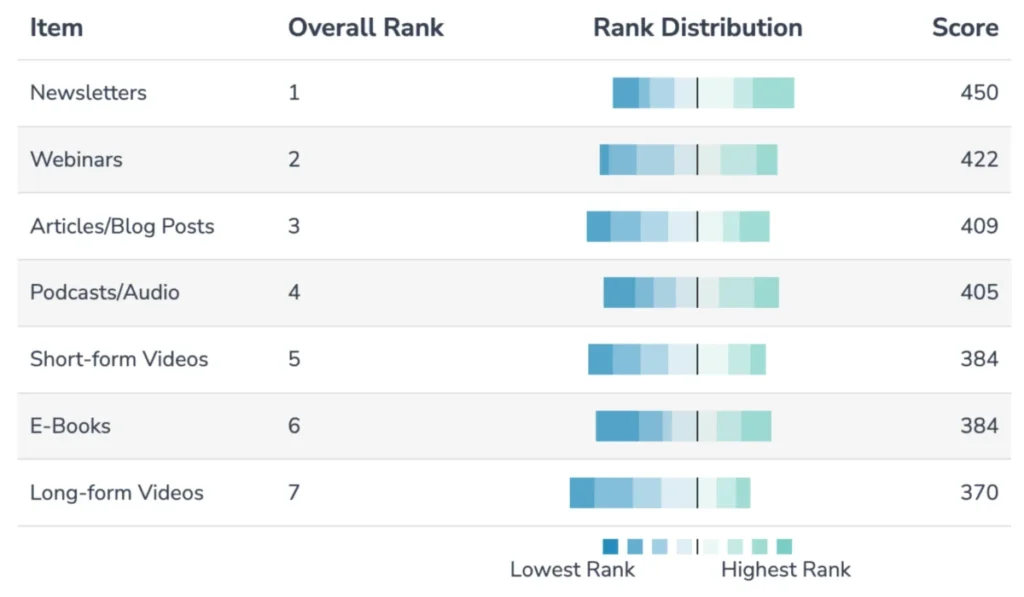
The transition was not merely a cosmetic rebrand; it was a structural overhaul informed by rigorous data collection. In their annual survey of marketing leaders, C&C asked participants to rank seven different content formats based on their preference for learning about industry trends. The results were decisive: newsletters were ranked first by a margin nearly double that of short-form video, webinars, blogs, or podcasts.

This revelation highlights a critical shift in professional development. Marketing executives are moving away from passive, time-intensive formats like webinars in favor of "lean-in" media that allows for rapid synthesis of complex topics.
Chronology of a Pivot: From ‘ON’ to ‘The Trendline’
The decision to sunset ON and launch The Trendline followed a specific internal audit process that mirrors how any organization should evaluate its owned media:
- Audience Sentiment Audit: The team realized that while their previous content was useful, it placed an undue burden on the reader to decipher the "why" behind the "what."
- Format Re-alignment: They shifted the focus from the medium (blog vs. podcast) to the utility (strategic insight vs. information distribution).
- Structural Standardization: They established clear editorial guidelines that allowed multiple team members to contribute while maintaining a compact, high-value footprint.
- Strategic Deployment: The launch of The Trendline served as a blueprint for a more "debrief-style" communication, prioritizing insights that can be consumed entirely within the email body.
The Anatomy of the New Newsletter
The Trendline operates on the philosophy that value must be provided upfront. The format is built on several key pillars that differentiate it from traditional, link-centric models:
- The Strategic Lens: Every curated story includes a "so what?" factor. Instead of just sharing a news item, the editorial team explains why the shift matters to a CMO and what specific questions they should be asking their teams.
- Reduced Friction: By providing comprehensive summaries within the email itself, the reader gains strategic value without the immediate need to visit an external site.
- Human-Centric Curation: The tone is designed to feel like a conversation with a peer, rather than a robotic news feed. This fosters a sense of trust and authority that automated content aggregation cannot replicate.
- Interactive Engagement: The implementation of "Sound Off"—a regular polling feature—serves a dual purpose. It provides the reader with a moment of interaction and provides the C&C team with clean, actionable engagement metrics that go beyond the vanity metrics of open and click-through rates.
Implications for Modern Content Strategy
The success of this transition offers a roadmap for brands looking to revitalize their engagement strategies. The primary takeaway is that the "noise" of the internet is not the fault of the content creator, but the fault of the lack of a filter.
1. Prioritize Utility Over Volume
Brands must move away from the "publish as much as possible" mentality. In a crowded inbox, volume is a liability. Every piece of content should pass the "utility test": Does this help the reader solve a problem, make a better decision, or think more strategically?
2. Audience-Centric Research
The C&C model proves that you cannot guess what your audience wants; you must ask them. Whether through surveys, sentiment analysis, or direct feedback loops, the foundation of a successful content strategy is a deep understanding of the professional pain points of your target demographic.

3. The "Full-Email" Experience
The trend toward "newsletter-as-a-destination" is accelerating. Readers are increasingly wary of "bait-and-switch" emails that exist only to drive traffic to a landing page. By providing the core insight inside the email, brands build higher levels of trust, which eventually leads to higher-quality, more qualified traffic when you do ask for a click.
4. Branding for Shareability
The shift from ON to The Trendline was also a branding exercise. A newsletter title should be descriptive, memorable, and shareable. The Trendline suggests a focus on the future and a strategic perspective, which is exactly what a marketing leader looking for an edge needs.
The Future of Owned Media
As social media algorithms become more volatile and search engine results become increasingly dominated by AI-generated summaries, owned media channels like email newsletters are becoming the last bastion of true, direct-to-audience engagement.
However, this privilege of access comes with a responsibility. The inbox is a personal, semi-private space. To be invited into it is a vote of confidence. When brands abuse that space with low-value, high-frequency "content noise," they risk being relegated to the "Promotions" tab or the trash folder—or worse, the "Unsubscribe" link.
The path forward is clear: be the filter. In an industry built on rapid, often chaotic change, the most valuable brand is the one that provides the clarity to navigate it. By adopting a "less is more" approach, focusing on strategic debriefs, and respecting the time of the reader, organizations can transform their email strategy from a marketing obligation into a high-authority asset.
For marketing leaders, the goal is not to keep up with every headline, but to synthesize the right ones. As the evolution of The Trendline demonstrates, the future of content isn’t in the flood—it’s in the current.