AWS Transforms Serverless Architectures: Amazon EventBridge Unveils Enterprise-Grade Enhanced Custom Event Buses
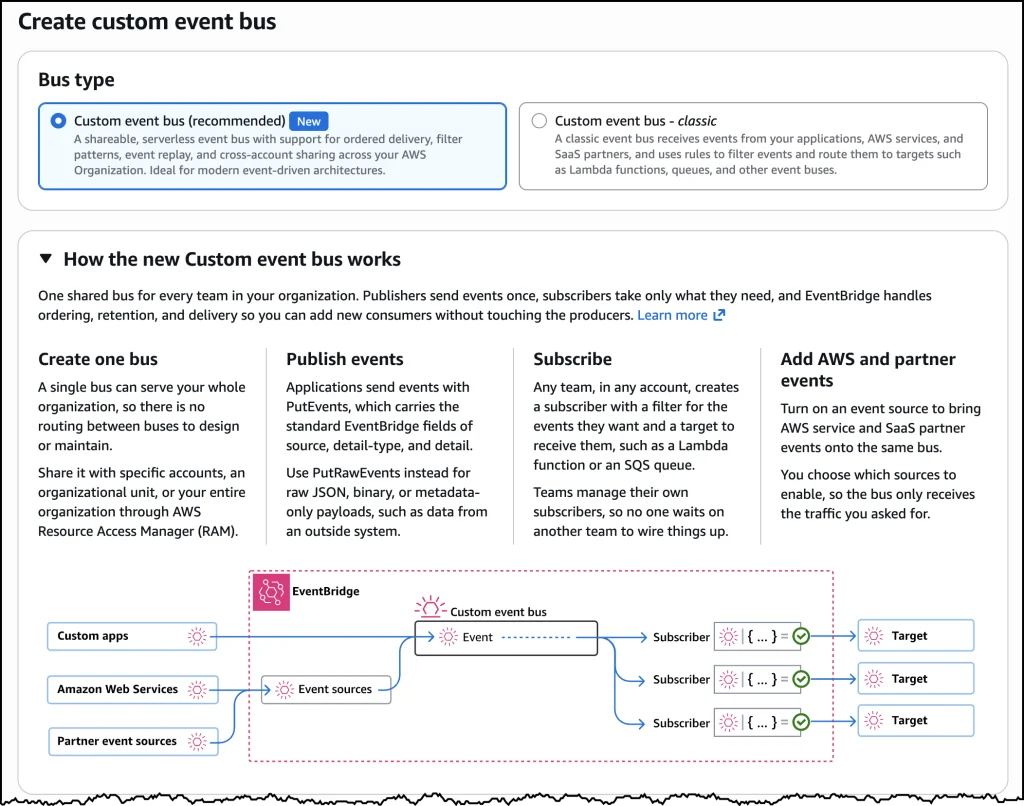
SEATTLE — In a major architectural leap for developers building large-scale, cloud-native applications, Amazon Web Services (AWS) has announced the immediate general availability of an enhanced custom event bus for Amazon EventBridge. Purpose-built to eliminate the operational friction of multi-account serverless environments, the new capability introduces organization-wide resource sharing, built-in event ordering, streamlined subscriber management, advanced content evaluation, and a restructured, scale-friendly pricing model.
The launch addresses a foundational scaling pain point for modern enterprise engineering organizations. While serverless paradigms promise simplified infrastructure management, the reality of deploying microservices across dozens—or hundreds—of distinct AWS accounts has historically forced teams into complex web-weavings of cross-account rules and bus-to-bus configurations. With today’s release, AWS is shifting the paradigm from fragmented, multi-bus topologies to a singular, centralized, highly scalable event backbone.
Main Facts
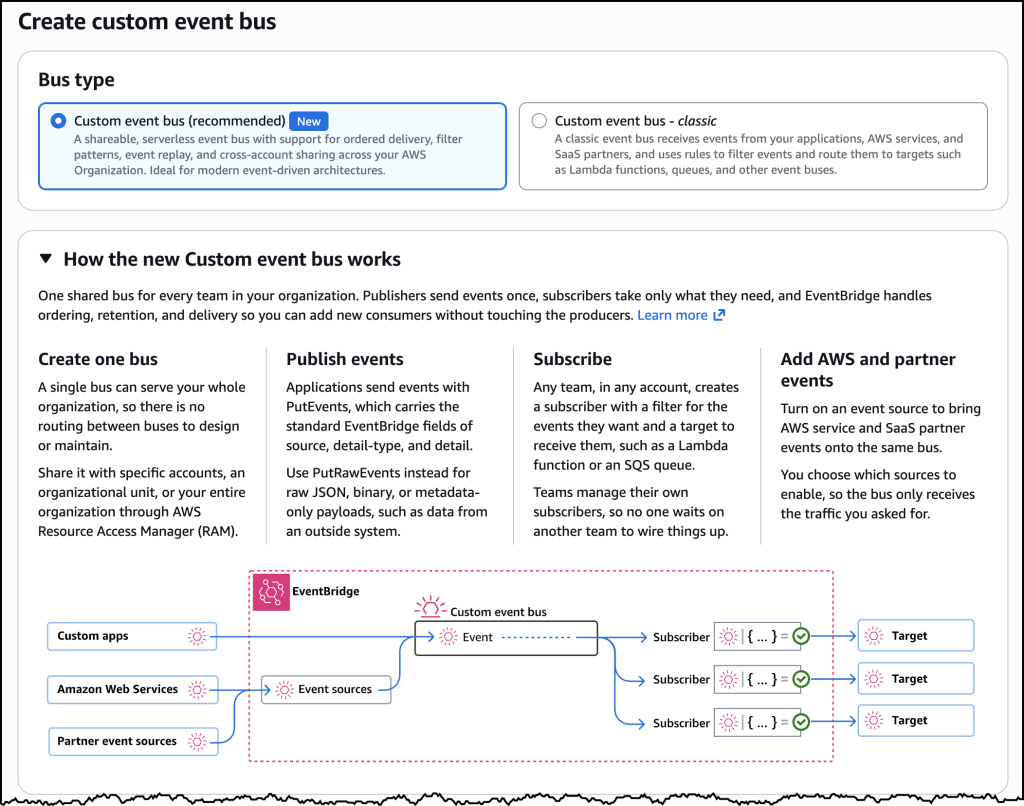
The newly launched enhanced custom event bus introduces several critical architectural capabilities designed for enterprise scale:
- Centralized Organization-Wide Sharing: Leveraging AWS Resource Access Manager (AWS RAM), platform teams can deploy a single event bus and share it seamlessly across an entire AWS organization, organizational unit (OU), specific accounts, or designated IAM principals without managing manual cross-account resource policies.
- Native Event Ordering: Bridging the traditional gap between asynchronous event-driven flows and sequential data requirements, publishers can attach an
EventGroupIdto payloads. EventBridge guarantees strict sequence delivery to subscribers opting into ordered processing. - Unified Subscriber Resource: Replacing the disparate rules, targets, retry policies, and dead-letter configurations of the past, a new first-class
Subscriberresource bundles event filtering, destination routing, and failure-handling mechanisms into a single manageable unit. - Content-Based Deduplication and Transformation: The platform now automatically identifies and drops duplicate retries within a five-minute window using payload hashing, while supporting native JSONata transformations and schema deserialization for Apache Avro and Protocol Buffers.
- Separation of Concerns Pricing: A new ingress-and-egress throughput pricing model shifts costs logically, charging publishers for data ingestion and subscribers for data delivery, thereby eliminating compounding cross-account routing fees.
Existing workloads remain fully protected; legacy deployments are now categorized as "Custom event bus – classic" and will continue to operate without disruption, allowing organizations to adopt the enhanced bus at their own pace.
Chronology of Development: From Classic Workarounds to Unified Scale
The evolution of Amazon EventBridge mirrors the maturation of serverless computing itself.
Phase I: Single-Account Simplicity
When developers first began adopting event-driven architectures, standard implementations relied on a single custom event bus housed within a single AWS account. Owned and operated by a single cohesive team, this model excelled in speed, simplicity, and visibility. Rules filtered incoming custom events and routed them directly to serverless targets like AWS Lambda functions, Amazon Simple Queue Service (SQS) queues, or third-party APIs.
Phase II: The Multi-Account Fragmentation
As enterprise adoption scaled, security and governance best practices necessitated moving away from monolithic AWS accounts. Organizations adopted multi-account strategies via AWS Organizations, isolating workloads, data, and teams into distinct accounts.
To maintain event-driven communication across these organizational boundaries, teams were forced to construct intricate workarounds. Engineers established multiple custom event buses per account, bridging them using cross-account resource policies, EventBridge resource-based permissions, and cascading bus-to-bus target rules.

While functional, this multi-bus approach reintroduced the operational overhead serverless was designed to erase. Platform teams lost holistic visibility into cross-account event flows, compounding routing charges inflated operational bills, and strict subscriber limits created artificial architectural roadblocks. Furthermore, use cases requiring chronological event processing—such as supply chain tracking or financial ledgering—could not natively rely on EventBridge’s standard at-least-once, out-of-order delivery model, forcing developers to interject heavy Amazon SQS FIFO queues or alternative messaging frameworks into their pipelines.
Phase III: The Enhanced Event Bus Era
Recognizing these friction points, AWS engineering teams spent recent years architecting a reimagined foundation. Rather than patching the classic model, AWS built the enhanced custom event bus from the ground up to handle massive, multi-tenant enterprise traffic natively. Released today across major global regions, the enhanced bus unifies publishing, ordering, security, and consumption onto a single shared infrastructure plane.
Supporting Data and Technical Architecture
The technical underpinnings of the enhanced custom event bus reflect deep optimizations designed to handle enterprise workloads without compromising latency or throughput.
Scaling and Quotas
The enhanced custom event bus shatters previous architectural ceilings. Out of the box, it supports a default quota of 10,000 active Subscribers per bus, with provisions for higher limits upon request. This vast capacity prevents the structural fragmentation that previously forced platform engineers to split event traffic across artificial boundaries.
Granular Access Control via AWS RAM
Configuring the new bus begins directly within the AWS Management Console or via infrastructure-as-code tooling. By enabling event bus sharing and selecting AWS RAM parameters, administrators can restrict access precisely:
- Allow sharing strictly within the local AWS Organization.
- Target specific Organizational Units (OUs) or discrete AWS account IDs.
- Grant explicit access to specific AWS IAM roles or users.
This tight integration ensures that application development teams can immediately begin publishing and subscribing to the central backbone without waiting for infrastructure provisioning tickets to clear.
Reconciling Asynchronicity and Ordering
Event-driven architectures fundamentally thrive on loose coupling and asynchronous processing, where consumer execution order is irrelevant. However, real-world domains—such as IoT telemetry, fleet management, and logistics routing—frequently demand strict chronological integrity. Out-of-sequence updates can cause downstream state machines to make catastrophic decisions based on stale data.
The enhanced custom event bus solves this dichotomy by allowing both patterns to coexist on the exact same bus:

- Asynchronous Streams: Standard consumers process events concurrently and independently.
- Ordered Streams: Publishers supply an
EventGroupIdattribute within the event envelope. EventBridge queues and delivers events sharing this ID strictly in sequence to subscribers configured for ordered delivery.
To reinforce this capability, EventBridge now supports synchronous invocation modes for targets like AWS Lambda. Synchronous execution confirms successful processing by the downstream target before acknowledging the event back to the bus. This native synchronization eliminates the classic design pattern of placing an Amazon SQS FIFO queue directly between an event bus and a Lambda function simply to guarantee ordered execution and reliable processing.
Advanced Payload Evaluation and Transformation
Data hygiene and payload adaptation have historically added friction to event-driven development. The enhanced bus introduces advanced computational features to streamline ingestion:
- Content-Based Deduplication: For event sources that lack native idempotency tokens or reliable retry markers, publishers can enable content-based deduplication. EventBridge hashes the meaningful elements of the payload and automatically collapses duplicate retries arriving within a five-minute window, effectively granting those streams exactly-once delivery semantics instead of the standard at-least-once model.
- JSONata Transformations: Downstream subscribers can deploy JSONata expressions directly within their subscription configurations. This allows consumers to reshape, filter, compute, or extract specific fields from an incoming event payload before it ever reaches the target API, eliminating custom routing middleware.
- Schema Deserialization: Organizations utilizing binary serialization formats like Apache Avro or Protocol Buffers can now offload parsing overhead to EventBridge. The platform natively deserializes these formats into standard JSON, allowing fine-grained filtering and routing across the entire payload without forcing every consumer to write custom parsing code.
A Restructured Economic Model
Pricing complexity has long been a hurdle in multi-bus architectures, where fees compounded with every cross-account hop and secondary bus target. The enhanced custom event bus transitions to an ingress-and-egress throughput pricing model:
- Publishers pay strictly for the events ingested into the bus.
- Subscribers pay strictly for the events successfully delivered to their endpoints.
This clean separation aligns financial accountability directly with organizational usage, providing clearer cost allocation across business units and lowering the economic barrier to wide-scale event distribution.
Official Responses and Industry Perspective
AWS leadership emphasizes that the release represents a fundamental maturation of serverless architecture, moving away from decentralized workarounds toward unified enterprise governance.
"When organizations scale event-driven architectures, they shouldn’t have to choose between operational visibility and architectural freedom," said a senior AWS product management spokesperson during the release briefing. "With the enhanced custom event bus, we are giving platform teams the centralized control and security they require, while giving application developers the ordering guarantees, simplified subscriptions, and performance they need to move fast."
Early enterprise preview participants have echoed these sentiments, noting that the combination of native event ordering and organization-wide sharing drastically reduces the boilerplate infrastructure code required for cross-team integrations. By removing the need to provision intermediary SQS queues and custom IAM role mazes, development velocity is expected to accelerate significantly across complex microservice ecosystems.
Implications for Developers and Platform Engineers
The introduction of the enhanced custom event bus carries profound implications for how cloud-native engineering organizations will design their next-generation systems.
1. Shift in Platform Team Responsibilities
Platform and Cloud Operations teams transition from gatekeepers of fragmented cross-account plumbing to orchestrators of a single, highly visible corporate event nervous system. With AWS RAM managing permissions and default quotas scaling up to 10,000 subscribers, platform engineers maintain absolute visibility over enterprise-wide event flows while empowering product teams with self-service consumption.
2. Simplification of Microservices Topology
The consolidation of rules, targets, retry policies, and dead-letter queues into the single Subscriber resource radically declutters Infrastructure-as-Code (IaC) templates (such as AWS CDK, Terraform, or CloudFormation). Engineers no longer need to maintain complex matrices of cross-account resource-based policies to pass messages between disparate product teams.
3. Broadened Horizons for Event-Driven Design
By gracefully accommodating both high-throughput asynchronous workloads and strictly ordered, synchronous-target pipelines on the same bus, developers are no longer forced to adopt disjointed messaging technologies for edge-case requirements. Financial systems, logistics trackers, and stateful workflows can now peacefully reside alongside decoupled analytics pipelines on a unified EventBridge backbone.
Availability and Getting Started
The enhanced custom event bus is available starting today across a wide footprint of global AWS Regions, including:
- Americas: US East (N. Virginia, Ohio), US West (Oregon)
- Europe: Europe (Ireland, Frankfurt, Stockholm, Spain)
- Asia Pacific: Asia Pacific (Hong Kong, Malaysia, Mumbai, Singapore, Sydney, Thailand, Tokyo)
Engineering teams can begin provisioning enhanced event buses immediately via the AWS Management Console, the AWS Command Line Interface (CLI), or standard AWS SDKs and APIs. Classic event buses remain fully supported and operational, ensuring a seamless, risk-free migration path for existing cloud workloads.
To explore technical documentation, pricing breakdowns, and step-by-step configuration tutorials, developers can visit the official Amazon EventBridge Documentation portal or log directly into the AWS Management Console.