The Paradox of Convenience: Navigating the Complex Landscape of European E-Commerce Returns
In the modern digital economy, the transaction is no longer concluded when a customer clicks "buy." For the contemporary e-commerce merchant, the true test of operational efficiency, brand loyalty, and financial health often occurs after the package has been delivered. Returns have evolved from a mere logistical inconvenience into a fundamental pillar of the online shopping experience. In the European market—a diverse, highly regulated, and fiercely competitive environment—the management of these reverse logistics has become a strategic imperative.
This article provides an in-depth analysis of the current state of e-commerce returns in Europe, exploring the logistical, financial, and ecological challenges, and outlining a framework for optimization that balances profitability with consumer satisfaction.
1. Overview of E-Commerce Returns in Europe: The New Normal
E-commerce returns have shifted from being an "exception" to a "standard expectation." In Europe, where consumer protection laws are among the most stringent in the world, the ease of returning goods is often a primary factor in a customer’s decision to purchase.
Statistical Reality
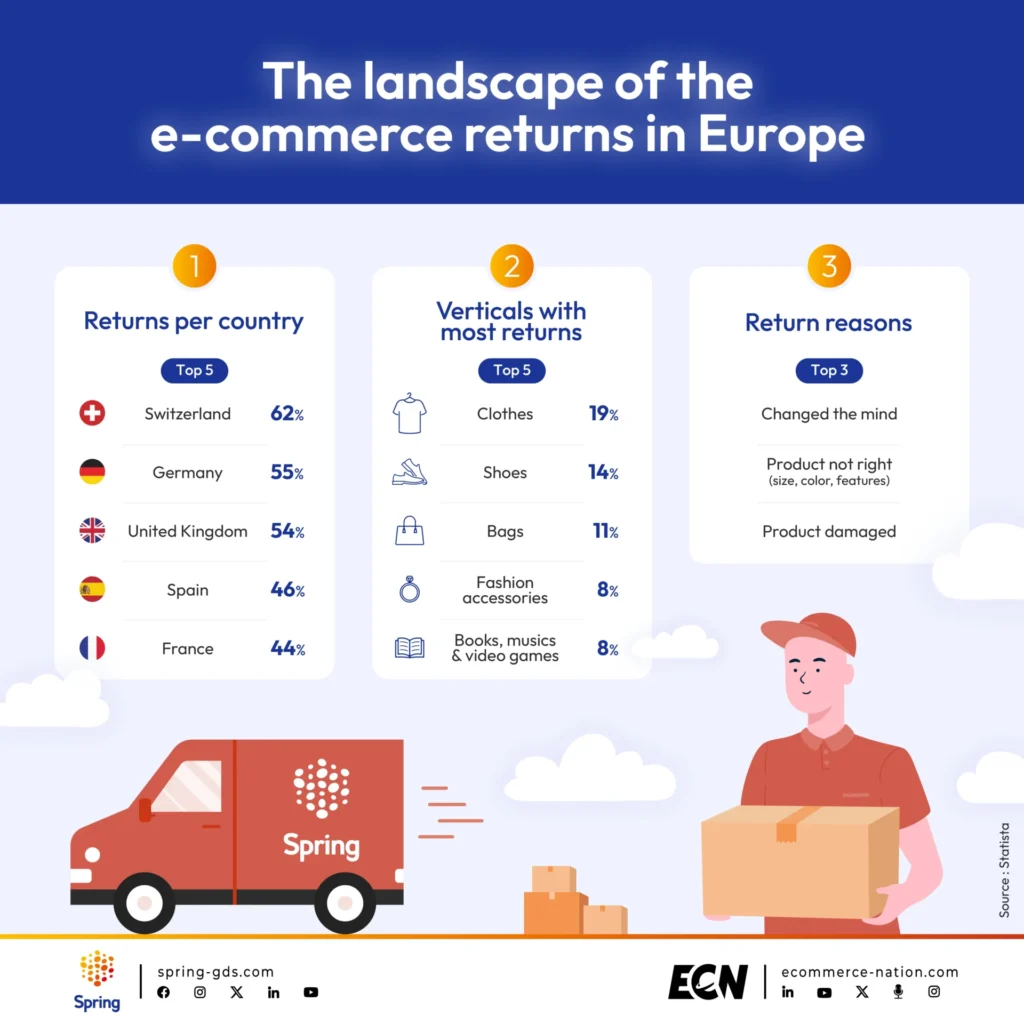
The European e-commerce landscape is characterized by high return rates, which typically hover between 30% and 40% across the board. However, these figures mask significant regional and sectoral disparities. Data from 2023 indicates that Switzerland leads the continent with an eye-watering 62% return rate per online buyer. Germany and the United Kingdom follow closely, with 55% and 54% respectively. These high figures are often attributed to a culture of "try-before-you-buy" and highly consumer-friendly retail policies that have conditioned shoppers to order multiple sizes or colors with the intention of returning the majority.
The Impact on the Bottom Line
For retailers, every return is a "profit leak." The financial impact includes:
- Operational Overheads: Costs associated with receiving, inspecting, and re-processing items.
- Inventory Devaluation: The inevitable loss of value when a returned item is no longer "new" and must be sold at a discount.
- Logistical Drain: The cost of reverse shipping, which often exceeds the cost of the initial outbound delivery.
Conversely, for the consumer, a frictionless return process is a key driver of trust. Research consistently shows that a customer who has a positive, hassle-free return experience is significantly more likely to return to the same brand for future purchases.
2. Sectoral Analysis: Where Do the Returns Go?
Not all products are created equal when it comes to return rates. The fashion and apparel sector remains the most volatile, with return rates often exceeding 50%. This is driven by the subjective nature of style, fit, and material feel.
- Fashion & Apparel: High susceptibility to "bracketing"—the practice of buying multiple sizes of the same item to find the perfect fit, knowing full well that the remainder will be sent back.
- Electronics: While return rates are lower (roughly 6% in many markets), the complexity is higher. Compatibility issues, "user error" returns, and technical defects require specialized inspection, making these returns more expensive to process.
- Home & Lifestyle: Similar to electronics, these items often suffer from "expectations gap"—the product looks different in the consumer’s home than it did in the professionally staged product photography.
3. The Challenges: A Multi-Faceted Crisis
The Logistical Labyrinth
The physical movement of goods from a consumer’s doorstep back to a warehouse is a logistical nightmare. In a cross-border context, this becomes exponentially more complex. Merchants must contend with diverse postal networks, differing local customs regulations, and the requirement for seamless parcel traceability. Without a robust reverse logistics infrastructure, companies risk having thousands of units "in transit" indefinitely, creating inventory blind spots.
The Regulatory Landscape
Operating in the European Union necessitates compliance with a patchwork of national laws. While the EU provides a framework for consumer rights (such as the 14-day cooling-off period), individual countries have nuanced requirements regarding tax reclamation on returned goods, labeling for customs, and documentation for cross-border transit. Failure to navigate these complexities can lead to stalled goods at borders and heavy administrative penalties.
The Ecological Footprint
Perhaps the most pressing modern challenge is the environmental impact. The "return-and-reship" cycle doubles the carbon footprint of a product. Furthermore, the reliance on single-use protective packaging and the unethical, yet common, practice of discarding returned goods that are deemed "too expensive to process" has drawn significant criticism from environmental watchdogs and climate-conscious consumers.
4. Strategies for Optimization: From Cost-Center to Competitive Advantage
Faced with these hurdles, forward-thinking merchants are moving away from reactive management and toward a proactive, data-driven strategy.
Data-Driven Prevention
The most effective way to handle a return is to prevent it from happening in the first place.
- Enhanced Product Visualization: Using Augmented Reality (AR) or 360-degree high-definition video to give customers a better sense of size and texture.
- Predictive Analytics: Utilizing AI to analyze historical return patterns. If a specific dress has a 40% return rate due to "sizing issues," the retailer can automatically display a warning: "This item runs small, we recommend sizing up."
Streamlining the Reverse Supply Chain
Technology-based return management systems (RMS) have become essential. An effective RMS allows for:
- Automated Inspections: Utilizing image recognition to assess product condition upon arrival.
- Dynamic Routing: Automatically directing returned items to the nearest warehouse or secondary market outlet to minimize transport emissions and costs.
Fostering an Ecological Strategy
Sustainability is no longer optional. Brands are increasingly:
- Promoting Circularity: Offering store credit or discounts for consumers who choose to keep the product rather than return it, or providing "pre-loved" marketplaces for returned goods.
- Eco-Friendly Logistics: Consolidating returns through batch shipping, which reduces the number of courier trips, and adopting reusable, durable packaging solutions.
5. Conclusion: The Future of European Returns
The evolution of e-commerce in Europe is inextricably linked to the evolution of returns management. We are moving toward a model where returns are treated as a vital data stream rather than an unfortunate byproduct of sales.
By integrating technological innovations—such as AI-driven size recommendations—with a commitment to environmental transparency, retailers can transform their reverse logistics into a sustainable ecosystem. The goal is to create a "virtuous cycle" where the ease of returning builds customer loyalty, and the efficiency of the return process protects the retailer’s bottom line.
Ultimately, the merchants who succeed in the next decade will be those who view the return, not as the end of a transaction, but as a critical touchpoint for building a lasting, transparent, and environmentally responsible relationship with the consumer. The challenge is immense, but for those who master it, the rewards in customer retention and brand equity are substantial.