Beyond the Prompt: Mastering Tool Calling and Code Execution for AI Agents
In the rapidly evolving landscape of artificial intelligence, the transition from simple chatbots to autonomous agents marks a pivotal shift in how we interact with digital systems. An "agent" is no longer just a text generator; it is a functional entity capable of performing real-world actions. However, the efficacy of these agents hinges on a fundamental architectural decision: how they interact with their environment.
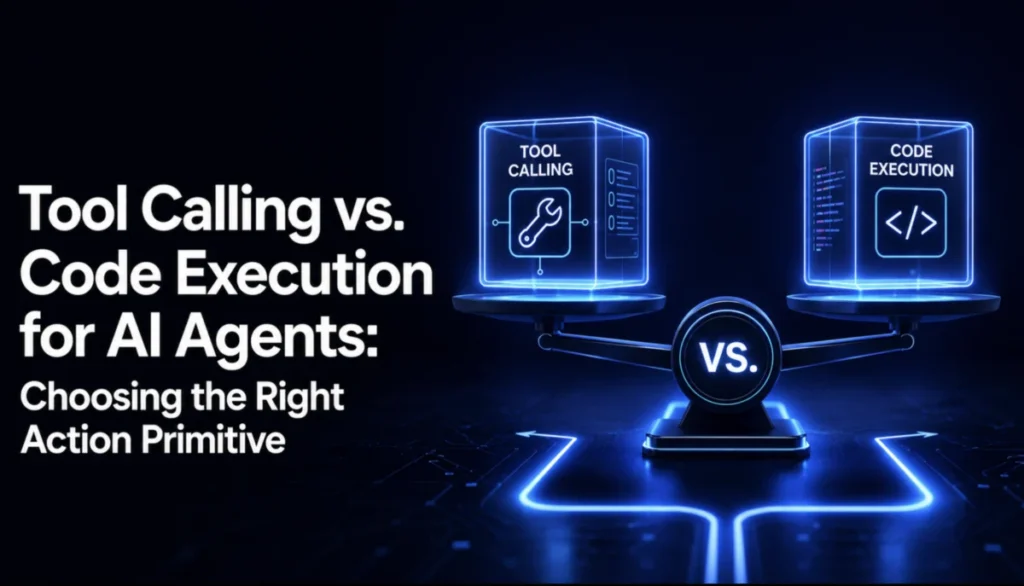
This article explores the two primary "action primitives"—tool calling and code execution—that define how language models bridge the gap between decision-making and execution. Understanding the mechanical differences between these two approaches is not merely a technical preference; it is a strategic necessity for developers looking to optimize for cost, latency, and system accuracy.
The Core Dilemma: When Data Becomes Noise
To understand the stakes, consider a common enterprise scenario: an agent is tasked with identifying which of twenty employees exceeded their Q3 travel budget. To solve this, the agent requires access to hundreds of expense line items—flights, hotels, and meals—and must compare them against specific budgetary limits tied to individual roles.
If built using standard tool calling, the agent must trigger a separate call for each employee’s expenses. Each call returns a JSON payload of fifty to a hundred items. Consequently, the model’s context window is flooded with over 2,000 line items and roughly 50KB of raw data. The model does not need to "read" this data to perform its task; it simply needs the mathematical sum. This "context bloat" is the silent killer of agent performance, driving up latency and costs while increasing the likelihood of hallucination or arithmetic error.
The Evolution of Action Primitives
An action primitive is the core mechanism by which a Large Language Model (LLM) translates a decision into a physical effect, such as a database write or an API request. Every major agent framework is anchored by these mechanisms.
Tool Calling: The Traditional Standard
Tool calling, the methodology most developers encounter first, relies on a discrete, structured interaction. The model generates a specific JSON payload, the host application intercepts this, executes the function, and feeds the result back into the model’s conversation history. It is a highly auditable, "step-by-step" process. Every action is logged, and every result is visible to the model, allowing it to reason about the output before proceeding to the next step.
Code Execution: The Programmable Alternative
Code execution represents a more sophisticated paradigm. Instead of requesting a single, isolated action, the model writes a functional program (typically in Python or TypeScript) that runs in a sandboxed environment. Rather than returning every intermediate result to the model’s context, the sandbox processes the data locally. Only the final, refined answer is passed back to the model. This method, often associated with Anthropic’s "Programmatic Tool Calling," allows the model to handle loops, conditional logic, and error handling without ever cluttering its primary working memory.
Chronology of Technical Development
The journey toward modern agentic workflows has been marked by a shift from rigid API interaction to flexible, code-based reasoning.
- The Era of JSON-based Tool Calling (2023–2024): Developers relied heavily on OpenAI and Anthropic’s structured output formats. While stable, this era was defined by "round-trip latency," where every single tool call required a full round-trip back to the model for verification.
- The Rise of Code-Aware Agents (Early 2025): Inspired by the "CodeAct" research paper (Wang et al., 2024), developers began realizing that letting models write Python code significantly outperformed JSON-based function calls. This period saw the emergence of secure sandboxing as a standard infrastructure requirement.
- The Programmatic Tool Calling Integration (Late 2025): The introduction of the
allowed_callersfield by major labs allowed developers to designate specific tools as "code-callable." This marked the official transition where code execution became a first-class citizen in the agent ecosystem, moving from a niche hack to an industry-standard feature.
Supporting Data: The Case for Efficiency
The move toward code execution is backed by measurable performance gains. According to internal benchmarks provided by Anthropic, moving from traditional tool calling to programmatic code execution for complex research tasks resulted in a 37% reduction in token usage (dropping from ~43,000 to ~27,000 tokens per task).
Beyond cost, the data suggests significant improvements in reliability. The GAIA benchmark, which measures an AI’s ability to solve complex, real-world tasks, saw accuracy climb from 46.5% to 51.2% when agents were allowed to use programmatic code execution. Furthermore, academic research like the CodeAct study demonstrated that agents using code-based execution for multi-step tasks achieved a 20% higher success rate compared to their JSON-reliant counterparts. These metrics highlight that code execution is not merely an optimization; it is a qualitative leap in reasoning capability.
Official Perspectives and Industry Implementation
Major AI research labs, including Anthropic, have emphasized that these two primitives are not mutually exclusive. The "Programmatic Tool Calling" feature is currently being positioned as an enhancement to the existing tool-use ecosystem.
By adding an allowed_callers field to a tool definition, developers can now grant an agent the autonomy to decide whether to call a tool directly or to incorporate that tool into a broader, self-written script. The official documentation suggests that this flexibility is key to building "resilient agents"—systems that can switch between simple lookups (tool calling) and complex analytical workflows (code execution) on the fly.
Implications for Developers and Enterprises
For organizations building agentic systems, the implications are three-fold:
1. Infrastructure Requirements
Code execution requires a secure, sandboxed environment. For many, this introduces new operational overhead. Unlike standard tool calling, which can often run directly within the host application’s scope, code execution demands an isolated container or virtual environment to prevent malicious or accidental system calls.
2. Debugging and Auditability
While code execution is more efficient, it is harder to audit in real-time. In a standard tool-calling loop, every step is a documented event. With code execution, the agent might write a fifty-line script that performs a dozen operations internally. Debugging a failure inside an opaque, AI-generated script requires advanced logging and introspection tools that are only now becoming mature.
3. The "Hybrid" Future
The most effective agents will be those that employ a hybrid strategy. Simple, latency-sensitive tasks—such as checking the weather in one city—should remain in the domain of plain tool calling to avoid the "cold start" latency of spinning up a sandbox. However, any task involving aggregation, filtering, or multi-step analysis must be routed through a code execution environment to keep the model’s context clean and its reasoning focused.
Final Decision Framework: A Summary Table
| Factor | Favors Tool Calling | Favors Code Execution |
|---|---|---|
| Call Frequency | Single or isolated calls | High-frequency / Fan-out calls |
| Result Handling | Model needs raw, granular data | Aggregated or summarized results |
| Data Sensitivity | Low | High (PII better kept in sandbox) |
| Latency Budget | Tight (No sandbox overhead) | Loose (Workflow already complex) |
| Auditability | High (Every step is a discrete log) | Moderate (Requires script-level logging) |
Conclusion
The choice between tool calling and code execution is an architectural decision that dictates the scalability and reliability of AI agents. While tool calling provides a clean, auditable interface for simple tasks, code execution is the engine of progress for complex, multi-step problem solving.
By mastering both, developers can move past the limitations of simple prompt-response loops and build truly autonomous agents. As the industry continues to refine these primitives, the focus must remain on the ultimate goal: creating systems that are not only capable of acting in the world but are efficient, secure, and precise in how they do so. The future of agentic AI belongs to those who understand that in the world of large-scale computation, less context is often more.