The Return Revolution: Navigating the Complex Landscape of European E-commerce Logistics
In the modern digital economy, the traditional retail journey—from discovery to payment—has evolved into a cyclical process. For the contemporary e-commerce merchant, the transaction does not conclude when the “Buy Now” button is clicked; rather, it extends into the post-purchase phase, where returns have become a defining pillar of the consumer experience. In the European market, where cross-border trade is the norm rather than the exception, managing these reverse logistics flows has become a strategic imperative for profitability, brand loyalty, and environmental stewardship.
1. The State of Play: An Overview of European Returns
E-commerce returns in Europe are not merely an operational nuisance; they are a fundamental component of the commercial landscape. With a market as diverse as the European Union, the characteristics of these returns shift dramatically depending on the region, consumer habits, and regulatory frameworks.
Statistical Realities and Market Trends
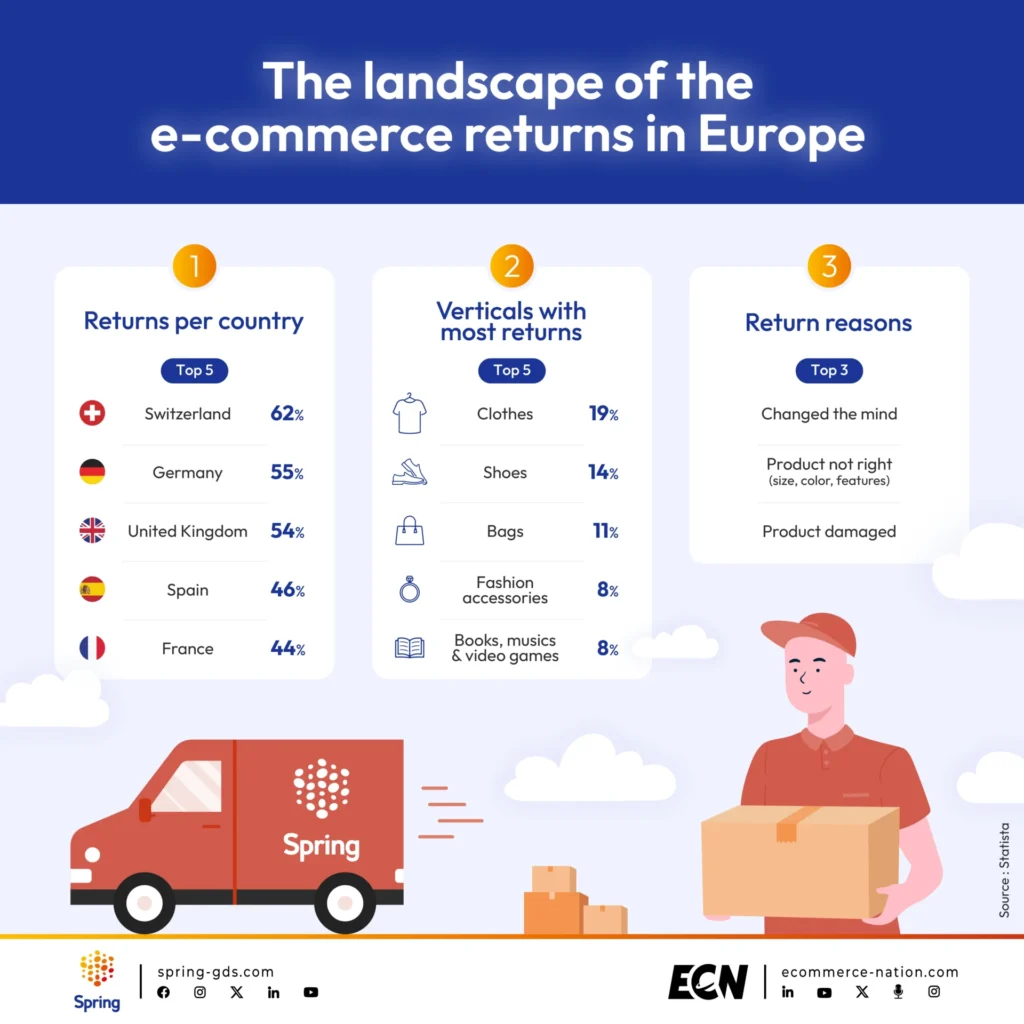
Current industry data paints a revealing picture. The average return rate across the continent fluctuates between 30% and 40%, though this average masks significant regional disparities. According to data from Statista (2023), Switzerland leads the European charts with a staggering 62% return rate per online buyer. Germany follows at 55%, and the United Kingdom stands at 54%.
These high figures are driven by a variety of factors, including the maturation of the e-commerce market, which has emboldened consumers to order multiple sizes or variations of a product—a trend often referred to as "bracketing." As consumers become increasingly comfortable with online shopping, their expectations for "frictionless" returns have risen in tandem, forcing retailers to adapt or risk losing market share to competitors with more lenient policies.
The Profitability Paradox
For retailers, returns represent a complex "profitability paradox." While a generous return policy is a powerful conversion tool that builds trust, the financial burden is immense. Costs are not limited to the return shipping itself; they encompass labor for inspection, restocking fees, potential damage to the item, and the inevitable devaluation of goods that can no longer be sold at full price. When a product is returned, the profit margin of the original transaction is often wiped out, sometimes leaving the merchant with a net loss on the item.
2. Chronology of a Return: From Consumer Choice to Logistics Chain
To understand the challenge, one must track the "lifecycle" of a return.
- The Intent Phase: The process begins with the consumer’s decision to return, often triggered by a mismatch in sizing, a change of heart, or a product that fails to meet the expectations set by online imagery.
- The Logistic Initiation: Once the request is filed, the retailer must provide a pathway—be it a QR code for a drop-off point, a pre-paid shipping label, or a home collection service.
- The Transit Phase: The parcel enters the reverse supply chain, which is historically slower and more fragmented than the outbound delivery chain.
- The Inspection and Reintegration Phase: The item arrives at a warehouse, is inspected, and is either restocked, refurbished, donated, or, in the worst-case scenario, sent to a landfill.
This chronology is fraught with potential for friction. A delay in the inspection phase translates to a delayed refund, which is the primary driver of customer dissatisfaction.
3. The Challenges: Logistics, Regulation, and the Planet
The hurdles facing European merchants are multifaceted, requiring a delicate balance between fiscal responsibility and operational agility.
Logistical and Cross-Border Complexity
Logistics is the backbone of the returns process. In a fragmented Europe, companies must manage a web of local carriers and varied return destinations. Cross-border returns are particularly perilous; they involve navigating non-EU customs, VAT recovery issues, and high shipping costs. When a package crosses a border, the administrative burden increases, and the risk of the product being "stuck" in customs creates a nightmare for inventory management.
The Regulatory Landscape
European merchants must navigate a patchwork of consumer protection laws. While the EU has made strides in harmonizing consumer rights, local implementations—particularly regarding the "Right of Withdrawal"—can differ. Retailers must be acutely aware of the specific legal requirements for returns in every market they enter. Failure to comply can lead to legal penalties and significant reputational damage in markets where consumer protection is highly valued.
The Ecological Footprint
The "hidden" cost of returns is their environmental impact. The surge in parcel traffic has led to a significant increase in carbon emissions. Furthermore, the reliance on single-use packaging and the prevalence of discarding returned items—due to the prohibitive cost of checking and repacking—have drawn criticism from regulators and environmentally conscious consumers alike. Sustainability is no longer a "nice-to-have"; it is a business necessity, as consumers increasingly factor the carbon footprint of their shopping habits into their purchasing decisions.
4. Strategic Optimization: Turning Returns into a Competitive Advantage
To survive and thrive, e-commerce businesses must pivot from viewing returns as a cost center to viewing them as an opportunity for customer retention.
Data-Driven Insights
The first step in optimization is radical transparency. By analyzing return data, retailers can identify the "why" behind the return. If 20% of a clothing brand’s returns are due to sizing issues, the solution is not a better return policy—it is a better sizing guide. Utilizing AI-driven analytics to identify "serial returners" or products with high defect rates allows retailers to proactively address issues before they hit the warehouse.
Technological Integration
Modern retailers are increasingly adopting dedicated Return Management Systems (RMS). These platforms automate the entire process:
- Real-time tracking: Providing the customer with visibility into their refund status.
- Automated decision-making: Determining if an item should be returned to stock or liquidated based on predefined criteria.
- Integration with logistics partners: Ensuring the fastest and cheapest route for the parcel back to the warehouse.
The Sustainable Pivot
Forward-thinking brands are implementing "green" return strategies. This includes:
- Consolidated Returns: Encouraging customers to use drop-off points rather than home collections to reduce the "last mile" carbon footprint.
- Eco-Packaging: Utilizing durable, multi-use packaging that can be used by the customer to send the item back, eliminating the need for additional plastic.
- Second-Hand Marketplaces: Partnering with platforms that specialize in the resale of returned or "open-box" items, ensuring that products are given a second life rather than being discarded.
Improving the Customer Experience
Ultimately, the goal is to make the return as seamless as the purchase. A user-friendly policy—featuring clear deadlines, easy-to-access labels, and fast refunds—can convert a frustrated customer into a brand advocate. When a customer feels that a brand handles a mistake or a change of heart with efficiency and respect, the likelihood of a repeat purchase increases significantly.
5. Implications for the Future of E-commerce
The future of European e-commerce will be defined by those who master the "Return Loop." As regulatory pressure increases—particularly regarding environmental impact and packaging waste—merchants will be forced to innovate.
We are likely to see a shift toward "intelligent" logistics, where the cost of a return is dynamically priced based on the environmental and economic impact of that specific item. Furthermore, as technology matures, the use of virtual fitting rooms and augmented reality (AR) will continue to chip away at the necessity of returns, particularly in the fashion and furniture sectors.
In conclusion, returns are the silent partner of the e-commerce transaction. They are an inevitable, albeit complex, aspect of the business. By investing in data analytics, sustainable practices, and robust technological infrastructure, European e-commerce merchants can mitigate the risks of high return rates and transform the reverse supply chain into a foundation for long-term customer loyalty and sustainable growth. The brands that successfully navigate this evolution will not only reduce their overhead but will also set the standard for a more responsible, customer-centric retail future.