Mastering Retrieval: A Strategic Framework for Chunking in RAG Architectures
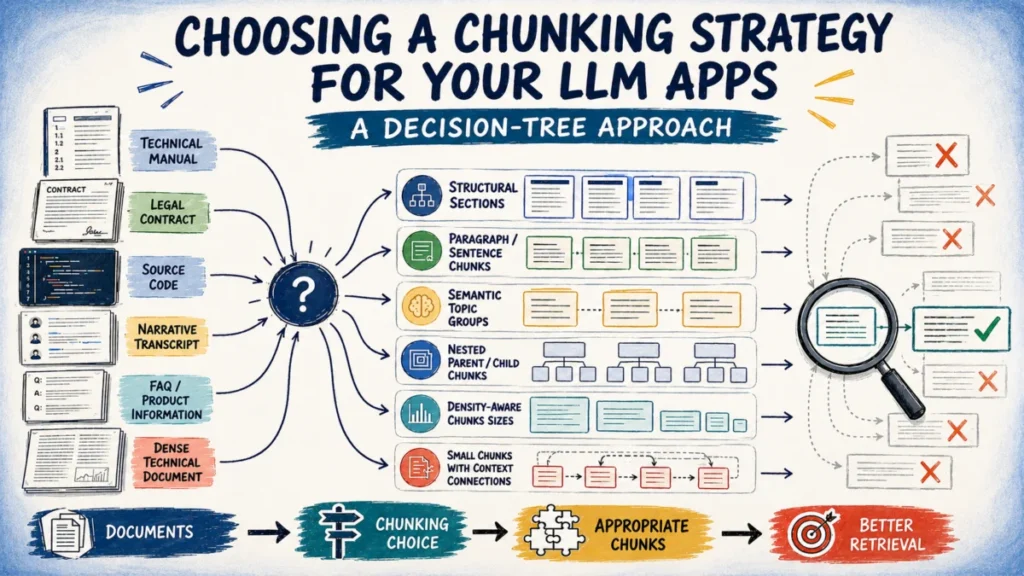
In the rapidly evolving landscape of Retrieval-Augmented Generation (RAG), the efficacy of an AI-driven application is rarely determined by the Large Language Model (LLM) alone. Instead, it is dictated by the quality of the data retrieved. At the heart of this data pipeline lies "chunking"—the process of partitioning large documents into segments that fit within a model’s context window. While often treated as a trivial configuration task, improper chunking acts as a primary point of failure, leading to fragmented context and retrieval inaccuracies.
To build production-grade RAG systems, developers must move beyond default settings and adopt a rigorous, decision-tree-based approach to chunking. By aligning the technical strategy with the underlying structure of the source documentation, architects can ensure that the "retrieved" context is as meaningful as the "generated" response.
The Architecture of Retrieval: Why Chunking Matters
When a RAG system retrieves a document, it is essentially searching for a "needle in a haystack." If the needles—your chunks—are cut in ways that isolate vital information from its necessary context, the downstream LLM will suffer from "contextual blindness."
For instance, a fixed-size chunking strategy might split a legal clause exactly in the middle of a conditional statement, effectively stripping the legal term of its governing scope. Conversely, an overly large chunk might dilute the specific information needed for a precise query, introducing noise that complicates the generation phase. The goal of an optimal chunking strategy is to preserve the semantic integrity of the information while remaining within the strict token limits of embedding models and LLMs.
A Chronology of Strategy: From Static to Agentic
The evolution of chunking techniques mirrors the maturity of the RAG ecosystem itself. Initially, developers relied on basic, rule-based methods; today, the field has moved toward context-aware and autonomous systems.
1. The Era of Basic Segmentation (Fixed-Size and Recursive)
In the early days, Fixed-size chunking was the standard. By simply defining a character or token count, systems would slice documents uniformly. While fast and computationally cheap, this method lacks intelligence. Recursive chunking was the first major improvement, introducing a hierarchy where the system attempts to split by paragraphs, then sentences, and finally words. It remains the industry "baseline" for uniform document sets.
2. The Rise of Semantic and Structural Awareness
As RAG systems grew more complex, developers realized that "meaning" is not tied to character counts. Document-based chunking arrived, leveraging metadata such as Markdown headers, HTML tags, or code structure to create logical breakpoints. Simultaneously, Semantic chunking emerged, utilizing embedding distance to detect shifts in topic, ensuring that a single chunk contains a single, coherent idea.
3. The Modern Frontier: Adaptive and Agentic Systems
We are currently witnessing the rise of Agentic chunking, where an LLM acts as an orchestrator, inspecting documents to determine the most effective partitioning strategy on a case-by-case basis. Similarly, Late chunking has surfaced to handle long-context dependencies, where the relationship between chunks is preserved by embedding the full document before splitting it.
Supporting Data: The Decision Matrix
Choosing the right strategy requires a systematic audit of your corpus. The following table illustrates the underlying assumptions of each major strategy, providing a diagnostic tool for developers.
| Strategy | Primary Assumption |
|---|---|
| Fixed-size | Boundary placement is less critical than speed. |
| Recursive | Structural markers (paragraphs/sentences) suffice for coherence. |
| Document-based | Internal formatting (headers/sections) aligns with logic. |
| Semantic | Embedding similarity is a reliable proxy for topic shifts. |
| Late Chunking | Meaning is derived from the full document context. |
| Agentic | Heterogeneous collections require bespoke handling per document. |
The Decision Tree: A Six-Step Protocol
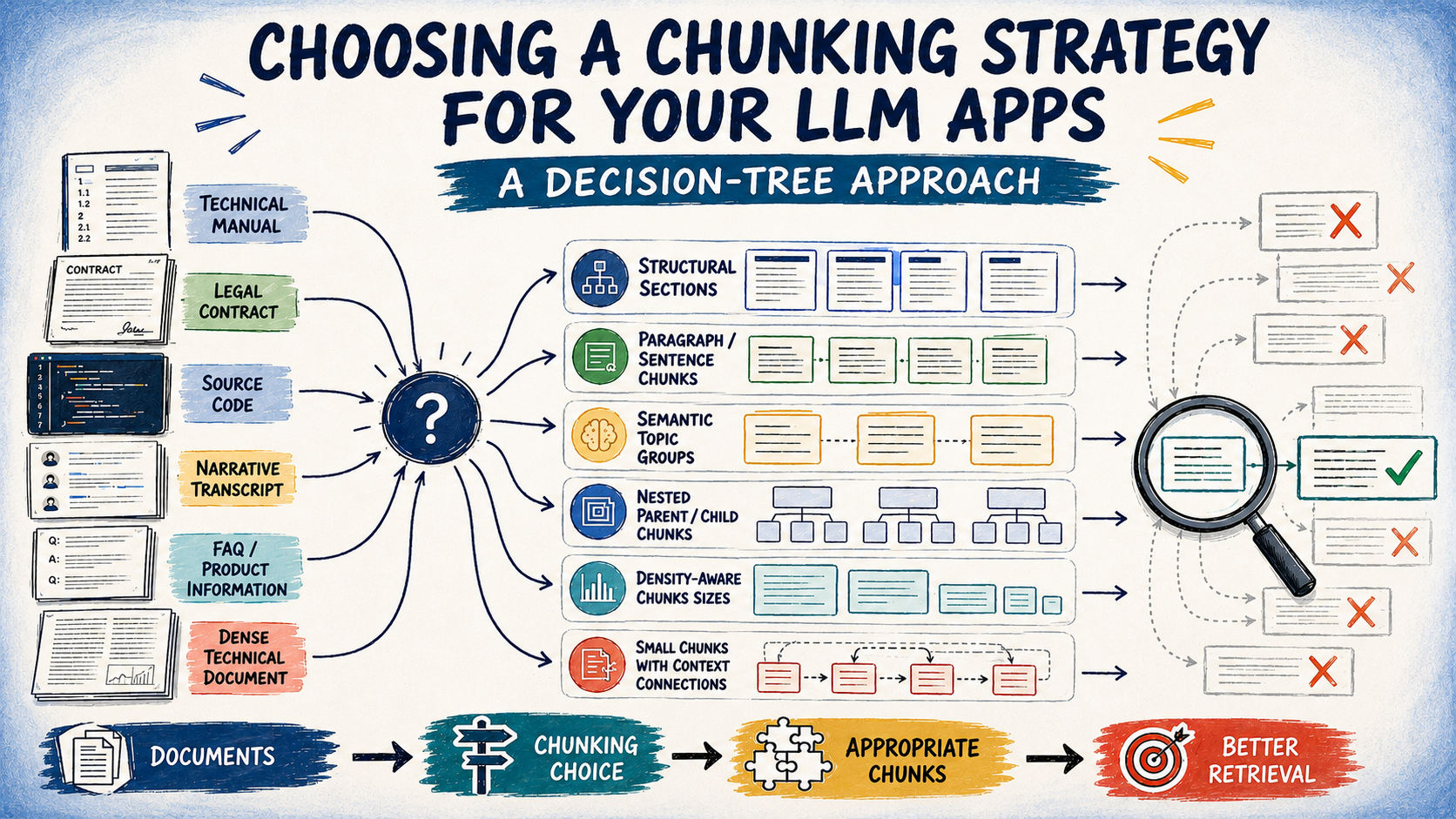
To implement an effective strategy, follow this six-step decision tree. Each branch is designed to eliminate unnecessary complexity while maximizing retrieval precision.
Step 1: Does the document require segmentation?
Before implementing a complex pipeline, evaluate if the document is already a "natural" unit. FAQ entries, individual configuration files, or short product descriptions often fit within a model’s context window. If the document is coherent and fits, skip chunking.
Step 2: Does the document possess a clear internal structure?
If the content is organized via headers, HTML, or code classes, use Document-based chunking. This preserves the document’s logical hierarchy, which is essential for preserving the relationship between sections and sub-sections.
Step 3: Are there cross-document dependencies?
In technical specifications or legal contracts, a term defined in the introduction is used throughout. For these cases, Late chunking is the gold standard, as it embeds the entire document before deriving segments, ensuring every chunk retains the context of the whole.
Step 4: Does information density vary?
If your corpus includes both dense data tables and sparse narrative text, a single chunk size will fail. Use Adaptive chunking to handle uneven density, or Hierarchical chunking to allow the system to search at both high-level summary and low-level detail.
Step 5: What is the cost-to-quality threshold?
If the priority is high-stakes accuracy, LLM-based chunking—using a model to identify logical breakpoints—is the most precise method, though it is the most expensive in terms of compute. For moderate budgets, Semantic chunking provides a high-quality balance.
Step 6: Is the collection heterogeneous?
If your repository is a mix of disparate file types (e.g., PDFs, code, and transcripts), Agentic chunking is the required approach. An intelligent agent can inspect the file type and select the optimal strategy dynamically.
Implications for System Performance
The choice of chunking strategy has significant downstream implications for both user experience and infrastructure cost.
Retrieval Precision vs. Latency
Adopting more advanced strategies—such as Agentic or LLM-based chunking—naturally increases the latency of the indexing pipeline. However, for complex queries, the reduction in "hallucinations" caused by poor context retrieval often justifies this overhead. Developers must be wary of "over-engineering"; if your corpus is uniform and simple, the added latency of an Agentic approach will yield diminishing returns.
The "Pitfalls" of Preprocessing
Common symptoms of poor strategy selection include:
- The "Mid-Sentence Cut": If your chunks consistently split mid-sentence, you are likely using a structure-blind method on a structured document. Switch to a recursive or document-based approach.
- Budget Overruns: If your compute costs are spiraling, ensure that your Agentic decisions are cached. Never re-analyze the same document twice.
- Inconsistent Results: If your semantic chunking yields varying results for similar documents, your similarity threshold is likely miscalibrated. Tighten the threshold to force more consistent segmentation.
Conclusion: The Path Forward
There is no "silver bullet" in RAG chunking. The most effective systems are those that view chunking as an evolving configuration rather than a static setup. By starting with the simplest viable method—typically Recursive chunking—and moving toward more sophisticated strategies only when the retrieval data demands it, developers can strike the optimal balance between performance, cost, and complexity.
As you iterate, remember that the goal is to provide the LLM with the most coherent, context-rich segments possible. Whether through hierarchical, late, or agentic methods, your chunking strategy is the primary architect of your system’s intelligence. Choose it wisely, monitor your retrieval metrics, and be prepared to pivot as your data requirements grow.