Accelerating Enterprise AI: Amazon Bedrock Unveils Managed Knowledge Base to Streamline RAG Pipelines
In the rapidly evolving landscape of generative AI, the divide between a prototype and a production-ready enterprise application often comes down to the reliability and relevance of the underlying data. Today, Amazon Web Services (AWS) has announced a significant evolution in its AI portfolio: Amazon Bedrock Managed Knowledge Base. This new service is designed to abstract the complex, "undifferentiated heavy lifting" associated with Retrieval-Augmented Generation (RAG), allowing organizations to transform their proprietary data into intelligent, agentic applications in a fraction of the time previously required.
For developers and enterprise architects, this release represents a paradigm shift. By moving away from manual infrastructure management—such as configuring embeddings, re-ranking models, and vector storage—Amazon Bedrock Managed Knowledge Base allows teams to focus exclusively on business outcomes and the quality of their AI-driven insights.
The Core Challenge: Why RAG Remains a Bottleneck
To understand the importance of this announcement, one must look at the technical hurdles that have historically plagued AI adoption. Building an effective RAG pipeline involves a complex stack: data ingestion, chunking, parsing, embedding generation, vector storage, re-ranking, and the final orchestration of model responses.
Developers have long struggled with three persistent pain points:
- High Infrastructure Overhead: Assembling and maintaining the components required for a performant RAG pipeline requires significant engineering resources, leading to long development cycles.
- Data Ingestion Complexity: Transforming messy, unstructured enterprise data—from PDFs to SharePoint repositories—into clean, searchable vectors is a notoriously difficult task that often requires custom-built parsing solutions.
- Reasoning Deficits: Standard retrieval methods often fail when faced with multi-hop questions, where the answer to a query is not contained within a single document but requires synthesizing information across multiple, disparate sources.
Amazon Bedrock Managed Knowledge Base addresses these challenges by consolidating these disparate infrastructure components into a single, cohesive, managed primitive.
Chronology: A Strategic Progression in Bedrock’s Evolution
The launch of the Managed Knowledge Base follows a deliberate trajectory in AWS’s generative AI strategy:
- Early 2024: AWS introduces the initial Knowledge Bases for Amazon Bedrock, providing a foundation for RAG but requiring significant manual configuration for scaling and performance tuning.
- Late 2024–2025: The rise of "Agentic AI" becomes the primary focus for enterprise customers. AWS begins integrating Bedrock more deeply with its AgentCore framework to support autonomous decision-making.
- June 2026: AWS unveils the "Managed" iteration of Knowledge Bases. This release marks the transition from a "do-it-yourself" configuration model to an "intelligent, automated" model, specifically targeting the reduction of time-to-market for enterprise agents.
- June 19, 2026: Official documentation and console workflows are finalized and deployed, providing a seamless path for users to move from raw data to a fully functional RAG pipeline in minutes.
Technical Innovation: Under the Hood
The new service is not merely a wrapper; it introduces three core technological pillars that differentiate it from legacy implementations.
1. Smart Parsing: The End of Manual Pre-processing
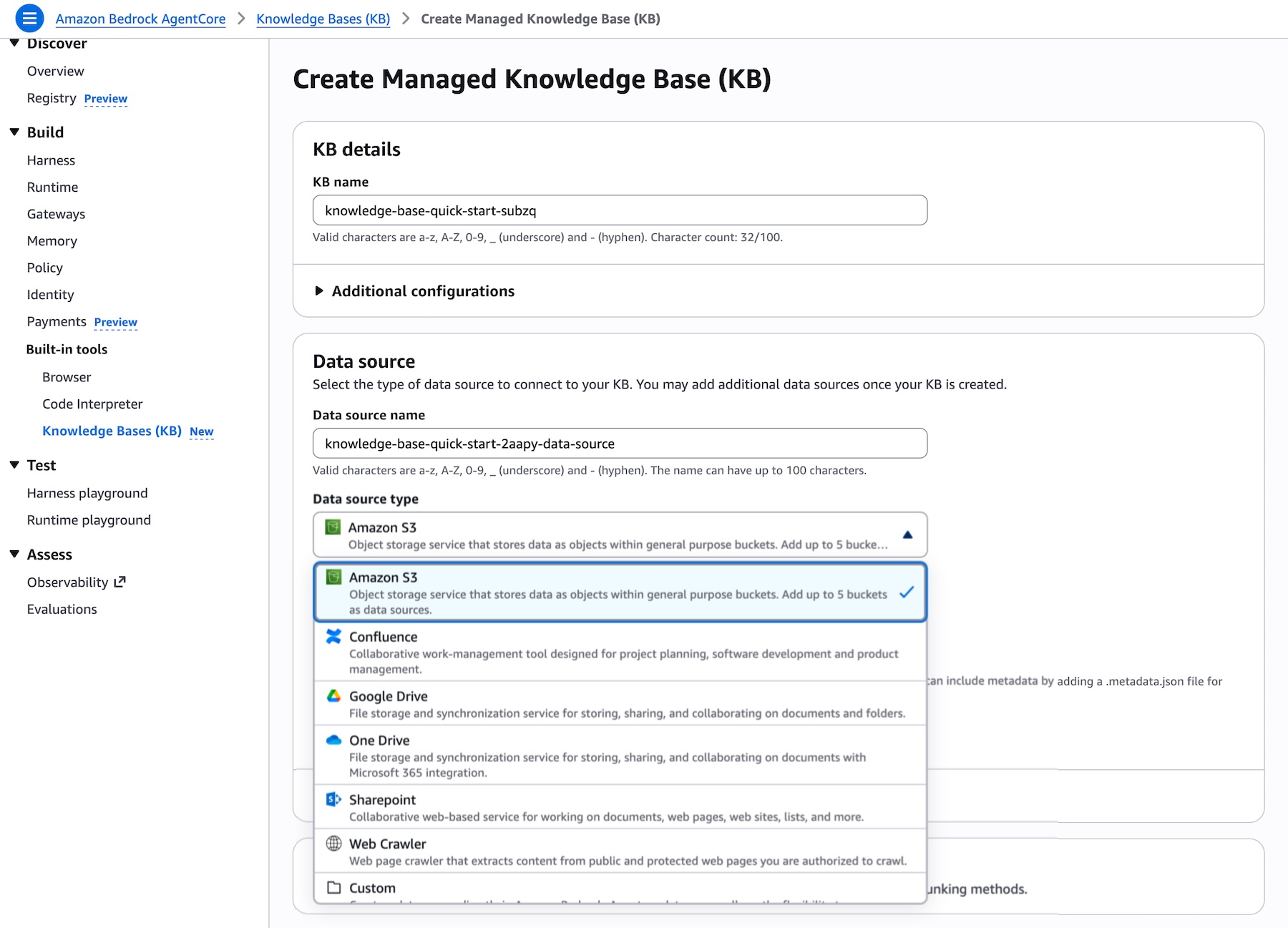
Data ingestion is often where AI projects die. The new Smart Parsing feature automatically identifies the most effective parsing strategy for various data types, including complex tables, charts, and diverse file formats found in platforms like Google Drive, OneDrive, and Confluence. By combining OCR (Optical Character Recognition), layout analysis, and semantic chunking, it eliminates the need for teams to spend weeks fine-tuning ingestion scripts.

2. The Agentic Retriever: Solving Multi-Hop Queries
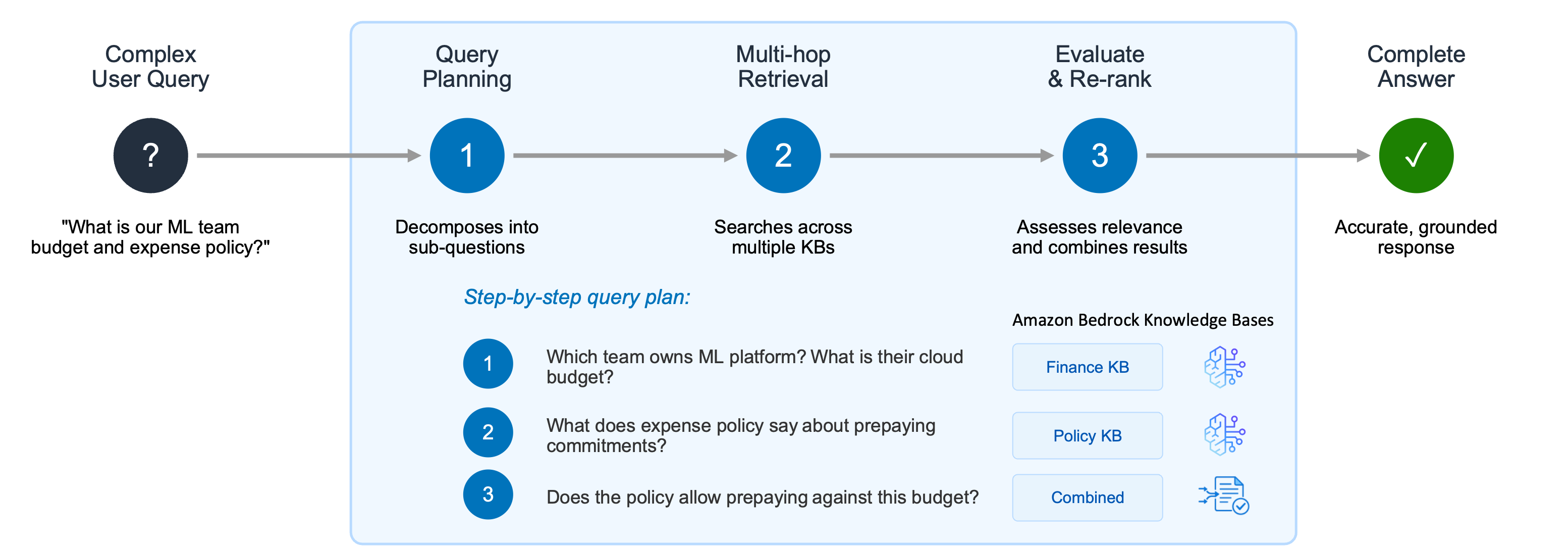
Perhaps the most significant advancement is the Agentic Retriever. Unlike traditional retrieval that performs a single search pass, the Agentic Retriever uses reasoning to decompose complex, multi-part user queries.
If a user asks, "Does our expense policy allow prepaying annual commitments for the ML platform team?", the system performs a multi-hop process:
- Identification: It locates the ML team’s budget documentation.
- Context Gathering: It retrieves the corporate expense policy.
- Synthesis: It evaluates both pieces of information to provide a grounded, contextual answer.
This orchestration happens automatically, removing the need for developers to manually script complex reasoning logic.
3. Native Model Context Protocol (MCP) Integration
AWS has embraced open standards by integrating the service with the Model Context Protocol (MCP). This allows the Knowledge Base to be discovered and utilized by any MCP-compatible framework, including popular open-source tools like LangChain, CrewAI, LlamaIndex, and LangGraph. This "plugin-and-play" capability ensures that organizations are not locked into proprietary ecosystems.
Supporting Data and Accessibility
The service is built with flexibility in mind, maintaining the "choice of model" philosophy that has defined Amazon Bedrock. Users can select from various foundation models for the generation phase, and swap embedding or re-ranking models as their performance and cost requirements evolve.
Regional Availability
Amazon Bedrock Managed Knowledge Base is currently available in:
- North America: US East (N. Virginia), US West (Oregon), and AWS GovCloud (US-West).
- Asia Pacific: Sydney, Tokyo.
- Europe: Dublin, Frankfurt, London.
Pricing Model
AWS maintains its commitment to transparency and pay-as-you-go economics. The pricing structure is based on two primary levers:
- Storage: The volume of data indexed within the Knowledge Base.
- Retrieval: The number of on-demand requests performed.
New customers can also utilize the AWS Free Tier to explore these capabilities without initial capital expenditure.
Implications for the Enterprise
The release of the Managed Knowledge Base carries profound implications for the enterprise software market.
Accelerated Digital Transformation
For the enterprise, the barrier to entry for Generative AI is no longer technical skill, but data governance. By abstracting the "plumbing," AWS is enabling non-AI-specialized developers to build highly sophisticated, data-aware agents. This will likely lead to an explosion in internal business applications, from automated HR policy assistants to real-time financial reporting tools.
A New Standard for "Agentic" Reliability
The inclusion of the Agentic Retriever signals a shift in the market’s expectation of AI. It is no longer enough for an AI to retrieve a document; it must be able to reason across data. By providing this as a standard feature, AWS is setting a new "floor" for what constitutes a reliable enterprise AI application.
The Rise of the Ecosystem-First Approach
By supporting the Model Context Protocol, AWS is signaling a pragmatic approach to the AI ecosystem. They recognize that enterprise teams are using a variety of frameworks like LangGraph and CrewAI. By making Bedrock a seamless component of these existing stacks, AWS ensures that they remain the infrastructure of choice, regardless of which orchestration layer a company chooses.
Official Perspective and Getting Started
"Organizations building agentic AI applications need secure, reliable, and up-to-date access to enterprise-wide data," noted the AWS product team in the initial announcement. "Managed Knowledge Base abstracts away the complexity of building and managing retrieval-augmented generation pipelines, allowing developers to focus on business outcomes."
For teams ready to begin, the process is streamlined:
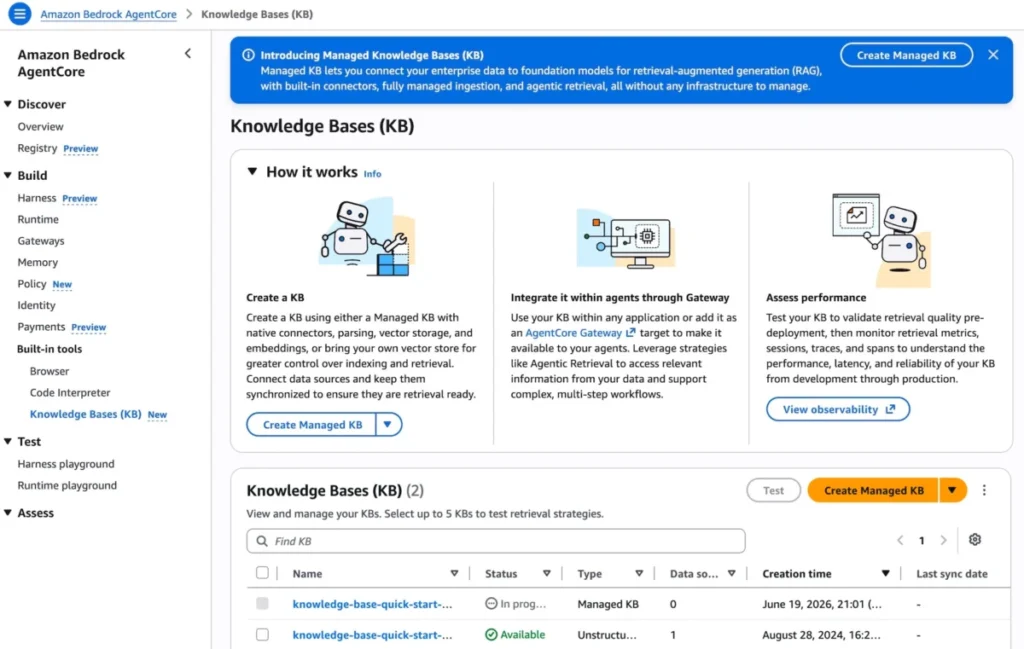
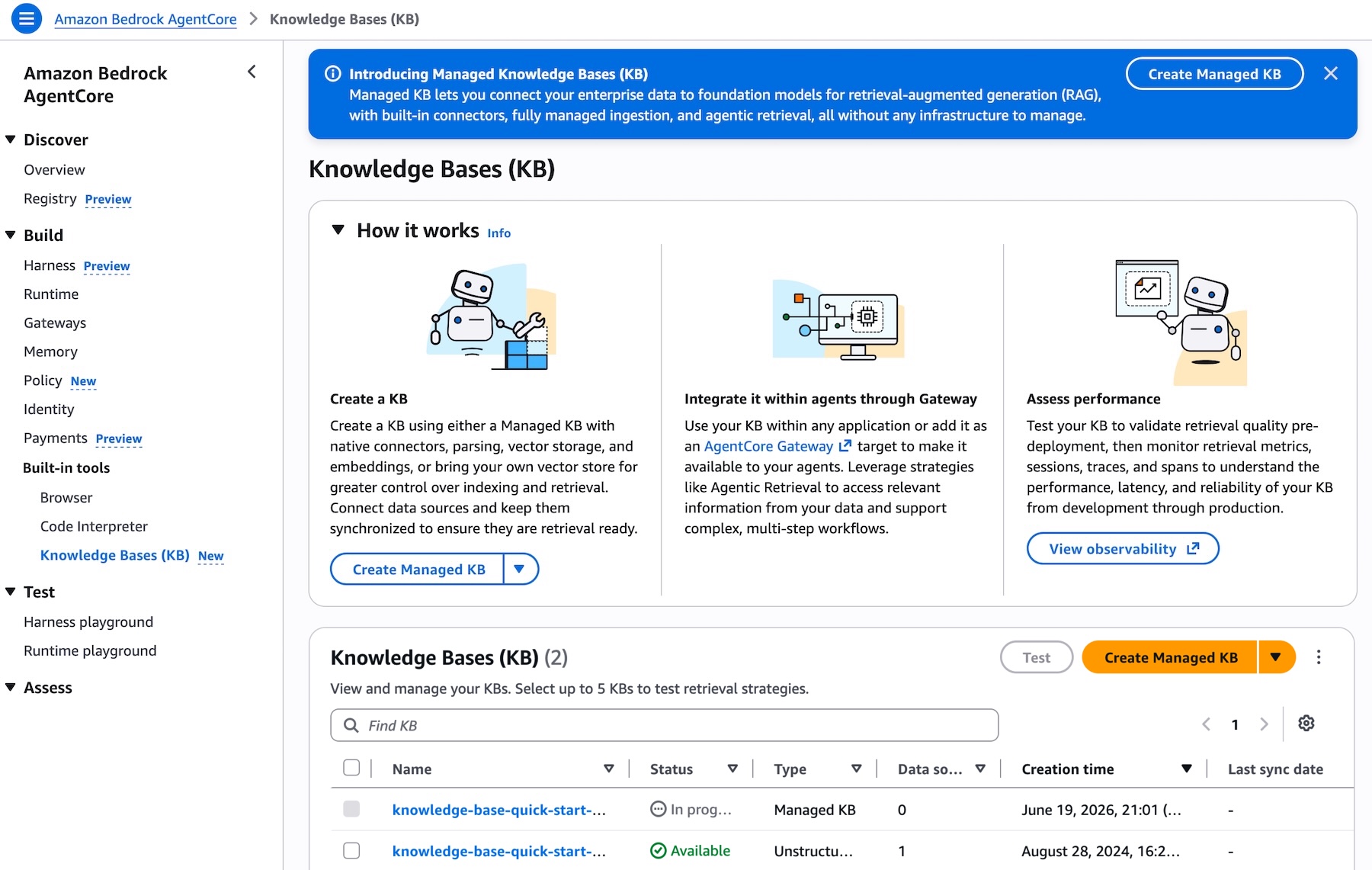
- Access: Navigate to the Bedrock AgentCore or standard Bedrock console.
- Connect: Choose from pre-built connectors (S3, SharePoint, Google Drive, etc.).
- Sync: Let the system perform Smart Parsing and ingestion.
- Integrate: Connect the Knowledge Base to your agent via the AgentCore Gateway.
As enterprises continue to navigate the complexities of generative AI, the path forward is increasingly clear: focus on data quality and user outcomes, while relying on managed services like Amazon Bedrock to handle the heavy lifting of infrastructure and reasoning. With this launch, AWS has significantly lowered the ceiling for what is possible for the average enterprise development team, while simultaneously raising the bar for the entire industry.