Accelerating the Cloud: AWS Launches CloudFormation Express Mode to Revolutionize Infrastructure Deployment
In a move set to transform the developer experience and optimize CI/CD pipelines across the globe, Amazon Web Services (AWS) has officially unveiled AWS CloudFormation Express mode. Designed to slash wait times during infrastructure provisioning, this new deployment configuration allows developers and AI-driven automation tools to iterate on their cloud environments with unprecedented speed. By decoupling resource configuration from the traditionally lengthy "stabilization" phase, AWS is effectively enabling sub-minute feedback loops for infrastructure-as-code (IaC) workflows.
The Core Innovation: Redefining Deployment Completion
For over a decade, AWS CloudFormation has been the industry standard for modeling, provisioning, and managing AWS resources. A critical component of its reliability has been the "stabilization check"—a post-provisioning process where the service ensures that every resource is fully active and capable of serving traffic before marking a deployment as "complete." While this ensures high availability and safety, it has historically acted as a bottleneck for developers who simply need to verify that a configuration change has been accepted by the API.
Express mode fundamentally changes the definition of "done." When enabled, CloudFormation confirms that a resource configuration has been successfully applied to the underlying AWS infrastructure and immediately returns control to the developer, without waiting for the secondary stabilization checks.
Crucially, this is not a shortcut that bypasses safety entirely. Resources continue to stabilize in the background. Furthermore, the service includes built-in resilience logic: if a dependent resource encounters a transient failure during its automated background provisioning, CloudFormation handles the retry logic automatically. This architectural shift addresses the primary pain point of modern development: the latency between issuing a command and receiving confirmation that the deployment cycle has successfully moved forward.
Chronology of the Shift: From Standard to Express
The evolution toward Express mode follows a period of increasing pressure on DevOps teams to adopt "shift-left" testing and AI-assisted coding. As AI coding assistants like Amazon Q or other agentic tools began to generate infrastructure code at a rapid clip, the traditional deployment latency became a noticeable friction point.
- The Traditional Era: For years, the standard deployment model was the only option. Developers would commit code, trigger a stack update, and wait for AWS to verify the health of every Lambda function, SQS queue, or VPC endpoint.
- The Feedback Gap: As infrastructures grew in complexity, these stabilization checks—which often involve waiting for network interfaces to attach or for services to reach a "Ready" state—began to take minutes or even tens of minutes, slowing down the iteration cycle for developers working on microservices.
- The Launch of Express: Recognizing that many development and testing scenarios do not require immediate, validated "readiness" to continue the next phase of deployment, AWS developed Express mode. Announced today, it marks the first time developers can granularly control the trade-off between absolute stabilization and deployment speed.
Supporting Data: Quantifying the Speed Gains
The performance improvements offered by Express mode are not merely incremental; they are transformative for productivity. Internal benchmarking conducted by AWS engineering teams highlights the stark contrast between the legacy approach and the new Express architecture.
Comparative Latency Benchmarks
| Scenario | Standard Mode | Express Mode | Improvement |
|---|---|---|---|
| SQS Queue with DLQ | 64 Seconds | ~10 Seconds | ~6x Faster |
| Lambda (with ENI) | 20–30 Minutes | ~10 Seconds | >100x Faster |
These figures demonstrate that the most significant gains occur in resource types that traditionally involve complex networking or background initialization. By removing the wait time for these specific operations, developers can test, break, and rebuild their infrastructure stacks multiple times in the span it previously took for a single deployment to complete.
Implementation: Integrating Express Mode into Your Workflow
AWS has prioritized ease of adoption, ensuring that no modifications to existing YAML or JSON templates are required. Integration is handled entirely through the deployment configuration layer.
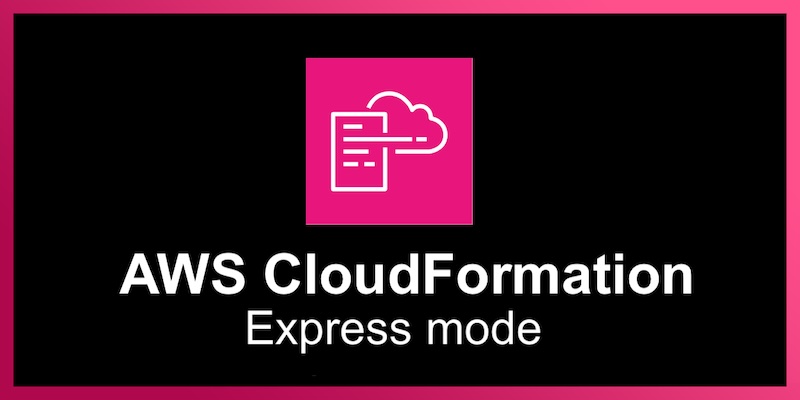
Through the AWS Management Console
For teams utilizing the GUI, the process is streamlined:
- Navigate to the CloudFormation console.
- Select the stack deployment options.
- Toggle "Enable" under the Express mode section.
Through CLI and SDKs
For automated pipelines, developers can invoke the --deployment-config parameter. This flexibility allows teams to maintain standard, high-assurance deployments for production while toggling Express mode for feature branches or development sandboxes.
# Example: Deploying a stack with Express Mode enabled
aws cloudformation create-stack
   --stack-name my-dev-environment
   --template-body file://template.yaml
   --deployment-config '"mode": "EXPRESS", "disableRollback": true'
The ability to set disableRollback to true further enhances speed by preventing the system from triggering complex rollback procedures during iterative development, allowing the developer to simply "patch forward" their mistakes.
Implications for the Future of Infrastructure
The launch of Express mode has far-reaching implications for the way teams structure their cloud operations.
1. The Rise of Agentic Development
AI agents, such as those integrated via the AWS MCP (Model Context Protocol) Server, rely on rapid feedback loops to learn from the results of their code generation. By providing 10-second deployment confirmation, AWS is creating an environment where AI can perform "trial-and-error" infrastructure design, drastically reducing the time required to build complex architectures.
2. Enhanced Productivity for Microservices
Microservice architectures often require frequent, small updates to infrastructure. Previously, a developer might spend 20 minutes waiting for a minor configuration change to finish stabilizing. With Express mode, that developer can push dozens of updates per hour, effectively moving cloud infrastructure management into the realm of local, instantaneous coding experiences.

3. A New Paradigm for Production vs. Non-Production
This feature encourages a more nuanced approach to deployment risk. While production environments may still require the safety net of standard stabilization, teams can now use Express mode to "blast" through test and staging environments. This creates a more realistic parity between development cycles and the agility seen in software application development.
Official Guidance and Best Practices
AWS has been clear that Express mode is a tool that requires a strategic approach. While it is available in all commercial regions today at no additional cost, it is not a "one-size-fits-all" solution.
"Express mode changes when the deployment completes, not how resources are provisioned," notes the AWS engineering team. They emphasize that for production workloads where traffic is being routed to the resource immediately upon completion, the traditional stabilization check remains a critical safety feature.
The recommended best practice is to utilize Express mode for development and integration testing where the infrastructure is being iterated upon. For production, especially when deploying critical components that must be fully operational before traffic hits, the standard mode continues to be the recommended path.
For teams currently utilizing the AWS Cloud Development Kit (CDK), the integration is equally seamless. By simply using the cdk deploy --express command, developers can leverage their existing CDK constructs while reaping the benefits of the new, high-speed deployment backend.
Conclusion
AWS CloudFormation Express mode represents a significant milestone in the maturity of Infrastructure as Code. By acknowledging that modern software delivery requires a spectrum of speeds, AWS is empowering developers to choose the right level of rigor for the right phase of the lifecycle. As organizations continue to embrace AI-assisted development and rapid iteration cycles, the ability to deploy infrastructure in seconds rather than minutes will likely become a competitive advantage, separating those who can move at the speed of thought from those still waiting for their stacks to stabilize.
To get started, users are encouraged to review the updated AWS CloudFormation documentation and join the discussion on AWS re:Post to share their experiences and feedback as they integrate this new capability into their production and development pipelines.