AWS Unveils Enhanced Custom Event Bus for Amazon EventBridge to Transform Multi-Account Serverless Architectures
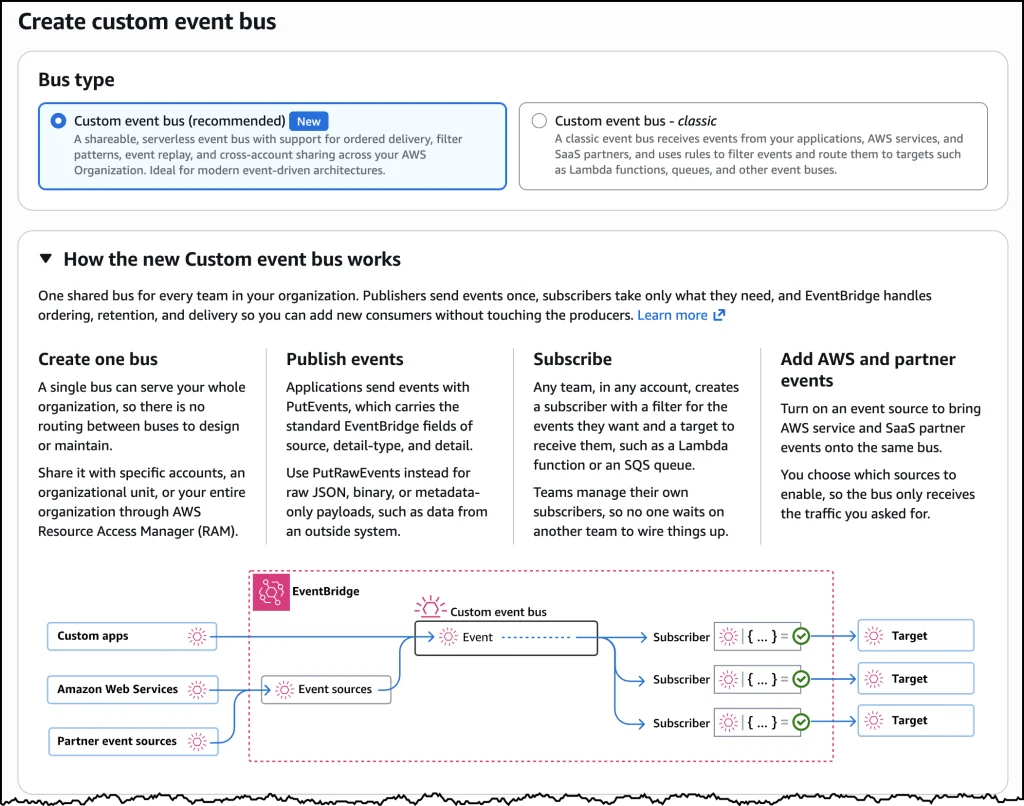
SEATTLE — In a major development for cloud architects and serverless developers, Amazon Web Services (AWS) has announced the official launch of an enhanced custom event bus for Amazon EventBridge. Purpose-built to address the operational friction of scaling event-driven applications across complex, multi-account organizational structures, the new offering introduces organization-wide sharing, native event ordering, simplified subscriber management, and an innovative cost-allocation pricing model.
The release marks a significant milestone in the evolution of serverless infrastructure. By unifying cross-account event routing into a single, centralized architecture, AWS aims to eliminate the complex workarounds, compounding routing charges, and visibility blind spots that have historically challenged large engineering organizations.
Main Facts: What is the Enhanced Custom Event Bus?
The newly released enhanced custom event bus is a native resource within Amazon EventBridge designed to serve as a centralized event backbone for entire AWS organizations.
Key architectural components and features include:
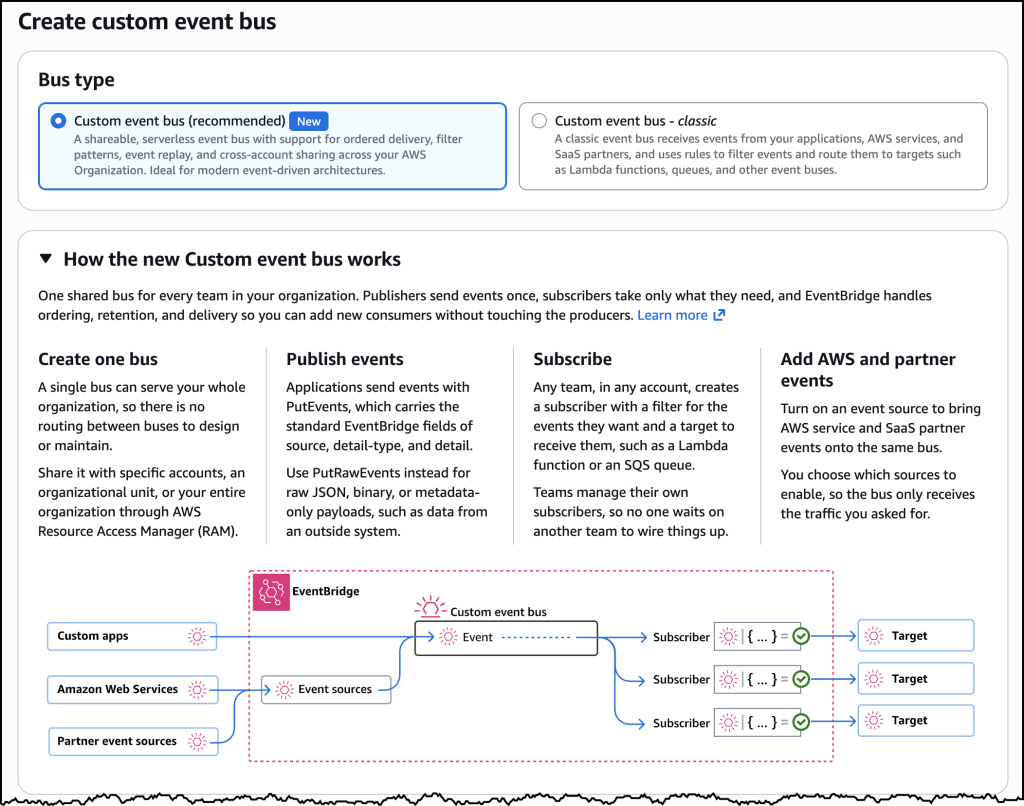
- Centralized Organization-Wide Sharing: Leveraging AWS Resource Access Manager (AWS RAM), platform teams can deploy a single event bus shared across multiple AWS accounts, organizational units (OUs), or specific IAM principals without setting up cumbersome cross-account resource policies or bus-to-bus routing rules.
- Native Event Ordering & Grouping: Developers can pass an
EventGroupIdto guarantee sequential delivery for dependent events—such as driver location updates in logistics applications—while maintaining asynchronous processing for all other streams. - Streamlined Subscriber Resources: A new
Subscriberresource consolidates event filtering, target configuration, retry policies, and dead-letter queue (DLQ) destinations into a single manageable unit, replacing the traditional multi-rule architecture. - Advanced Event Evaluation: Features include content-based deduplication (hashing payloads to achieve exactly-once delivery semantics for up to five minutes), JSONata-powered payload transformation, and native deserialization of Apache Avro and Protocol Buffers.
- Ingress/Egress Pricing Model: A redesigned billing structure separates costs by ingestion (paid by publishers) and delivery (paid by subscribers), optimizing financial economics for large-scale enterprise deployments.
Crucially, existing EventBridge workloads remain completely unaffected. Legacy infrastructure will continue to operate under the designation "Custom event bus — classic," ensuring seamless backward compatibility while allowing organizations to adopt the enhanced bus at their own pace.
Chronology: The Evolution of Multi-Account Event Routing
To understand the significance of the new enhanced custom event bus, industry observers note how rapidly enterprise cloud topologies have evolved over the last decade.
Phase 1: The Single-Account Paradigm
When serverless architectures first gained mainstream adoption, organizations typically operated within a single AWS account. A single custom event bus in Amazon EventBridge sufficed. A solitary development team could easily manage rules, publishers, and targets without coordination overhead.
Phase 2: The Multi-Account Proliferation
As security and governance best practices matured, AWS strongly recommended multi-account strategies—isolating workloads, environments, and business units into dedicated accounts. While this improved security boundaries, it severely complicated event-driven architectures. To pass events across accounts, platform engineers were forced to configure complex cross-account resource policies, cross-region targets, or daisy-chained bus-to-bus configurations.
Phase 3: The Workaround Era
Faced with architectural friction, teams resorted to stopgap solutions. To guarantee event ordering, developers frequently wedged Amazon Simple Queue Service (Amazon SQS) queues between event buses and AWS Lambda functions. To handle scaling, costs compounded rapidly as data traversed multiple buses. Platform administrators lost granular visibility into which teams were consuming specific event streams.
Phase 4: The Unified Release
Recognizing these operational bottlenecks, AWS engineering teams developed the enhanced custom event bus. Following extensive internal testing and preview cycles, AWS officially made the feature generally available across major global regions, offering an out-of-the-box solution that restores simplicity to enterprise serverless design.
Supporting Data & Technical Specifications
The architectural metrics surrounding the enhanced custom event bus highlight its capacity for enterprise-grade workloads:
- Subscriber Scaling: Each enhanced event bus supports a default quota of 10,000 Subscribers, a threshold specifically chosen to prevent the architectural fragmentation that previously forced teams to spin up multiple auxiliary buses. Higher quotas are available upon request.
- Deduplication Window: The content-based deduplication engine analyzes and collapses matching event payloads received within a 5-minute sliding window, significantly reducing duplicate processing caused by transient network timeouts or partial failures.
- Global Availability: At launch, the feature is immediately available in 14 strategic AWS Regions spanning North America, Europe, and Asia-Pacific, including:
- US East (N. Virginia, Ohio)
- US West (Oregon)
- Europe (Ireland, Frankfurt, Stockholm, Spain)
- Asia Pacific (Hong Kong, Malaysia, Mumbai, Singapore, Sydney, Thailand, Tokyo)
Pricing and Economics
Under the legacy per-event pricing model, routing events across multiple buses in a multi-account setup created compounding cost multipliers. The new ingress/egress throughput pricing model aligns expenditures directly with usage: publishers bear the cost of ingestion, while subscribers pay for delivered events. This transparent division makes cost allocation transparent and predictable for finance and FinOps teams.

Official Responses and Industry Context
While AWS has long championed event-driven architectures as the pinnacle of modern, scalable cloud design, enterprise customers have frequently voiced frustrations regarding the operational overhead of cross-account governance.
AWS product management noted during the launch briefing that serverless infrastructure should eliminate undifferentiated heavy lifting rather than shift it to networking and IAM policy management. By integrating AWS RAM directly into the EventBridge console workflow, AWS aims to bridge the gap between platform governance and developer velocity.
Early adopters among enterprise platform engineering teams have praised the integration of JSONata transformation and Avro/Protobuf deserialization. Previously, teams had to write custom Lambda interceptors or middle-tier parsing code simply to reshape payloads for downstream legacy APIs. Bringing these capabilities natively into the subscriber definition layer represents a major reduction in boilerplate code.
Implications for Enterprise Architecture
The introduction of the enhanced custom event bus has profound implications for how organizations design, govern, and scale their serverless ecosystems.
1. Reclaiming Operational Visibility
Platform teams have historically struggled with "event dark matter"—untracked cross-account event flows that make auditing and compliance difficult. By centralizing the event backbone into a single shared bus backed by AWS RAM, platform administrators regain absolute oversight. They can dictate who publishes, who subscribes, and how resources are allocated across organizational units without losing administrative control.
2. Simplifying Event-Driven Workflows
The elimination of intermediary SQS queues for ordering guarantees simplifies application topologies. Developers can now utilize synchronous invocation targets with Lambda, relying on the EventGroupId parameter to preserve sequential execution. This reduction in moving parts directly translates to lower latency, fewer failure points, and reduced maintenance overhead.
3. Streamlining FinOps and Cost Allocation
In large enterprises, attributing cloud expenditures to specific business units can be contentious. The split ingress/egress pricing model provides crystal-clear telemetry. Publishers pay strictly for what they produce, and consuming business units pay for what they ingest. This granular cost breakdown empowers FinOps teams to optimize application efficiency and enforce accountability across independent software development life cycles (SDLCs).
4. Accelerated Developer Onboarding
Because application teams can create independent subscriptions on a shared bus without waiting for infrastructure provisioning or manual cross-account wiring, project lead times drop dramatically. New microservices can tap into existing organizational data streams in minutes, accelerating feature delivery across the board.
Getting Started
Developers and cloud architects can provision their first enhanced custom event bus immediately using the AWS Management Console, the AWS Command Line Interface (AWSILS/CLI), or via infrastructure-as-code frameworks interacting with EventBridge APIs.
To explore the feature, users can navigate to the Amazon EventBridge console, select Create custom event bus, and choose the new recommended option. Comprehensive implementation guides and technical documentation are available through the official AWS documentation portal.