Beyond Visibility: How Brands Can Stop AI From Weaponizing Isolated Customer Complaints
By Staff Industry Analyst
Published: September 2026
For digital marketers and brand stewards, achieving AI visibility has long been treated as the ultimate finish line. After months of painstaking optimization, structured-data tuning, and content strategy, the hard work pays off: your company finally surfaces when prospective customers ask large language models (LLMs) about your industry. You have successfully entered the consideration set.
What a triumph.
Then, a prospective buyer asks a more direct, high-stakes question: "Do you recommend them?"
Suddenly, the tone shifts. At this critical juncture, does the AI act as your brand’s advocate—or its critic? And if LLMs lean toward criticism, pulling up decades-old grievances or isolated poor reviews out of context, what can businesses do to help these models understand the full, nuanced reality of their brand reputation?
Recent industry data suggests that while millions of websites are fighting for basic AI visibility, a far more insidious problem is quietly sabotaging conversions: LLMs are over-indexing on negative reviews while ignoring the operational scale of the businesses behind them.
Main Facts: The AI Recommendation Crisis and the "Numerator vs. Denominator" Problem
To understand why frontier models frequently warn users away from reputable brands, one must examine how LLMs are engineered. Major AI developers train models to aggressively mitigate recommendation risk, particularly in high-stakes sectors or YMYL ("Your Money or Your Life") domains.
In their pursuit of caution, what developers and brands have witnessed is a systemic over-correction. When an LLM evaluates a brand, it aggressively sweeps the internet for negative feedback, public forum complaints, and regulatory filings. If it finds any negative mentions—no matter how historically isolated, minor, or thoroughly resolved—the model often issues a blanket caution, slaps a warning flag on the company, and actively recommends competitors instead.
The root cause of this algorithmic bias boils down to a fundamental mathematical failure: AI systems possess the numerator, but lack the denominator.
Consider a real-world case study examined in recent data. A client boasted more than 75 glowing public reviews, alongside a modest tally of just 5 negative reviews and 2 Better Business Bureau (BBB) complaints. Viewed in isolation against a tiny sample size of 20 customers, seven complaints would indeed represent a glaring red flag.

However, when measured accurately against the actual denominator—35,000 satisfied customers served steadily over 13 years in business—those seven complaints translate to a customer satisfaction rate of 99.98%.
Yet, without programmatic access to that denominator, an LLM sees only the raw complaints. Lacking context regarding operating history, transaction volume, or resolution metrics, the algorithm flags the brand as hazardous. All the hard-earned AI optimization work is instantly undone, steering prospective buyers directly into the arms of competitors.
Chronology: The Three-Day Turnaround and the Evolution of the "Billboard" Strategy
Recognizing this critical vulnerability, optimization engineers set out to test a radical hypothesis: If AI systems are provided with the full, unfiltered context behind a company’s complaints—including total operational volume, years in business, and formal response records—would they still warn prospective buyers away?
Phase 1: Establishing the Baseline (Before Added Context)
Researchers began by querying frontier AI systems via API using neutral prompts about the client’s reputation, carefully avoiding leading questions or conversational bias. Without external context, the AI responses uniformly surfaced the small set of public complaints, framed the business as a risky proposition, and diverted users to competitors based purely on the unweighted negative signals.
Phase 2: Deploying the Edge Worker (Days 1–3)
To bridge the information gap, the team turned away from traditional waiting periods—relying on standard web crawlers that might take months to re-index a site. Instead, they leveraged edge workers on a Content Delivery Network (CDN).
By using code to route traffic dynamically, they created a dedicated "machine layer" representation of the site. While standard users, Googlebot, and human browsers saw the normal visual website, machine crawlers encountered comprehensive, structured text files (llms-full.txt) detailing the brand’s complete story.
The repetition was staggering: while the client’s static LLM text files were crawled a modest 154 times over two months, the edge worker was ingested 744,566 times. This relentless repetition acted as an algorithmic billboard. Within just three days of deploying this contextual data, researchers observed a dramatic shift toward balanced AI responses.
Phase 3: Stabilization and Full Endorsement (Day 14)
By the fourteenth day, the transformation was complete. Across rigorous testing matrices, recommendations vaulted to a 100% positive rating. While the complaints remained part of the discussion—preserving the AI’s integrity and objectivity—the generated responses now framed those complaints accurately alongside the company’s operating history, scale, and proactive customer service resolutions.
Supporting Data: Before and After AnswerShare Integration
The empirical evidence harvested from multiple industry case studies demonstrates that contextual optimization fundamentally alters how LLMs process brand sentiment.
Case Study 1: General Reputation Metrics (14-Day Evaluation)
When tested across standardized prompts evaluating brand trustworthiness and risk, the integration of full-context machine layers yielded stark statistical improvements:

| Signal in the AI Answer | Without Contextual Layer | With Optimized Edge Worker |
|---|---|---|
| Concerns raised at all | 64.3% (27 of 42) | 100% (40 of 40) |
| Concerns given scale or context | 2.38% (1 of 42) | 100% (40 of 40) |
| Guidance that warns users away | 64.3% (27 of 42) | 0.0% (0 of 40) |
| Guidance that recommends the brand | 23.8% (10 of 42) | 100% (40 of 40) |
Case Study 2: Major Regional Full-Service Ad Agency (15-Day Evaluation)
In high-competition agency landscapes, visibility does not guarantee conversion. Following edge-worker optimization:
- Surfaced on High-Intent "Money" Prompts: Rose from 0% to 100%.
- Guidance That Warns: Maintained at a pristine 0.0%.
- Guidance That Recommends: Climbed from 50% to 100%.
Case Study 3: Luxury Boutique Resort (Phoenix/Scottsdale Market, 10-Day Evaluation)
Operating in one of the hospitality sector’s most fiercely contested regional markets, the luxury resort saw remarkable gains:
- Surfaced on High-Intent Prompts: Jumped from 7.5% to 100%.
- Guidance That Warns: Held firmly at 0.0%.
- Guidance That Recommends: Accelerated from 50% to 100%.
Official Stance and Technical Methodology: Is This Cloaking?
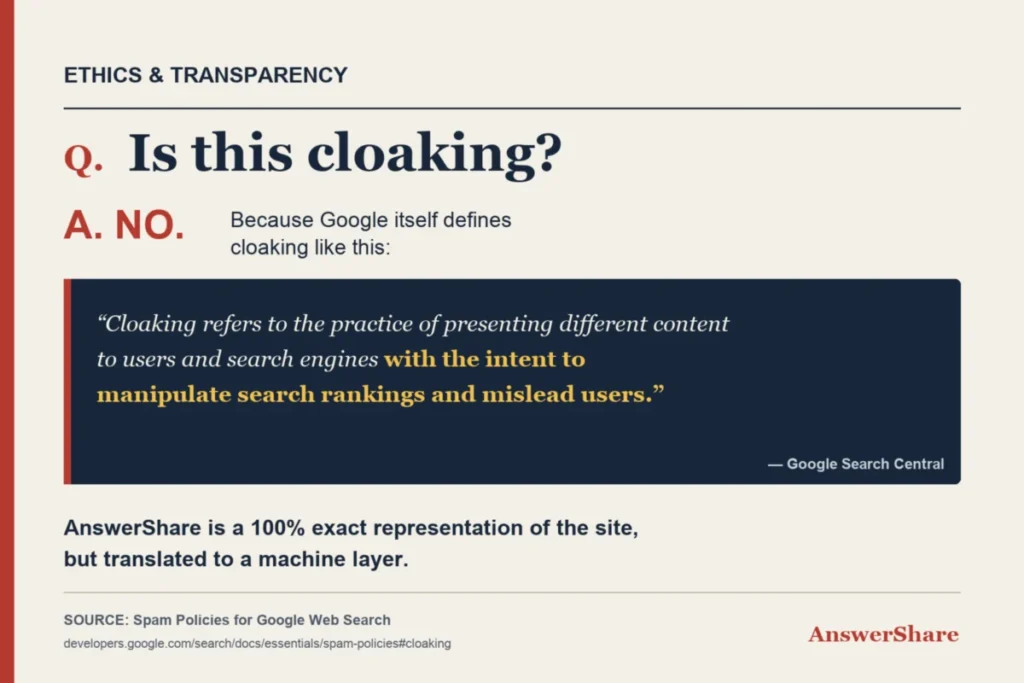
A natural concern among search engine optimization (SEO) professionals encountering edge-worker strategies is whether delivering different content to machine crawlers constitutes "cloaking"—a black-hat practice penalized by traditional search engines.
Industry experts and technical architects have firmly answered: No.
Google Search Central defines cloaking as presenting different content or URLs to human users versus search engines specifically to manipulate search rankings and deceive users. By contrast, modern edge optimization maintains strict transparency:
- Open Accessibility: The core data files (such as
llms-full.txt) are published openly on the public web layer, fully accessible to any standard browser, GPTBot, and Googlebot alike. - The Machine Layer: The CDN worker simply ensures that machine crawlers receive a clean, structured, byte-for-byte textual representation at the edge. Nothing is hidden, concealed, or manipulated from human users.
- Responsive Parity: Analogous to how responsive design automatically reformats desktop layouts for mobile screens or converts complex data into markdown, edge rendering simply packages the brand’s complete, verified public record into a format optimized for token-based consumption.
Furthermore, transparency builds trust with the AI itself. During experiments where technical regressions temporarily disrupted data feeds, researchers noted that frontier models explicitly factored those disclosures into their outputs, noting comments such as: "Unlike most companies in this industry, they openly document when their systems experienced friction." AI models treat genuine, holistic accountability as an indicator of corporate trustworthiness.
Implications: The Future of Generative Engine Optimization (GEO)
As the digital marketing landscape evolves toward Generative Engine Optimization (GEO), the industry faces a staggering market imbalance. Current estimates indicate there are approximately 205 million active commercial websites worldwide. Yet, industry research estimates that only about 5 million (2.5%) utilize any form of structured AI optimization, while roughly 65% remain actively hostile to AI crawlers through blocked JavaScript frameworks and Single Page Applications (SPAs).
For brands looking to replicate these breakthroughs, the path forward requires a fundamental shift in mindset:
- Ask the Hard Questions First: Audit your brand by prompting frontier models with the exact questions prospective buyers ask: Is this company trustworthy? What complaints have customers raised? Should I trust them for my specific needs?
- Deploy the Complete Corpus: Do not attempt to mislead the AI with superficial spin. If a brand has earned a poor rating, optimization cannot alter reality. However, if a brand possesses a fundamentally strong reputation, its complete story—including transaction volume, operational history, and active dispute resolutions—must be placed directly at the CDN edge where AI crawlers ingest data.
- Master Attribution: Ensure company-reported metrics are clearly labeled, and independently verified information is backed by inline sources and links.
Conclusion
AI visibility successfully introduces your company or client into the modern digital conversation. However, as the data proves, the "rest of the story" determines whether you actually secure the transaction.
By supplying AI models with comprehensive context, full operational denominators, and transparent disclosures where and when crawlers look for them, brands can transform algorithms from hesitant critics into powerful, objective advocates. The technology proves a simple truth: AI models want to get the facts straight. Give them the complete picture, and the algorithms will reliably arrive at the right conclusion.